
Some links below are Amazon affiliate links — we earn a small commission if you buy, at no extra cost to you.
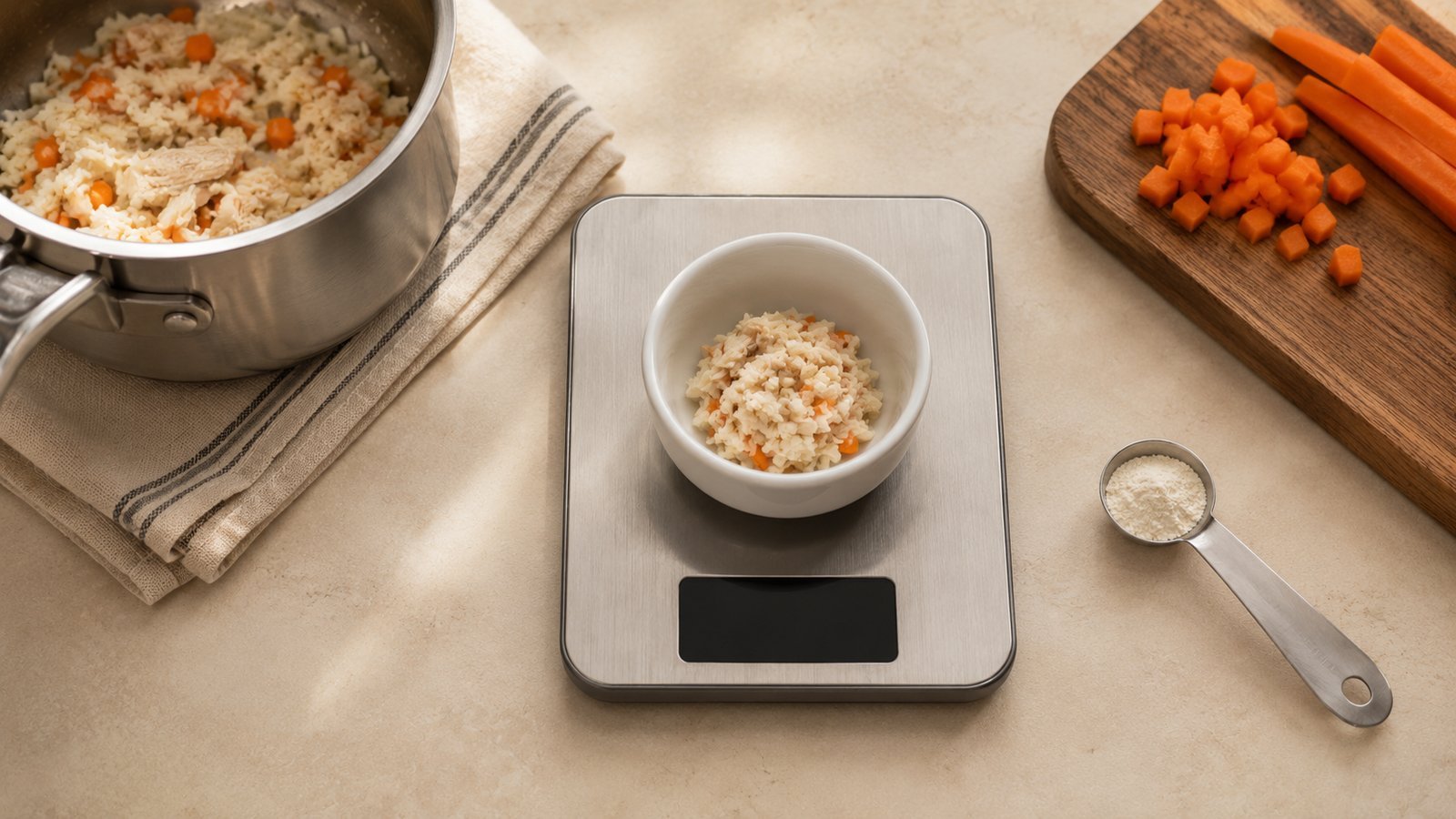
Homemade dog food recipes for small dogs are not big-dog recipes divided by four. A 10 lb dog burns more calories per pound than a 70 lb dog, eats a volume you could hold in one hand, and gains weight from an error you’d never notice on a Labrador.
That mismatch is the whole reason this page exists. The recipes below are scaled and portioned for dogs under about 25 lb, and the section on portion math is the part that will actually change something.
Here’s what’s on this page:
- 5 recipes sized for small dogs, with yields in days rather than pounds
- The calorie math, because “2–3% of body weight” fails badly at this size
- Four things that are genuinely different about feeding a small dog
- An honest account of what these recipes don’t cover
What’s actually different about a small dog
1. They need more calories per pound, not fewer
This surprises people. Smaller animals have a higher metabolic rate relative to body size. Run the standard resting-energy formula and a 10 lb dog needs roughly 1.6 times the calories per pound that a 70 lb dog does — about 48 kcal per kg of body weight against about 29.
The absolute number is still small — but it means you can’t scale a big-dog portion down linearly and expect it to be right.
2. Portion errors hit several times harder
An extra tablespoon of food on a 60 lb dog is noise. On a 10 lb dog it can be 5% of their daily intake. Do that twice a day for a year and you have an overweight dog who developed the problem invisibly.
This is why small breeds are over-represented in obesity statistics, and why “he’s only had a little bit” is the most expensive sentence in small-dog ownership.
3. Dental disease is close to universal — texture is not optional
Small breeds get dental disease earlier and worse than large ones, largely because the same number of teeth are packed into a much smaller jaw. By middle age a lot of small dogs are managing with compromised teeth.
Home-cooked food helps here for a reason that has nothing to do with nutrition: you control the texture. Everything below can be mashed.
4. Weight matters more for their joints than for a big dog’s
Luxating patella and tracheal collapse are both far more common in small breeds, and both are worsened by excess weight. Keeping a small dog lean isn’t cosmetic — it’s the main lever you have on two of the conditions they’re most likely to get.
The portion math
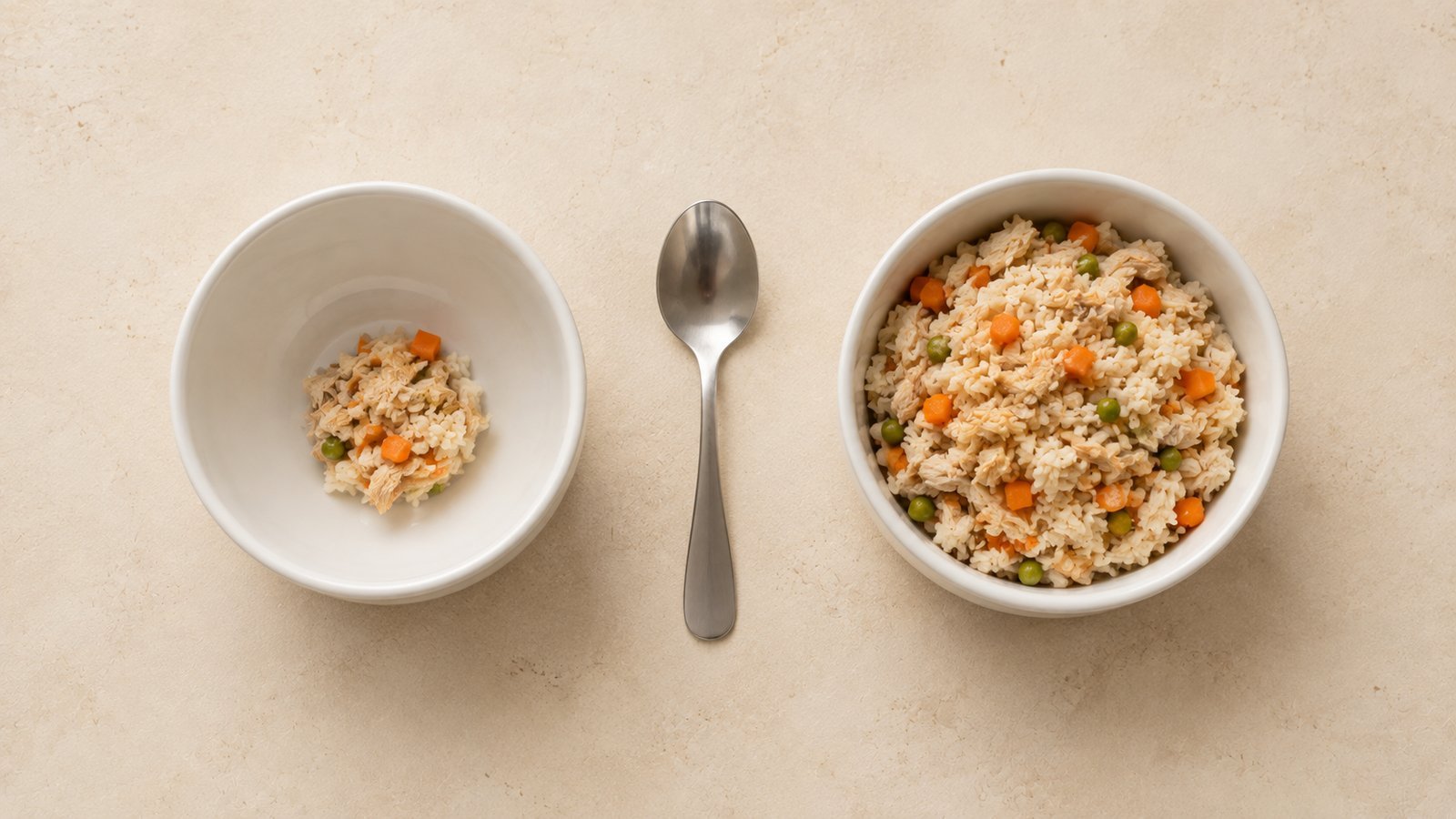
Do not use the “2–3% of body weight” rule. It comes from raw feeding, where food runs 1.5–2 kcal per gram. Home-cooked recipes with added water run closer to 0.9–1.4 kcal per gram, so 2–3% underfeeds — and at small-dog scale the error is easy to compound in the wrong direction.
Use calories instead:
- Resting need (RER) = 70 × (weight in kg)^0.75
- Daily need ≈ RER × 1.2–1.6, lower for a calm neutered adult, higher for a young active dog
| Dog | RER | Typical daily need |
|---|---|---|
| 5 lb (2.3 kg) | ~130 kcal | 155–210 kcal |
| 10 lb (4.5 kg) | ~215 kcal | 260–345 kcal |
| 15 lb (6.8 kg) | ~295 kcal | 355–470 kcal |
| 20 lb (9 kg) | ~365 kcal | 440–585 kcal |
| 25 lb (11.3 kg) | ~430 kcal | 515–690 kcal |
Then override the arithmetic with your hands: you should feel the ribs under a thin covering without pressing. If you can’t, cut 10% and check again in three weeks.
Weigh the food. At this size, eyeballing a portion is the single biggest source of error. A cheap kitchen scale pays for itself.
Before the recipes: what these are and aren’t
Same disclosure that goes on every recipe article here, because it matters more than any individual recipe.
These are not complete and balanced diets. UC Davis researchers evaluated 200 homemade dog food recipes in 2013 and found 95% were deficient in at least one essential nutrient, with more than 83% short on several — usually choline, vitamin D, zinc and vitamin E.
(Stockman J, Fascetti AJ, Kass PH, Larsen JA. JAVMA 2013;242(11):1500–1505.)
A general pet multivitamin does not fix that. Veterinary nutritionists are explicit: off-the-shelf supplements aren’t formulated against a specific recipe. Closing those gaps properly takes a veterinary balancing supplement matched to the recipe, a formulation service like BalanceIT, or a consult with a board-certified veterinary nutritionist (ACVN).
So use these two ways: as a topper under about 10% of daily calories — leave the calcium out, your dog’s complete food already supplies it — or as the whole diet with the calcium as written plus proper balancing. The middle version, half kibble and half homemade with calcium added, is the one that quietly goes wrong.
The calcium rule
Meat is phosphorus-heavy and calcium-poor. Fed as a whole diet without added calcium, the ratio inverts and the body starts pulling calcium out of the skeleton. AAFCO’s range for adult dogs is 1:1 to 2:1 calcium to phosphorus, optimum around 1.2–1.4:1.
Target roughly 900–1,000 mg of elemental calcium per pound (450 g) of finished food.
- Ground eggshell — rinse, bake at 300°F/150°C for 10 minutes, grind fine. 1 level tsp ≈ 2,000 mg calcium, so about ½ tsp per pound of finished food.
- Calcium carbonate powder — easier to dose accurately to a stated elemental figure, which matters more at small-dog scale than at any other size.
Measure the calcium, don’t eyeball it. Half a teaspoon guessed onto a two-pound batch is a much bigger error than the same slip on a six-pound one. And a kitchen scale is the other non-negotiable — a 20 g slip is a rounding error on a Labrador and 8% of a Chihuahua’s dinner.
The 5 homemade dog food recipes for small dogs
Each makes a small batch — 2 to 2½ lb — deliberately. A six-pound batch feeds a 10 lb dog for two weeks, and cooked food doesn’t keep that long.
Cook everything through, cool in shallow containers and refrigerate within two hours, and no onions, garlic, grapes, raisins, xylitol, macadamia nuts or cooked bones. Check anything you’re unsure about in our safe human foods guide.
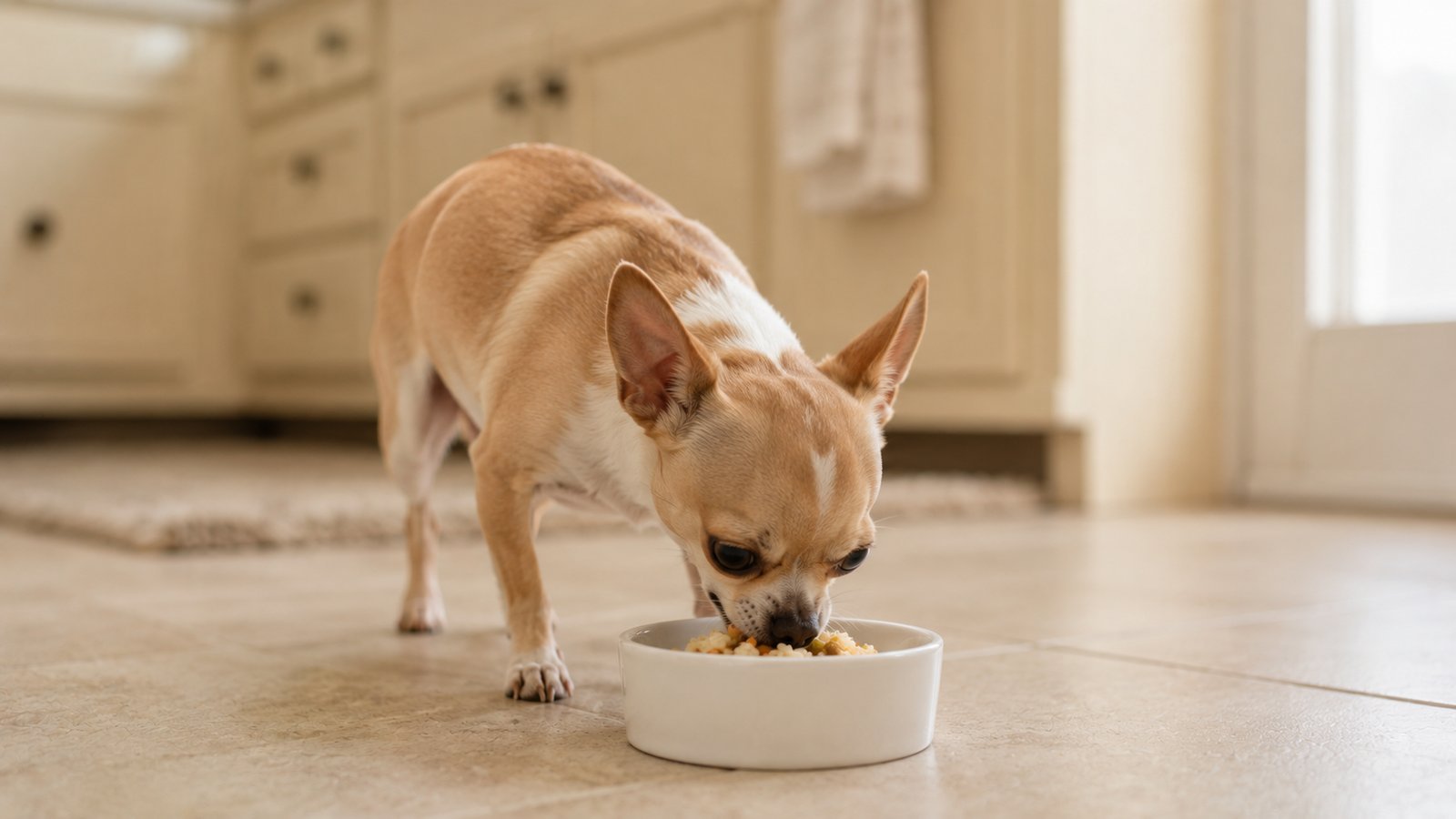
1. Chicken, Rice & Carrot (the starter)
The gentlest place to begin, and the one to fall back on when anything is off.
Ingredients
- 12 oz boneless skinless chicken breast, diced small
- ¾ cup white rice
- 1 carrot, finely diced
- 2½ cups water
- 1 tsp olive oil
Method
- Simmer chicken, rice, carrot and water 20 minutes, covered, until the rice is soft.
- Stir in the oil and mash to a soft, spoonable texture.
- Cool in shallow containers.
Add calcium: ≈1 tsp ground eggshell (≈2 lb finished). Feeds: a 10 lb dog roughly 5 days as a full diet. Keeps: 4 days refrigerated, 2 months frozen.
2. Turkey, Sweet Potato & Green Bean
A little richer, good for a small dog who needs to hold condition.
Ingredients
- 12 oz ground turkey
- 1 medium sweet potato, peeled and cubed
- 1 cup green beans, chopped small
- 2 cups water
- 1 tsp olive oil
Method
- Brown the turkey and drain.
- Simmer with sweet potato and water 20 minutes, until the potato falls apart.
- Add green beans for the last 5 minutes.
- Mash roughly, stir in the oil, cool in shallow containers.
Add calcium: ≈1 tsp ground eggshell (≈2 lb finished). Feeds: a 10 lb dog roughly 5 days. Keeps: 4 days refrigerated, 2 months frozen.
3. Salmon & Rice (for coat and joints)
The one with actual evidence behind an ingredient. Salmon supplies EPA and DHA, the omega-3s with clinical trial data in arthritic dogs — and small breeds get patella and joint problems early.
Ingredients
- 10 oz boneless skinless salmon fillet
- ¾ cup white rice
- 1 cup courgette, diced small
- 2½ cups water
Method
- Simmer rice in the water 15 minutes.
- Add the salmon and courgette, simmer 8–10 minutes more until the fish flakes.
- Check meticulously for bones — a pin bone in a 10 lb dog’s portion is a different problem than in a Labrador’s.
- Flake through, mash, cool in shallow containers.
Add calcium: ≈1 tsp ground eggshell (≈2 lb finished). Feeds: a 10 lb dog roughly 5 days. Keeps: 3 days refrigerated — fish holds less well than meat. 2 months frozen.
4. Soft Chicken & Oat Mash (for bad teeth)
For the small senior whose teeth have given up. No chewing required at all.
Ingredients
- 12 oz boneless skinless chicken thigh
- ¾ cup rolled oats
- ½ cup pumpkin puree (plain, not pie filling)
- 3 cups water
Method
- Simmer the chicken in the water 25 minutes until it shreds with a fork.
- Shred it finely, return to the pot with the oats, simmer 10 more minutes.
- Stir in the pumpkin. Mash to a thick porridge.
- Add warm water at serving to loosen further if needed.
- Cool in shallow containers.
Add calcium: ≈1 tsp ground eggshell (≈2 lb finished). Feeds: a 10 lb dog roughly 5 days. Keeps: 4 days refrigerated, 2 months frozen.
5. Beef & Squash (the calorie-dense one)
For a small dog who’s underweight or fussy — the most calories in the smallest volume here.
First: if your small dog has lost weight without you cutting their food, see a vet before you reach for more calories. Unexplained weight loss is a clinical sign — dental pain, kidney disease and heart problems all present this way, and small breeds are prone to all three.
Ingredients
- 12 oz lean ground beef (90/10 or leaner)
- 1½ cups butternut squash, cubed
- ½ cup white rice
- 2 cups water
Method
- Brown the beef and drain the fat thoroughly — small dogs handle a fat load worse than big ones.
- Simmer with squash, rice and water 20 minutes.
- Mash, cool in shallow containers.
Add calcium: ≈1 tsp ground eggshell (≈2 lb finished). Feeds: a 10 lb dog roughly 4–5 days. Keeps: 4 days refrigerated, 2 months frozen.
Freezing, which matters more at this size
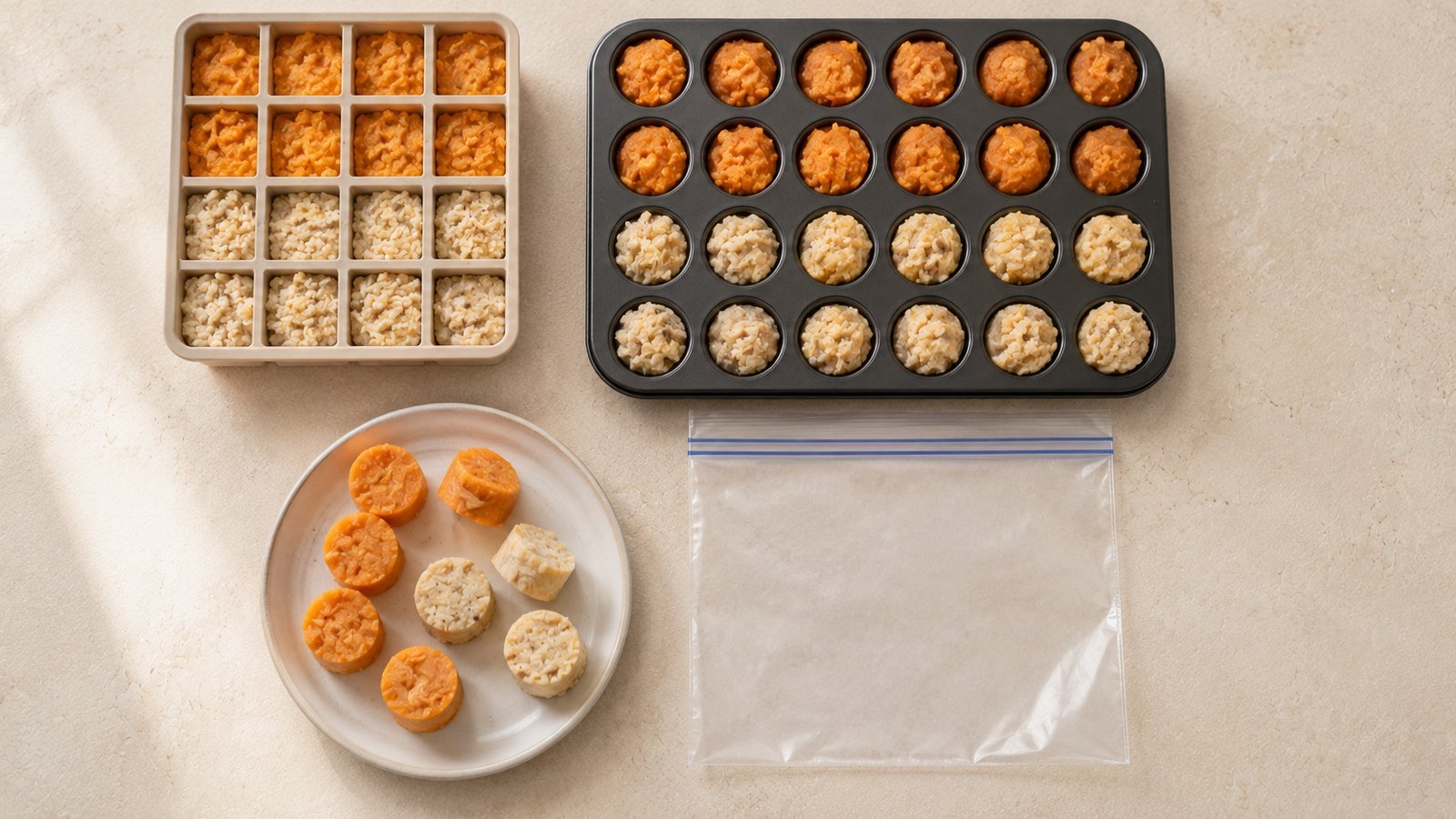
A small dog eats such small portions that the fridge clock runs out before the food does. So freeze from the start:
- Portion before freezing, not after. A silicone ice cube tray or mini muffin tray gives you roughly 1–2 oz pucks — near-perfect single portions for a small dog.
- Freeze, pop out, bag the pucks. Take out what you need the night before.
- Thaw in the fridge, never on the counter.
- Label the bag with the recipe and date. Three unlabelled bags of brown mash look identical in February.
Five things that go wrong with small dogs specifically
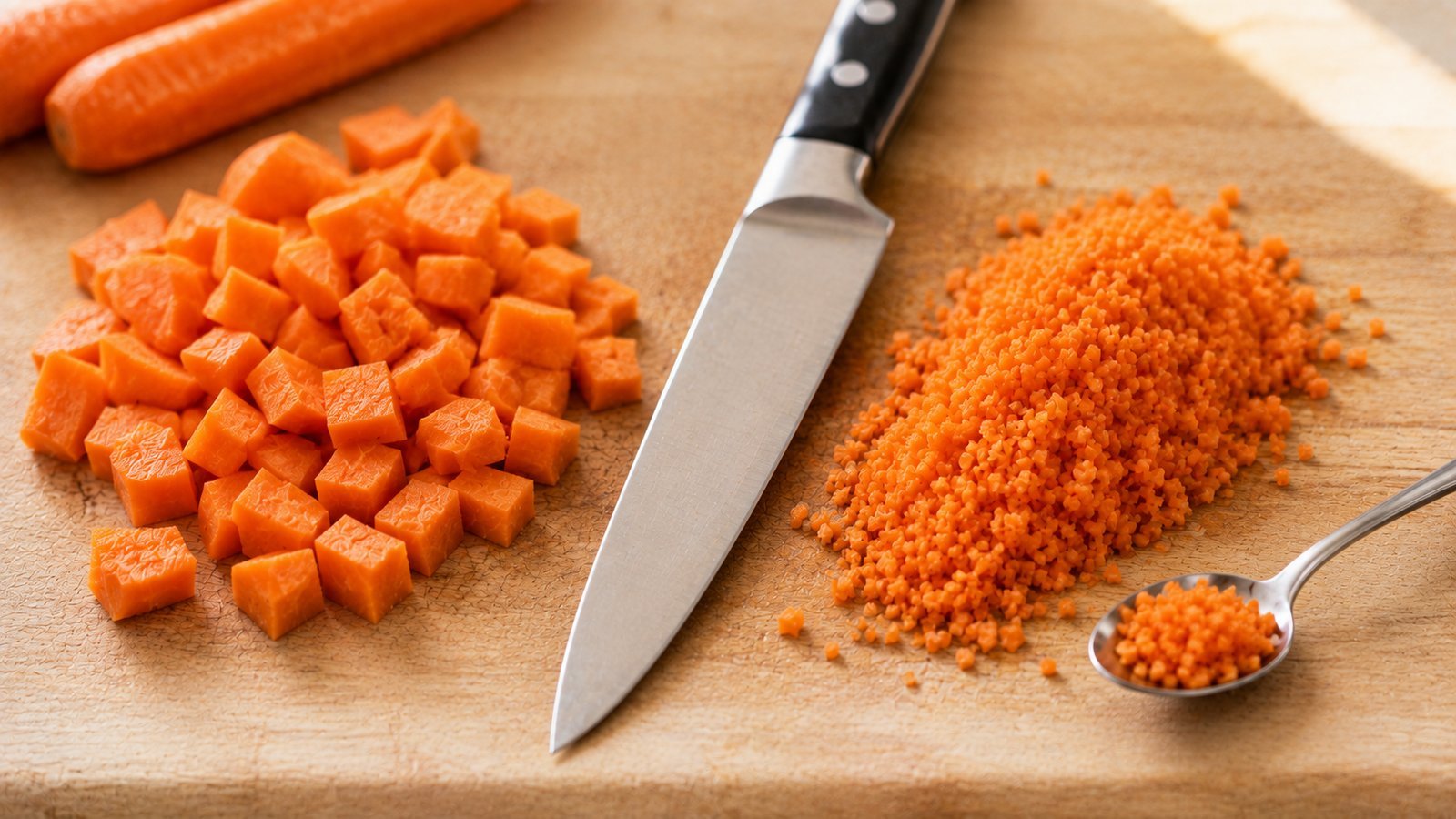
- Pieces too big. Dice everything to roughly the size of your dog’s kibble or smaller. A carrot chunk that’s fine for a Labrador is a choking hazard for a Chihuahua.
- Free-feeding. A bowl left down all day is how small dogs get fat without anyone seeing them overeat. Two measured meals.
- Treats not counted. A single medium dog biscuit can be 10% of a 10 lb dog’s daily calories. For lower-calorie options see our healthy homemade dog treats, or break bigger treats into quarters — dogs count events, not grams.
- Skipping the scale. Weigh food. Weigh the dog monthly. At this size, a 1 lb gain is a 10% body weight change.
- Toy-breed puppies and low blood sugar. Very young, very small puppies can develop hypoglycaemia if meals are spaced too far apart. Puppies need frequent feeding and a diet formulated for growth — these are adult maintenance recipes and are not suitable for puppies.
Frequently asked questions
How much homemade food does a small dog need per day? Calculate calories rather than volume: RER = 70 × (kg)^0.75, then × 1.2–1.6. A 10 lb adult typically lands around 260–345 kcal a day. Adjust by body condition.
Can I use these recipes for a small senior dog? Yes — they’re adult maintenance recipes and all mash easily, which suits older teeth. Recipe 3 in particular suits older joints. If your dog has flagged kidney values, none of these are appropriate as written; that needs veterinary formulation.
Can I make a bigger batch? You can, but freeze it in portions the same day. Cooked food keeps 3–4 days refrigerated regardless of how much you made.
Is homemade cheaper than small-breed kibble? Usually not dramatically, because the quantities are so small that bulk buying doesn’t help much. The honest cost breakdown is in cheap homemade dog food.
Can I use these as a topper instead of a full diet? Yes — that’s the lower-risk option. Keep it under about 10% of daily calories and leave the calcium out, since complete food already provides it.
What about a slow cooker? It works, but these batches are small for a large cooker — a 7-quart pot makes about three times what a small dog can eat before it spoils. Use a saucepan for these, or make a slow-cooker batch and freeze two-thirds of it immediately.
Can I add vegetables my dog likes? Within reason, and dice them small. Carrots and green beans are safe staples. Never onion, garlic, grapes or raisins.
My small dog has an upset stomach — should I stop the homemade food? Go back to recipe 1 for a few days and keep portions small. If it lasts more than a day or two, or there’s vomiting or lethargy, that’s a vet call — the gentle home options all have a limit.
The bottom line
Small dogs aren’t difficult to cook for — they’re just unforgiving of imprecision. Weigh the food, calculate calories rather than percentages, measure the calcium, and dice everything smaller than you think you need to.
And be honest about the balancing question. A small dog eating an incomplete diet gets there faster than a big one, simply because there’s less margin in everything.
Nuggy isn’t a small dog, but the one habit that transfers is the scale on the counter — it’s the difference between knowing and guessing.
What size is your dog, and are you weighing portions or eyeballing them? If it’s the second one, that’s the single change worth making this week.
This article is general information, not veterinary advice. Talk to your vet before changing your dog’s diet, especially if they have a diagnosed health condition.
As an Amazon Associate we earn from qualifying purchases.