
This post contains affiliate links. I may earn a small commission if you buy through them, at no extra cost to you.
✅ Yes, dogs can eat carrots. Raw or cooked, they’re one of the safest and most nutritious snacks you can give your dog. Low in calories, high in fiber and beta-carotene, and most dogs love the crunch. A great treat for everyday use.
Introduction
Nuggy discovered carrots by accident when one rolled off the cutting board. He picked it up, chewed it thoughtfully, and then sat and waited for another one. That was two years ago and carrots have been a weekly staple ever since.
Unlike a lot of human foods where the answer is “technically yes, but…” — carrots are a straightforward yes. They’re cheap, widely available, low-calorie, and genuinely good for dogs. Here’s why, and how to make the most of them.
Are Carrots Safe for Dogs?
Yes — carrots are one of the safest vegetables you can share with your dog. They contain no compounds that are toxic to dogs, they’re low in sugar compared to most fruits, and they’re easy to digest both raw and cooked.
Even in large quantities, carrots are unlikely to cause anything worse than mild digestive upset (loose stools if your dog eats a whole bag in one sitting). They’re one of the few treats that veterinarians and nutritionists consistently recommend without caveats.
The only practical consideration: cut them to appropriate size to avoid choking, especially for smaller dogs. A whole large carrot can be a choking risk if your dog tends to bolt food rather than chew.
Why Carrots Are Good for Dogs
Beta-carotene / Vitamin A — Carrots are rich in beta-carotene, which the body converts to vitamin A. Vitamin A supports healthy vision, immune function, and skin health. It’s especially valuable for older dogs whose vision and coat condition often decline with age.
Fiber — Carrots are a good source of dietary fiber, which supports healthy digestion and can help regulate bowel movements. Dogs with loose stools or mild constipation often benefit from increased fiber.
Low calorie — One medium carrot has about 25 calories. This makes carrots an excellent choice for dogs on a weight management plan who still need treats for training or enrichment.
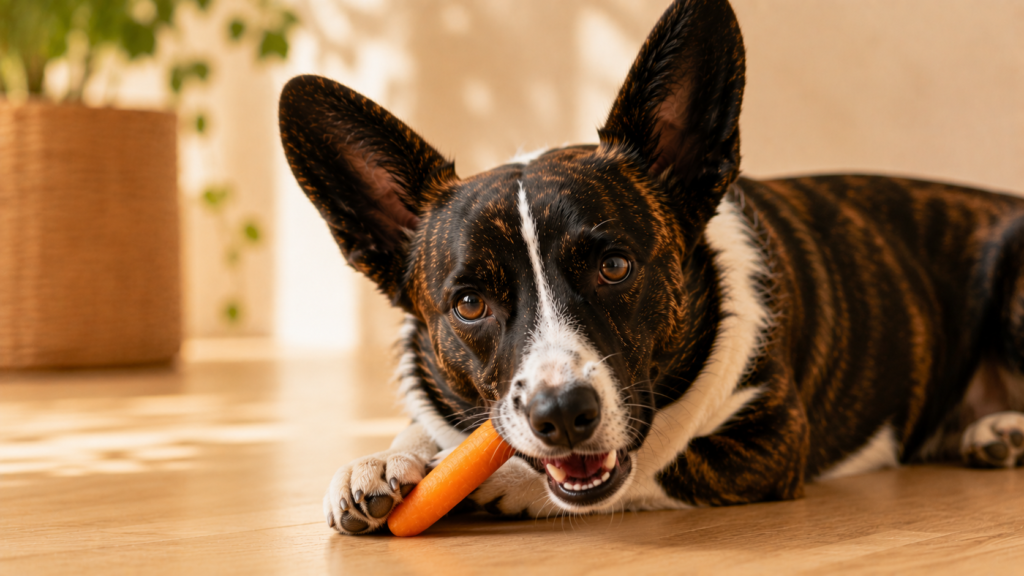
Dental benefits — Chewing raw carrots produces a gentle mechanical cleaning action on teeth. It doesn’t replace brushing, but the abrasive action helps reduce plaque buildup. Frozen carrots are especially effective for this — and great for teething puppies.
Hydration — Carrots are about 88% water, which contributes to your dog’s daily fluid intake.
Raw vs. Cooked Carrots — Which Is Better?
Both are safe. The choice comes down to what your dog prefers and what you’re using them for.
Raw carrots:
- Crunchier texture that most dogs enjoy
- Better for dental benefits (the crunch is what cleans teeth)
- Easy to slice into training treat-sized pieces
- Frozen raw carrots are excellent for teething puppies
Cooked carrots:
- Softer and easier to eat for older dogs or dogs with dental issues
- Slightly better nutrient absorption (beta-carotene is more bioavailable from cooked carrots)
- Can be mashed or mixed into food as a topper
- Important: cook plain — no butter, salt, garlic, or onion
How to Serve Carrots
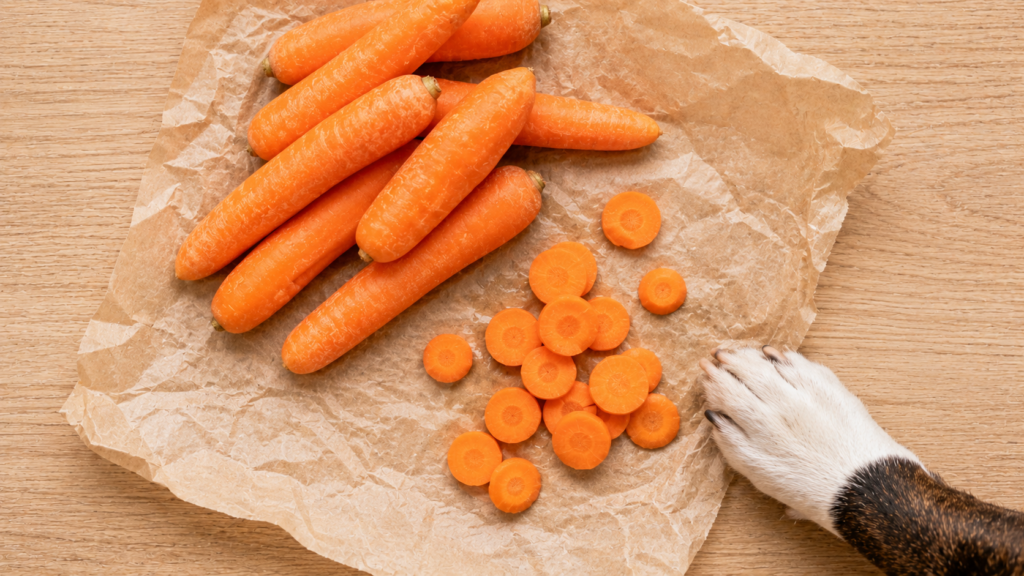
Raw: Wash, peel if you prefer, and cut into pieces appropriate for your dog’s size. Baby carrots work perfectly as-is for medium and large dogs. For small dogs or puppies, slice into coins.
Cooked: Steam or boil plain until just tender. No seasoning of any kind.
Frozen: Great for hot days and for teething puppies. Freeze baby carrots whole (large dogs) or sliced (small dogs). The cold reduces gum inflammation and the hard texture satisfies the urge to chew.
Stuffed in a Kong: Mash cooked carrot and mix with a little plain peanut butter or cottage cheese, then stuff into a KONG Classic and freeze. Nuggy can work at one of these for 20 minutes.
How much:
| Dog size | Suggested serving |
|---|---|
| Small (< 10 kg) | 1–2 baby carrots or a few coin slices |
| Medium (10–25 kg) | 3–5 baby carrots |
| Large (> 25 kg) | Half a large carrot or a small handful of baby carrots |
Carrots are low-calorie enough that exact portion control isn’t critical, but they should still supplement a balanced diet rather than replace it.
Carrots as a Training Treat
Baby carrots or sliced carrot coins work well as training treats for dogs who are food-motivated by crunchy textures. They’re especially useful when:
- Your dog is on a weight management diet and you want to keep treat calories low
- You’re doing high-repetition training and don’t want to overfeed rich treats
- You’re introducing a new food as a positive reinforcement anchor
They’re not quite as high-value as meat-based treats, so for harder commands or new skills, you may want to mix carrot pieces with a higher-value treat like Zuke’s Mini Naturals. More on training treat strategy in our 12 Easy Enrichment Ideas article.
The Bottom Line
Carrots are one of the few human foods that are genuinely good for dogs without any meaningful downsides. Low calorie, nutrient-rich, great for teeth, and cheap — there’s no reason not to have them in your dog treat rotation.
Nuggy gets carrots most weeks, usually raw as a crunchy snack or stuffed in a Kong with peanut butter. It’s one of the treats I feel completely good about giving without measuring.
For more safe and unsafe foods, see our complete safe foods guide.
Frequently Asked Questions
Q: Can dogs eat carrot tops (the green leafy part)?
A: Yes — carrot tops are non-toxic to dogs. Most dogs ignore them due to the bitter flavor, but they’re not harmful if nibbled.
Q: Can puppies eat carrots?
A: Yes — carrots are excellent for puppies. Frozen carrot pieces are particularly good for teething, as the cold reduces gum inflammation. Cut to appropriate size to avoid choking.
Q: Can dogs eat baby carrots straight from the bag?
A: Yes — baby carrots are one of the most convenient dog treats available. No prep needed for medium and large dogs. For small dogs, slice in half lengthwise to reduce choking risk.
Q: How many carrots can a dog eat in a day?
A: There’s no strict upper limit, but treats should stay within the 10% daily calorie guideline. Given that carrots are very low calorie (~4 calories per baby carrot), this is hard to exceed. A few baby carrots daily is perfectly reasonable for most dogs.
Q: Can dogs eat carrots with dip?
A: No — hummus, ranch, or other dips often contain garlic, onion, or other ingredients harmful to dogs. Plain carrots only.
Q: Are cooked carrots as good as raw for dogs?
A: Both are nutritious. Cooked carrots have slightly higher beta-carotene bioavailability but lose some of the dental benefits that come from the crunching action. Raw is generally preferred unless your dog has dental issues that make hard foods uncomfortable.