
Short answer
Yes — cheap homemade dog food can be healthy, but only when it’s done with intention and basic nutritional structure.
Many low-cost recipes online focus only on price.
This guide focuses on safety first, then affordability.
You’ll learn:
- when homemade food truly saves money
- what must be included to avoid deficiencies
- how to feed small dogs and puppies safely
- when homemade food is not the right choice
This is a decision and safety guide first, with five tested budget recipes at the end.
It’s a decision and safety guide for real dog owners.
Why people look for cheap homemade dog food
Most owners arrive here for honest reasons:
- rising cost of commercial dog food
- digestive issues or food sensitivities
- desire to control ingredients
- distrust of low-quality kibble
- tighter monthly budgets
All of these are valid.
The problem starts when saving money becomes more important than nutritional completeness.
The real risk of cheap homemade dog food
The biggest danger isn’t using affordable ingredients.
The danger is nutrient imbalance.
Dogs require specific ratios of:
- calcium and phosphorus
- essential vitamins and minerals
- protein, fat, and energy
Most budget recipes online fail because they:
- omit calcium entirely
- rely on vegetables as “complete nutrition”
- rotate ingredients randomly without balance
A dog may appear fine for months — until symptoms show:
- dull coat or hair loss
- low energy
- digestive problems
- joint or bone issues
- growth problems in puppies
Food that leads to health problems later is never truly cheap.
When homemade dog food actually saves money
Homemade food is cost-effective only when structured.
It works best when:
- meals are cooked in batches (3–7 days)
- ingredient lists stay simple and repeatable
- novelty ingredients are avoided
- supplementation replaces guesswork
If you cook daily, constantly change recipes, or skip supplements, costs rise quickly.
Typical monthly cost for a small dog (approximate)
- Low-end kibble: $30–50
- Quality commercial food: $60–90
- Homemade (done correctly): $35–60
Savings come from consistency, not shortcuts.
The 5 non-negotiable rules of cheap but healthy homemade dog food
1. Protein must be the foundation
Affordable, reliable protein sources include:
- ground turkey
- chicken thighs
- lean beef
Protein should form the base of every meal, not a small portion.
2. Carbohydrates are acceptable — with limits
Low-cost carbs can support energy and affordability:
- rice
- oats
- potatoes
They should support protein, not replace it.
3. Vegetables add support, not completeness
Vegetables provide fiber and some micronutrients:
- carrots
- green beans
- zucchini
They do not make a meal nutritionally complete on their own.
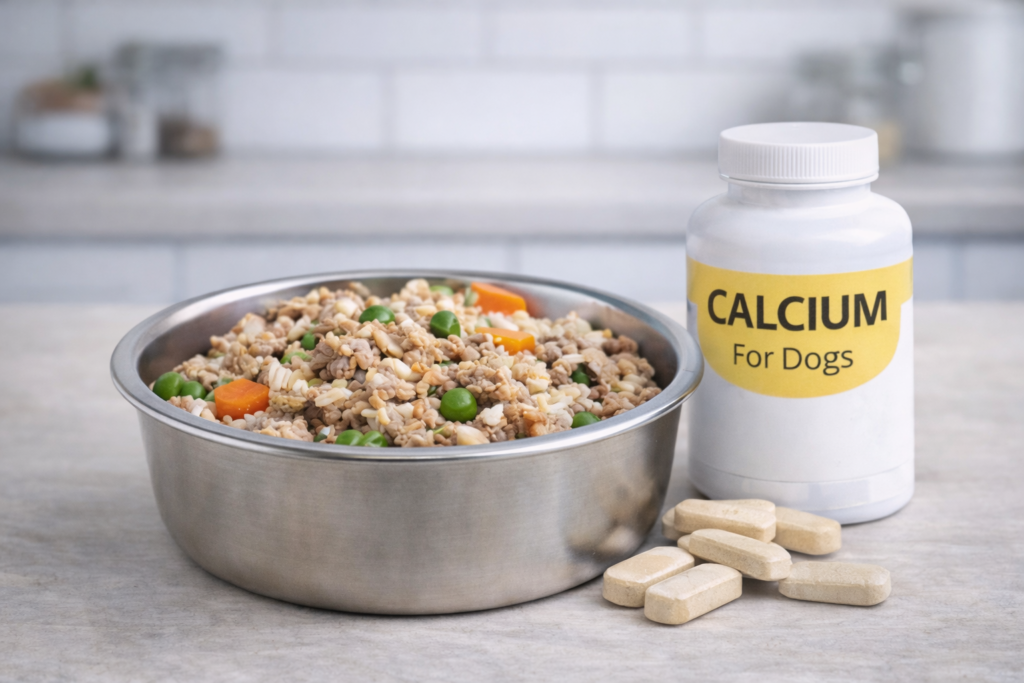
4. Calcium is mandatory — no exceptions
This is the most common and most dangerous mistake.
Meat-based homemade diets must include a calcium source to balance phosphorus.
Without proper calcium:
- bone density suffers
- teeth weaken
- long-term skeletal damage can occur
If you are unsure how calcium is being added, the diet is incomplete.
5. Supplements are cheaper than health problems
A basic, well-chosen supplement is far less expensive than:
- treating deficiencies
- joint problems
- chronic skin or digestive issues
Homemade dog food without supplementation is a gamble — not a plan.
Looking for easy treat ideas? Try these
5 Cheap Homemade Dog Food Recipes (With Real Cost Per Batch)
Everything above is the “why.” This is the “what.”
Each of these is bulk-cookable, uses ingredients from a normal grocery store, and comes with the actual cost — because “save money on dog food” is easy to say and much harder to prove. I’ve listed what each batch costs, how long it lasts, and what it works out to per day for a 30-pound dog like Nuggy.
Prices are approximate. They’re US averages and they move around by region and season. Use them to compare recipes against each other, not as a promise.
Every recipe needs calcium added. This is rule #4 above and it doesn’t get a pass just because a recipe looks complete. Meat is high in phosphorus and low in calcium — cooked meat and rice with no calcium source is not a balanced meal, no matter how healthy the ingredients sound. The rule of thumb most vets use is roughly 1,000 mg of calcium per pound of finished food, which is about ½ teaspoon of finely ground eggshell powder. If you use a calcium carbonate supplement instead, check the label — concentrations vary a lot.
Safety note: never feed cooked bones. They splinter. If a recipe uses bone-in cuts because they’re cheaper, debone completely after cooking and before serving. No exceptions.
1. Chicken & Rice Base — the cheapest way to start
This is the workhorse. Chicken leg quarters are consistently the cheapest protein in the meat case, and they’re fattier than breast, which dogs generally do better on anyway.
Ingredients
- 5 lb chicken leg quarters — ≈ $6.50
- 1½ lb brown rice, dry — ≈ $1.90
- 1 lb carrots, chopped — ≈ $1.00
- 1 lb frozen peas — ≈ $1.20
Method
- Simmer the chicken quarters in water for 35–40 minutes until fully cooked.
- Remove, cool, and pull all meat off the bone. Discard every bone.
- Cook the rice in the strained cooking liquid — free flavour, and it keeps the nutrients that leached out.
- Steam carrots and peas until soft, then chop small.
- Combine and cool completely before portioning.
Add calcium: this batch finishes at roughly 9 lb, so you need about 9,000 mg calcium — around 4½ teaspoons of ground eggshell powder, mixed in thoroughly while the food is still warm.
Cost: ≈ $10.60 per batch · ~14 cups · 7 days for a 30-lb dog · ≈ $1.51/day
Storage: 4 days in the fridge, 3 months frozen. Portion into daily containers before freezing — thawing one big block is miserable.
Make it easier: skip the carrots and peas and use a 1 lb bag of frozen mixed vegetables instead. Same cost, one less thing to chop.
2. Ground Turkey & Oats — the best cost-to-effort ratio
Oats cook faster than rice and hold moisture better, so this batch reheats well. Nuggy is noticeably more enthusiastic about turkey than chicken, for whatever that’s worth.
Ingredients
- 3 lb ground turkey (93/7) — ≈ $10.50
- 3 cups rolled oats, dry — ≈ $1.20
- 1 can (15 oz) pure pumpkin purée — ≈ $2.00
Method
- Brown the turkey in a large pot. Don’t drain the fat — your dog needs the calories.
- Add 6 cups water and bring to a simmer.
- Stir in the oats and cook 10 minutes until thickened.
- Remove from heat, stir in the pumpkin, cool completely.
Add calcium: ≈ 8 lb finished weight → about 4 teaspoons ground eggshell powder.
Cost: ≈ $13.70 per batch · ~14 cups · 7 days · ≈ $1.96/day
Storage: 4 days refrigerated, 3 months frozen.
Pro tip: buy pure pumpkin purée, not pumpkin pie filling. The pie version has sugar and spices in it, and nutmeg is genuinely not good for dogs. They sit next to each other on the shelf and the cans look almost identical — I’ve grabbed the wrong one before.
3. Crockpot Chicken Dinner — set it and walk away
The one you make on a Sunday while doing something else. Eight hours, no supervision, and the whole house smells like a roast dinner.
Ingredients
- 3 lb boneless chicken thighs — ≈ $9.00
- 2 cups brown rice, dry — ≈ $1.70
- 1 lb frozen mixed vegetables — ≈ $1.30
- 4 cups water
Method
- Put everything except the vegetables in the slow cooker.
- Low for 7 hours.
- Add the frozen vegetables and cook 1 more hour.
- Shred the chicken with two forks directly in the pot, stir, cool completely.
Add calcium: ≈ 8 lb finished → about 4 teaspoons ground eggshell powder, stirred in once the food has cooled to warm.
Cost: ≈ $12.00 per batch · ~13 cups · 6–7 days · ≈ $1.85/day
Storage: 4 days refrigerated, 3 months frozen.
Make it easier: double it. A 6-quart slow cooker handles twice this volume and the effort is identical — you’re just freezing more of it.
4. Beef & Sweet Potato — the expensive one, and why that matters
Beef costs roughly double what chicken does, so I’d normally leave it out of a budget guide. It’s here because some dogs genuinely don’t tolerate chicken, and if that’s your dog, “just feed chicken” isn’t advice.
Ingredients
- 3 lb ground beef (73/27 — the cheap grind) — ≈ $12.00
- 3 lb sweet potatoes, cubed — ≈ $3.00
- 1 lb frozen green beans — ≈ $1.30
Method
- Brown the beef, then drain the fat. 73/27 renders a lot, and unlike the turkey recipe this is more than a dog needs.
- Boil or roast the sweet potato cubes until fork-soft.
- Steam the green beans and chop them small.
- Combine and cool completely.
Add calcium: ≈ 7 lb finished → about 3½ teaspoons ground eggshell powder.
Cost: ≈ $16.30 per batch · ~12 cups · 6 days · ≈ $2.72/day
Storage: 4 days refrigerated, 3 months frozen.
That’s roughly 80% more per day than the chicken recipe. If budget is the whole reason you’re here, this is the one to skip.
5. Egg & Rice — the emergency batch
Not a long-term diet. This is the recipe for the week the paycheck is late, or the evening you realise the freezer is empty and the store is closed. Eggs are a complete protein and one of the cheapest ones available.
Ingredients
- 18 eggs — ≈ $4.50
- 2 cups white rice, dry — ≈ $1.20
- 1 lb frozen spinach — ≈ $1.30
Method
- Cook the rice.
- Scramble the eggs in a dry non-stick pan — no butter, no oil, no salt, no seasoning.
- Wilt the spinach, drain it well, chop it.
- Combine and cool.
Add calcium: ≈ 5 lb finished → about 2½ teaspoons ground eggshell powder. Convenient here: you’ve just cracked 18 eggs, so rinse the shells, bake them at 300°F for 10 minutes and grind them in a coffee grinder.
Cost: ≈ $7.00 per batch · ~9 cups · 4–5 days · ≈ $1.56/day
Storage: 3 days refrigerated only. Egg-based food doesn’t freeze well — the texture goes rubbery.
Safety note: always cook the eggs. Raw egg whites contain avidin, which blocks biotin absorption over time, and raw eggs carry a salmonella risk for both your dog and you.
So How Much Does This Actually Save?
Here’s the honest comparison, using the monthly figures from earlier in this guide.
| Option | Cost per month (30-lb dog) |
|---|---|
| Low-end kibble | $30–50 |
| Quality commercial food | $60–90 |
| Chicken & Rice Base | ≈ $45 |
| Turkey & Oats | ≈ $59 |
| Crockpot Chicken | ≈ $56 |
| Beef & Sweet Potato | ≈ $82 |
Read that table carefully, because it doesn’t say what budget-food articles usually say.
Homemade food does not beat cheap kibble on price. It beats mid-range and premium commercial food on price, while giving you full control of the ingredients. If your dog is currently eating a $30 bag of store-brand kibble and you switch to homemade to save money, you will spend more, not less.
The recipes that genuinely undercut commercial food are the chicken-based ones. Beef lands about level with premium kibble, which makes it a control decision, not a savings decision.
And none of this counts your time. A batch takes 45–60 minutes including cleanup. If that hour is expensive for you, factor it in honestly.
That’s not a reason to skip homemade feeding. It’s a reason to do it with clear eyes — which is the whole point of this guide.
If you’d rather start from a set of balanced recipes, we have those too: 6 balanced homemade dog food recipes. And if your dog is over seven, senior nutrition needs change in ways worth knowing about.
Feeding puppies homemade food: extra responsibility
Puppies are still developing.
Their bones, joints, and organs are highly sensitive to imbalance.
If feeding a puppy homemade food:
- calcium ratios must be precise
- growth must be monitored
- consistency matters more than variety
If budget or confidence is limited, a quality commercial puppy food may be safer.
There is no shame in choosing safety over experimentation.
Signs your homemade diet is working
Positive indicators include:
- steady energy levels
- healthy stool
- shiny coat
- stable weight
Warning signs to stop and reassess:
- persistent diarrhea
- lethargy
- weight loss
- changes in coat or behavior
When in doubt, pause and consult a professional.
What You’ll Need (Quick Links)
Here are the essentials mentioned in this guide — all dog-safe and budget-friendly:
- Calcium supplement for dogs — essential if feeding homemade long-term
- Dog multivitamin — covers micronutrient gaps in homemade diets
- Fish oil for dogs — omega-3s for coat and joint health
- Batch cooking containers — for storing weekly portions
This post contains affiliate links. If you buy through them, I earn a small commission at no extra cost to you — it helps keep Nuggy in treats.
Final Thoughts: Is Cheap Homemade Dog Food Worth It?

Cheap homemade dog food can be a responsible, healthy choice —
but only when it’s treated as a system, not a shortcut.
If you’re willing to:
- keep ingredients simple
- cook in batches
- respect nutritional rules
- supplement intentionally
then homemade food can be:
- healthier than low-quality kibble
- easier on digestion
- affordable over time
If you try to:
- skip supplements
- rely on random online recipes
- constantly improvise
you risk harming the very dog you’re trying to help.
The goal isn’t perfection.
The goal is consistency, balance, and safety.
When done right, cheap homemade dog food isn’t about saving money —
it’s about feeding with control, responsibility, and confidence.
If you want to reward your dog while keeping things healthy, try these easy homemade dog treat recipes.