
Some links below are Amazon affiliate links — we earn a small commission if you buy, at no extra cost to you.
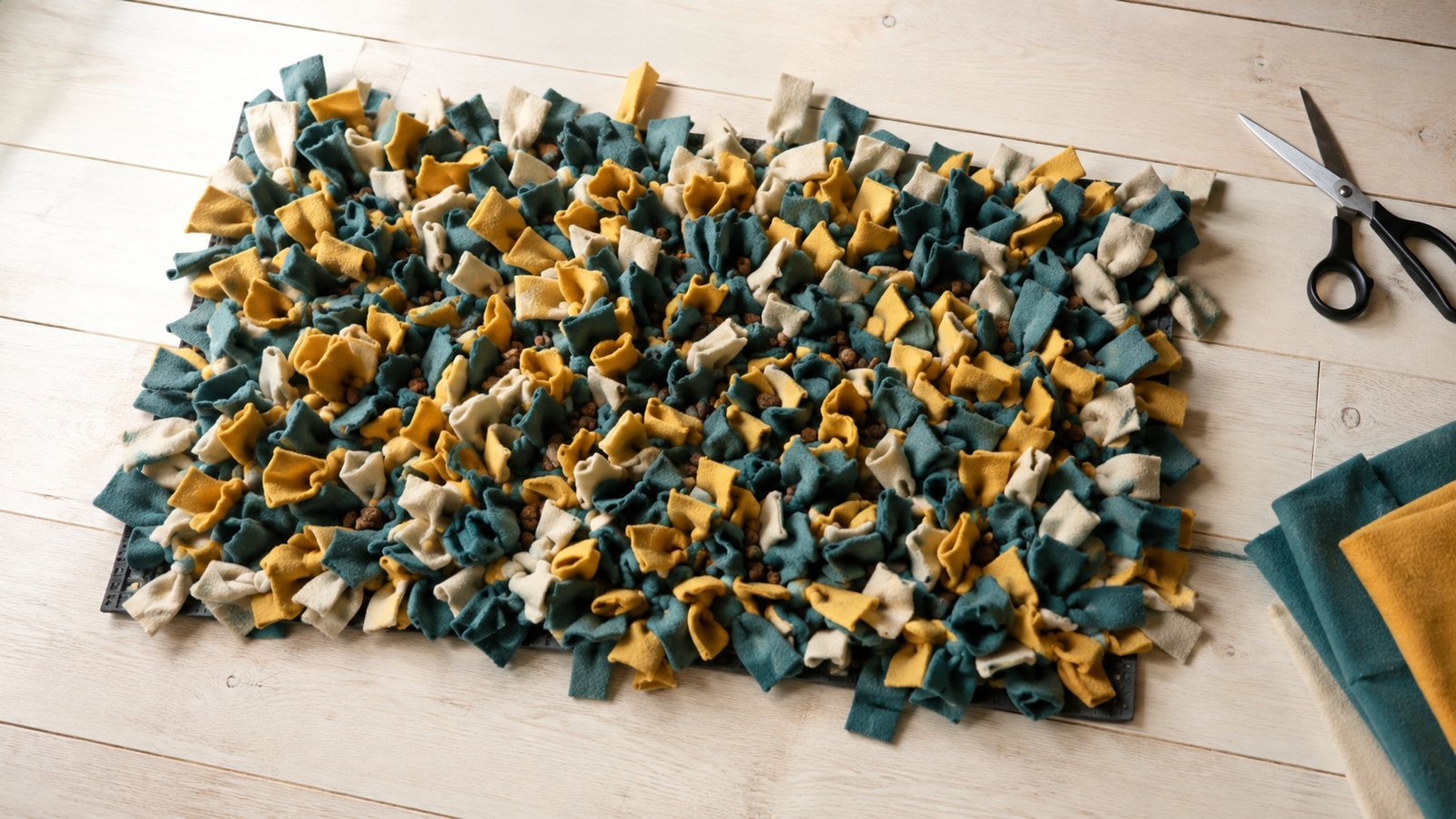
A DIY snuffle mat turns a bored dog’s dinner into ten minutes of real work for their nose. You can build one this evening with fleece and a mat full of holes — but before you spend the evening, there are two numbers worth knowing: what it actually costs, and how long it actually takes.
Here’s what’s on this page:
- 5 no-sew snuffle mat designs, each with materials, honest build time, and who it suits
- The real cost of building one versus buying one — priced today, including your time
- The safety section nobody writes, including what an obstruction looks like and the one thing not to do if your dog swallows a strip
- How to wash it so it doesn’t grow mould in the middle
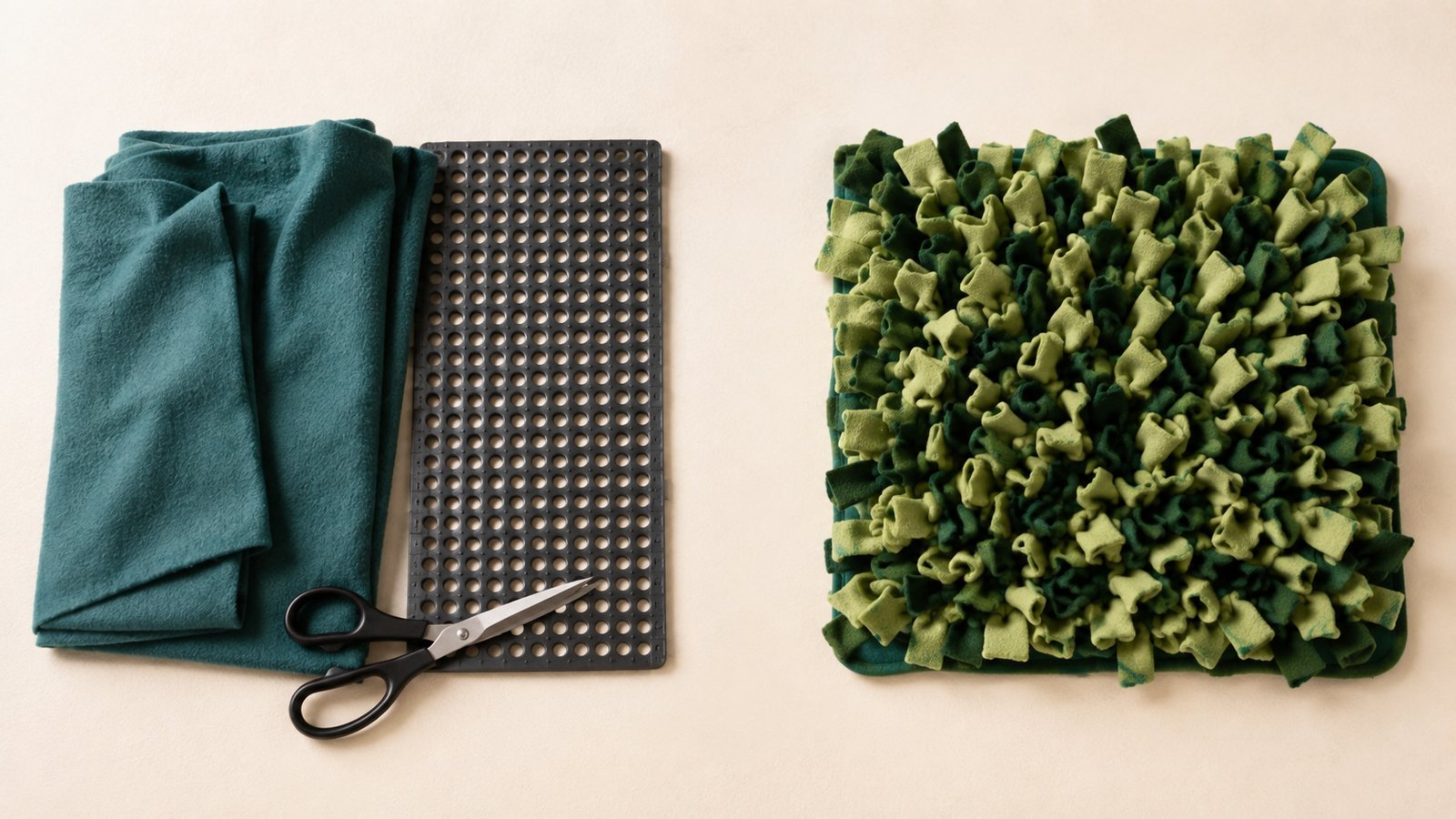
Snuffle mat DIY vs. buying: the numbers nobody puts in a DIY post
A finished, ready-to-use snuffle mat on Amazon — the AWOOF snuffle mat, 4.2 stars across more than 21,000 ratings — costs $11.98.
Now price the DIY version with everything bought new:
| Item | Realistic cost |
|---|---|
| Base — plastic canvas sheets (4 sheets, enough for 2 mats) | $7.59 → ~$3.80 per mat |
| Base alternative — new rubber or silicone sink mat from a dollar store | ~$1.25 |
| Fleece — ½ yard (60″-wide fabric gives roughly 300 strips per yard) | $3–5 |
| Total, all new | $5–9 |
So DIY does come out cheaper — by somewhere between three and seven dollars.
Then add the part the cost tables leave out: it takes 90 minutes to two hours. Twenty to thirty minutes cutting strips, another 45 to 90 minutes tying them. You are, in effect, paying yourself two to five dollars an hour to make a snuffle mat.
I’m telling you that because I’d rather you decide honestly than discover it forty minutes into cutting fleece.
DIY genuinely wins in four situations:
- You already have fleece — an old blanket, a worn-out throw, a stack of t-shirts. Now it’s free, and the mat is better than a cheap bought one because you control the density.
- You need a size nobody sells. Commercial mats are made for one medium dog. If you have a Great Dane, you’re not buying that mat — you’re making it.
- You want to replace it often. Snuffle mats get filthy and take a day to dry. Making them means owning several and binning one doesn’t sting.
- The making is the point. Some people like building things for their dog. Completely valid, and I’m not going to argue with it.
Buying wins if you’re starting from zero at a fabric store, you want it today, or you don’t enjoy repetitive crafts. Saving five dollars for two hours of work is a bad trade for most people.
Right — now that we’re being straight with each other, let’s build one.
What a snuffle mat actually does
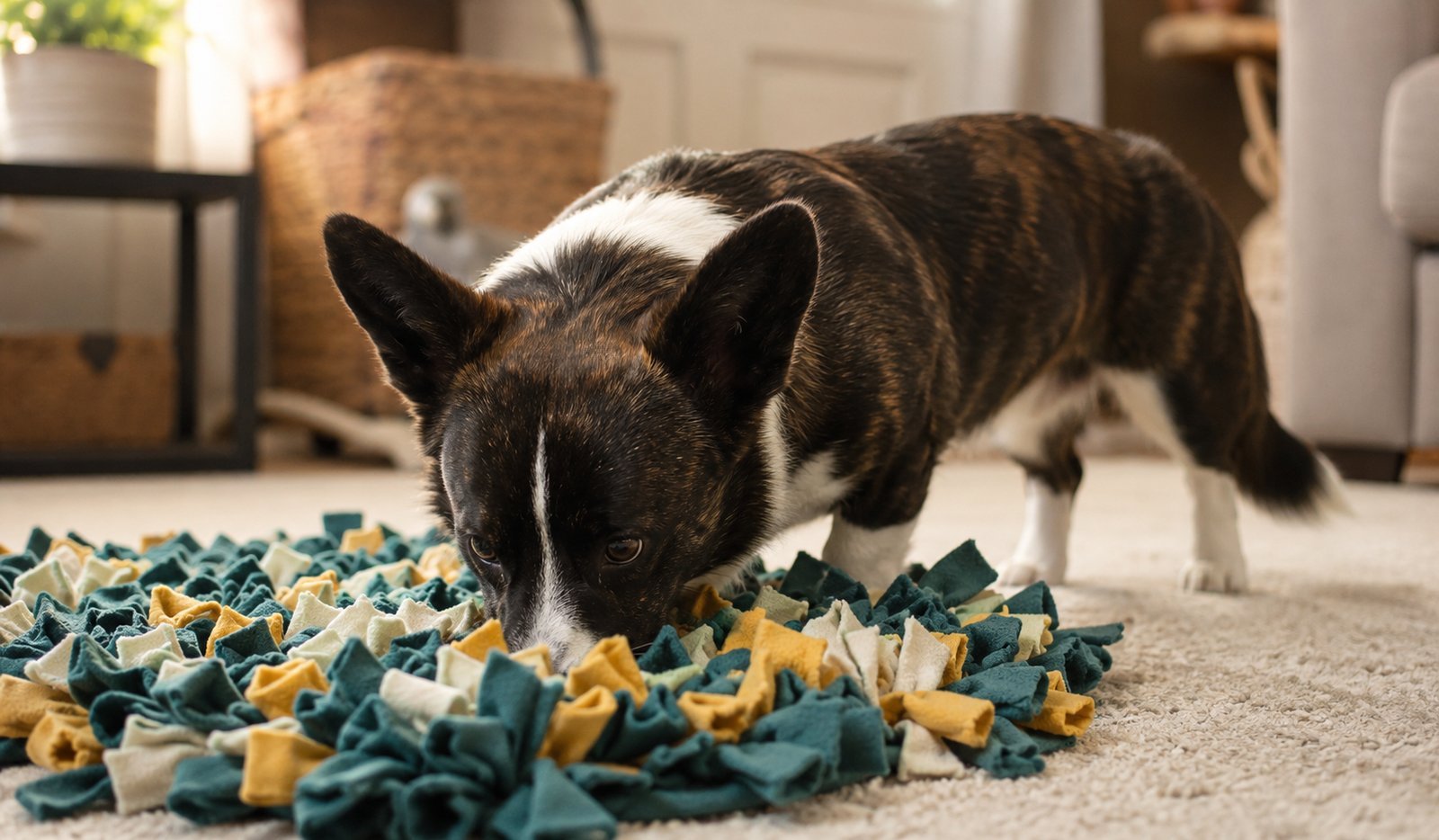
A snuffle mat is a dense field of fabric strips you hide food in. The dog has to use their nose to work the kibble out.
That sounds trivial. It isn’t. Smell is not a passive sense for a dog — brain imaging work published in 2022 traced five separate nerve tracts running from the olfactory bulb into the visual, emotional and memory centres of the dog’s brain, including a direct olfactory-to-visual connection that has never been found in any other species. Smell is wired into most of how a dog thinks.
And it appears to make them happier. In a 2019 study, twenty pet dogs were split between two weeks of daily five-minute nosework and two weeks of matched heelwork. The nosework dogs came out measurably more optimistic on a standard cognitive bias test; the heelwork dogs didn’t budge. A 2024 review of the wider literature found the same direction of travel — dogs allowed to sniff freely on walks show lower pulse rates than dogs walked to heel, and kennelled dogs given scent work rest better and show fewer stress behaviours.
What the research does not show, despite what you’ll read on every other page about this, is that ten minutes of sniffing tires a dog out like an hour’s walk. Nobody has measured that. Treat a snuffle mat as something that improves your dog’s mood and gives them a job — not as a substitute for physical exercise.
It also slows down fast eaters. A dog who empties a bowl in seconds will spend several minutes working the same food out of a snuffle mat — in our house it stretches a thirty-second breakfast into about ten minutes, though that depends entirely on how dense you make the mat and how determined your dog is.
Where it fits among the other options: a snuffle mat is for sniffing, a lick mat is for licking (better for anxiety and calm), and a puzzle toy is for problem-solving. Most dogs have a preference. If you’re not sure which yours is, our enrichment ideas guide walks through how to find out.
Before you start: the safety part
This goes above the tutorials on purpose, because fleece strips and dogs have one real failure mode.
Why fabric is the wrong thing to swallow
Fleece is swallowable, and swallowed fabric doesn’t reliably pass. In one study of dogs with upper-gut obstructions, fabric was the single most common thing found in the stomach — 20% of cases.
A long strip is the worst possible shape. It can anchor at one end while the gut keeps dragging the other end along, bunching the intestine up and sawing through the wall. Vets call this a linear foreign body, and it’s the version that usually ends in surgery: in one case series 87.5% of linear foreign bodies required an operation, against roughly half of swallowed objects overall that cleared with medical management alone.
That’s the whole argument for calling early rather than watching. Caught soon enough, a lot of these come out with an endoscope instead of a scalpel.
The rules
- Supervise every session. Every one. A snuffle mat is not a leave-the-house toy.
- Not for shredders. If your dog destroys plush toys and eats the stuffing, a snuffle mat is a bad idea in any form. Give them a rubber puzzle toy or a lick mat instead.
- Put it away between sessions. Out of reach, not on the floor.
- Inspect before and after each use. Pull-test the strips, check for loose threads and chewed edges. If strips are missing and you can’t account for them, assume they were swallowed.
- Tie tight, cut clean. Loose strips are the ones that get pulled free and eaten.
- Puppies need extra caution — they mouth everything, and their instinct is to chew rather than sniff. Short sessions, always watched.
- If your dog guards food, a snuffle mat concentrates high-value food in one spot on the floor, which is a guarding trigger. Work on that first — and don’t take the mat off a guarding dog, which tends to make guarding worse. Our behavior problems guide is a starting point, but serious guarding is a job for a board-certified veterinary behaviourist.
If your dog swallows a strip
Call your vet or an emergency clinic straight away — even if the dog seems completely fine.
Do not try to make your dog vomit unless a vet specifically tells you to. Bringing up a strip of fabric can do more damage than leaving it, particularly if it has already anchored.
Signs of a blockage — call the same day: repeated vomiting, especially bringing water back up · refusing food · lethargy · a hunched or painful belly · drooling · straining to poo, or producing nothing. These can start hours or even days after the fabric went down.
The 5 DIY snuffle mat designs
All five are no-sew. Nothing here needs a sewing machine or any skill beyond tying a knot.
A note on fabric: fleece is the standard because it’s a knit and doesn’t fray. Cotton and jersey work but shed threads over time — and unravelled cotton thread is exactly the shape that causes the worst kind of blockage, so inspect more often if you use it.
A note on bases: the base is a food-contact surface, so treat it like one. A new rubber or silicone sink mat is fine — wash it before first use. Avoid old car mats and outdoor doormats — car mats carry motor oil, brake dust and road salt, and recycled-tyre doormats aren’t made to be eaten off. Very soft, strong-smelling flexible plastic is usually PVC softened with phthalates; if it reeks of plastic out of the packet, pick something else. Plastic canvas is a hard, rigid plastic and is the easiest to vouch for.
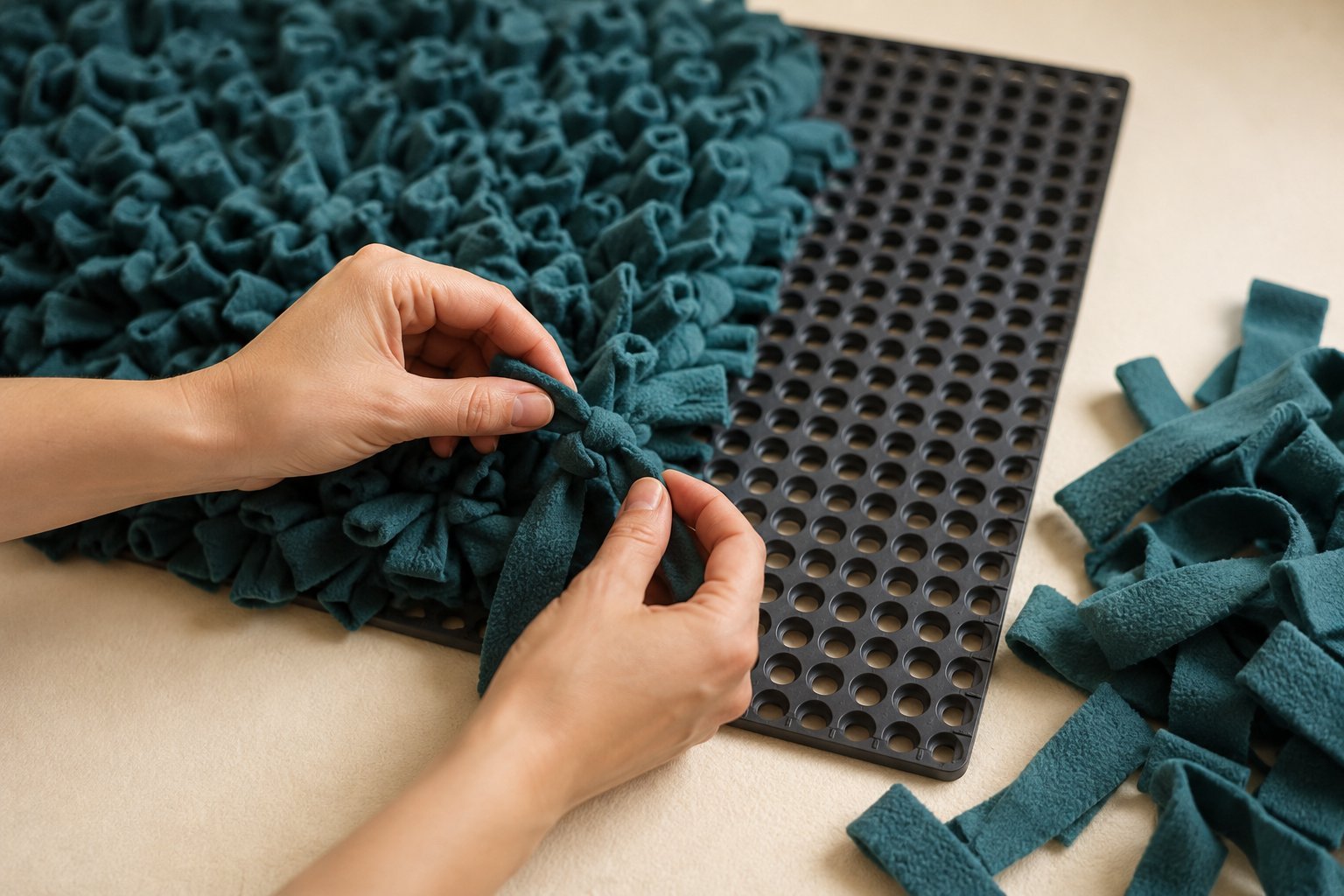
1. The Classic Fleece Snuffle Mat
The canonical build. If you make one snuffle mat in your life, make this one.
Materials
- 1 rubber or silicone sink mat with holes, or 2 plastic canvas sheets cable-tied side by side
- ½–¾ yard of fleece (60″-wide fabric yields roughly 300 strips per yard, so half a yard is plenty), or one old fleece blanket
- Sharp scissors
Build time: 20–30 minutes cutting, then 45–90 minutes tying.
How
- Cut the fleece into strips roughly 1 inch wide by 6–7 inches long. You’ll need 100 to 150 for a sink-mat-sized build. Cutting several layers at once speeds this up enormously.
- Push one end of a strip down through a hole and back up through a neighbouring hole.
- Tie a single tight knot on the top side. Tug it. If it slides, redo it.
- Work row by row. On a rubber sink mat, use every hole. On plastic canvas, use every second or third hole — 7-count canvas has seven holes to the inch and filling every one would take thousands of knots. Aim for roughly one knot per square inch, with strip ends overlapping their neighbours. Density is the whole point — a sparse mat gives up its food in thirty seconds and your dog loses interest.
- Trim any strips that came out much longer than the rest.
Who it’s for: Any dog who sniffs rather than shreds. This is the version that lasts.
Make it easier: Cut all your strips first, in one sitting, in front of the TV. Alternating two fleece colours makes it far easier to see where you are in a row.
2. The T-Shirt Snuffle Mat
The version that’s actually free — and the honest answer to the cost problem above.
Materials
- 4–6 old t-shirts (cotton or cotton blend)
- A base (new sink mat or plastic canvas — see the note on bases)
- Scissors
Build time: 30 minutes cutting, 60–90 minutes tying.
How
- Cut the t-shirts into strips about 1 inch by 7 inches. Cut across the body of the shirt and skip seams and hems — too thick to knot neatly.
- Tie them through the base exactly as in design 1.
- Cotton is thinner than fleece, so use more strips. Aim noticeably denser than you think you need.
Who it’s for: Anyone who wants a snuffle mat without buying fabric. Also the best option if you want several to rotate.
Watch for: Cotton frays. Check the strips before every session and trim anything that’s started to unravel — loose threads are the shape that causes linear obstructions.
3. The XL Snuffle Blanket
The one you can’t buy. Commercial snuffle mats are sized for one medium dog; this is for the dogs they aren’t made for.
Materials
- A large base: 4–6 plastic canvas sheets cable-tied into a grid, or a large new rubber mat with holes
- 1.5–2 yards of fleece, or two old fleece blankets
- Cable ties
Build time: 2–4 hours. A weekend project, not an evening one.
How
- Build the base first. Overlap plastic canvas edges by one row of holes and cable-tie every few inches. Trim the tie ends flush — a sharp plastic stub in a dog’s nose ruins the whole exercise.
- Cut strips as in design 1. Expect to need 300 or more.
- Tie in sections and take breaks. Doing it in one sitting will make you hate it.
Who it’s for: Giant breeds, or dogs who solve a normal mat too fast.
🔴 If you have more than one dog, make one mat each and feed them in separate rooms or behind a barrier. A shared food mat is a fight waiting to happen, even between dogs who normally get on — you’re concentrating high-value food on one surface, which is the classic setup for guarding.
Bonus: A large mat can be rolled from one end so different sections get used on different days. Same mat, new problem.
4. The Rolled-Strip Snuffle Mat (no base at all)
Fastest to build — and the one that needs the most care.
Materials
- ½ yard of fleece
- 4–5 long fleece ties, cut from the same fabric
Build time: 20–30 minutes.
How
- Cut the fleece into strips about 2 inches by 20 inches — or 12 inches if you have a small dog.
- Stack 8–10 strips into a loose bundle and tie them tightly at the centre with a long fleece tie.
- Repeat until you have 6–8 bundles.
- Tie the bundles to each other, centre to centre, until they form a shaggy rough circle. It should stand up in a loose pile, not lie flat.
- Scatter kibble down into the layers.
🔴 Trade-off — and a real one: this is the least safe design here. With no base, the dog can pick the whole thing up and carry it off, and the long strips are exactly the geometry that causes a linear obstruction if one gets swallowed. Use it only with a dog you already know doesn’t chew fabric, never out of arm’s reach, and count your bundles before and after every session.
Who it’s for: Dogs with a proven track record of sniffing rather than chewing. If you’re not sure how your dog will react to fabric, start with design 1 or 5 instead — a based mat is much harder to run off with.
It’s also harder to wash thoroughly than a based mat. Good for testing whether your dog enjoys snuffling at all; not a keeper.
5. The Travel Snuffle Mat
Small, flat and packable — for the car, the crate, or a hotel floor.
Materials
- 1 plastic canvas sheet (the standard 10.5 × 13.5 inch size is right)
- About ¼ yard of fleece
- Scissors
Build time: 30–45 minutes.
How
- Use one sheet uncut, or trim it to roughly 8 × 10 inches for a very small dog. If you cut it, cut through the middle of a hole row rather than across the bars — cutting across leaves a serrated edge of plastic spikes. Run a finger along every cut edge afterwards; if it catches your skin, file it smooth or bind it with a strip of fleece before the dog sees it.
- Cut strips 1 inch by 5 inches — slightly shorter than the classic, so it packs flat.
- Tie densely across the whole sheet.
- It rolls up. A rubber band holds it.
Who it’s for: Crate training, car journeys, vet waiting rooms — any situation where a dog needs a job for ten minutes somewhere unfamiliar.
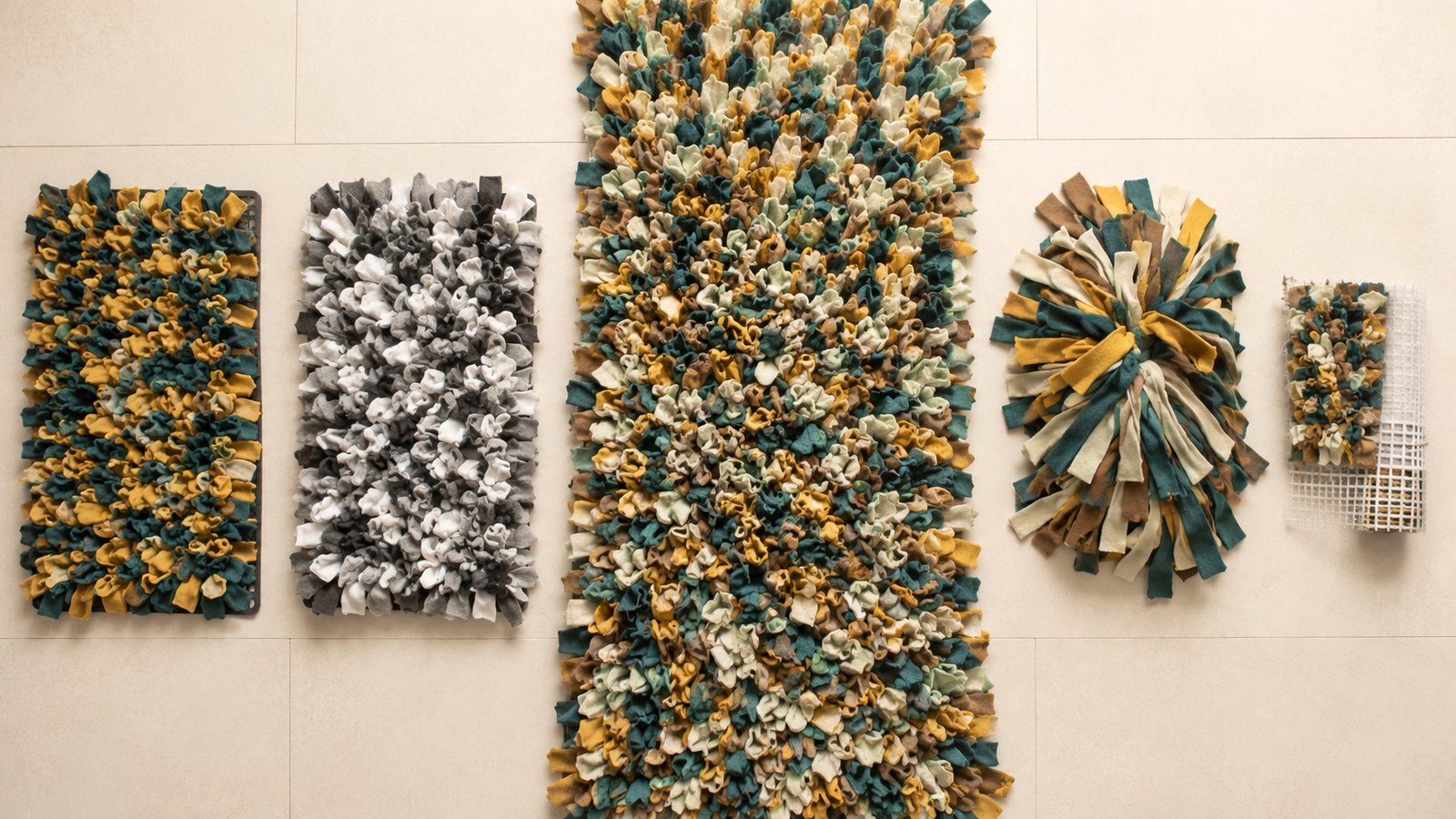
Which design should you make?
| If you… | Make | Why |
|---|---|---|
| Have fleece and an evening | #1 Classic | The one that lasts |
| Want it genuinely free | #2 T-Shirt | Uses what you already own |
| Have a giant breed | #3 XL Blanket | The size you can’t buy |
| Travel or crate-train | #5 Travel | Packs flat |
| Are testing whether your dog even likes sniffing | #4 Rolled-Strip — supervised, arm’s reach | 20 minutes, no base needed |
| Have a dog who shreds fabric | None — buy a rubber puzzle toy | Ingestion risk isn’t worth it |
| Have several dogs | One mat each, fed separately | Shared food mats cause fights |
| Want it done for $12 with no evening spent | Buy the AWOOF | No shame in it |
How to use it so your dog doesn’t give up
Most snuffle mats fail on day one because the dog gets frustrated and walks off.
- Start stupidly easy. First session: scatter kibble on top, in plain sight. Let them win in twenty seconds.
- Bury it deeper over three or four sessions, not all at once.
- Use their actual meal, not extra treats. A snuffle mat is a feeding method, not a snack dispenser — and if you’re watching your dog’s weight, that matters.
- Ten to fifteen minutes is a full session. Stop while they’re still interested; a dog who gets bored of a mat halfway through is harder to re-engage next time.
- Put it away afterwards. A mat that lives on the floor stops being interesting within a week.
- Resist nudging it toward them — a bit of persistence is the point. But if your dog is getting genuinely frustrated rather than absorbed, make the mat easier rather than letting them fail.
A snuffle mat is also useful for a dog on restricted exercise after surgery — though check with your vet first, and if the surgery was for a swallowed object, skip fabric entirely and use a rubber puzzle feeder.
Nuggy isn’t much of a snuffler — she’d rather solve a puzzle with her paws than her nose — but she’ll clear a mat happily when there’s chicken in it rather than kibble. If your dog seems uninterested, raise the value of what’s hidden before you conclude snuffling isn’t their thing.
Washing it (the part everyone skips)
A snuffle mat is a food bowl with a hundred saliva-soaked folds and a 24-hour drying time. Left alone, it grows things.
- Shake it out after every use. Ten seconds, outdoors.
- Wash weekly at minimum with dry kibble — and immediately after anything wet or greasy. For reference, the FDA’s advice for pet food bowls is soap and hot water after every use. A snuffle mat can’t realistically meet that, and that’s part of the trade-off you’re accepting. Dry food is the lower-risk case; if you’re using anything damp, wash the same day or don’t use it at all.
- Machine wash on gentle, in a mesh laundry bag so the strips don’t wrap around the drum. Cold protects a plastic base, but cold does less to bacteria than hot — another reason to wash more often rather than harder.
- Air dry completely. Don’t tumble dry — heat mats and pills the fleece, can distort a plastic base, and the strips knot themselves round the drum.
- If it smells musty, it isn’t dry. A mat still damp in the middle will grow mould in folds you can’t see, and mouldy fabric isn’t something you want your dog’s face buried in. Dry it somewhere with moving air, not in a heap. If a musty smell survives a wash, or you see dark speckling in the strips, bin it and make another — that’s the cheap part of this project.
- No fabric softener. Dogs are eating off this.
- Make two and rotate if you use one daily. A thick mat takes 24 hours or more to dry through.
- Retire it when strips work loose faster than you can re-tie them.
If damp fabric that takes a day to dry sounds like a problem in your house, that’s another point in favour of just buying one — or using a lick mat instead, which rinses clean in about four seconds.
Frequently asked questions
How long does it take to make a snuffle mat? The classic fleece version takes 20–30 minutes of cutting plus 45–90 minutes of tying. The rolled-strip version (design 4) takes 20–30 minutes total. Cut all your strips in one sitting — switching between cutting and tying is what makes it feel endless.
How much fleece do I need? Less than most tutorials say. Fleece is sold 60 inches wide, which gives roughly 300 strips per yard at 1 × 7 inches. Half a yard covers a standard mat; 1.5–2 yards covers an XL.
What can I use instead of fleece? Old t-shirts (design 2), jersey, or any soft non-fraying knit. Avoid anything that sheds long threads, and anything with a slippery weave — the knots won’t hold.
Can I put wet food or peanut butter in a snuffle mat? Don’t. It works into the fabric and won’t wash out properly. Dry kibble and dry treats only. Wet food belongs on a lick mat.
Is a snuffle mat safe to leave with my dog? No. Supervise every session and put it away afterwards. Fabric ingestion is a genuine obstruction risk.
My dog ignores it. What now? Make it easier and raise the value of the food — kibble on the surface first, chicken or cheese if plain kibble doesn’t move them. If they still don’t engage after several tries, your dog may simply prefer licking or problem-solving. Try the calm enrichment options instead.
Can puppies use a snuffle mat? With close supervision, and only if they’re sniffing rather than chewing. Puppies mouth everything, which is exactly the risk.
What’s the difference between a snuffle mat and a snuffle ball? A mat is flat and stays put; a ball rolls and adds a chase element. If a ball sounds better for your dog, we have a full fleece snuffle ball build in our 6 DIY dog toys guide.
The bottom line
A snuffle mat is one of the better returns on effort in dog enrichment — ten minutes of nose work gives a bored dog something to do, which another lap of the same block doesn’t.
Make one if you already have the fabric, need a size nobody sells, or enjoy the building. Buy one if you’d be starting from scratch at a fabric store — you’d save about five dollars and spend two hours, and I’d rather tell you that than sell you an evening of cutting fleece.
Whichever you do: supervise it, wash it, put it away between sessions, and count the strips.
Which design are you going to try — and does your dog turn out to be a sniffer or a puzzle-solver? If it’s the latter, our DIY interactive dog toys guide is the better next stop.
Prices and ratings checked August 2026 and will drift. This article is general information, not veterinary advice — if your dog swallows fabric, contact your vet immediately and don’t induce vomiting unless told to.
As an Amazon Associate we earn from qualifying purchases.