
Some links below are Amazon affiliate links — we earn a small commission if you buy, at no extra cost to you.
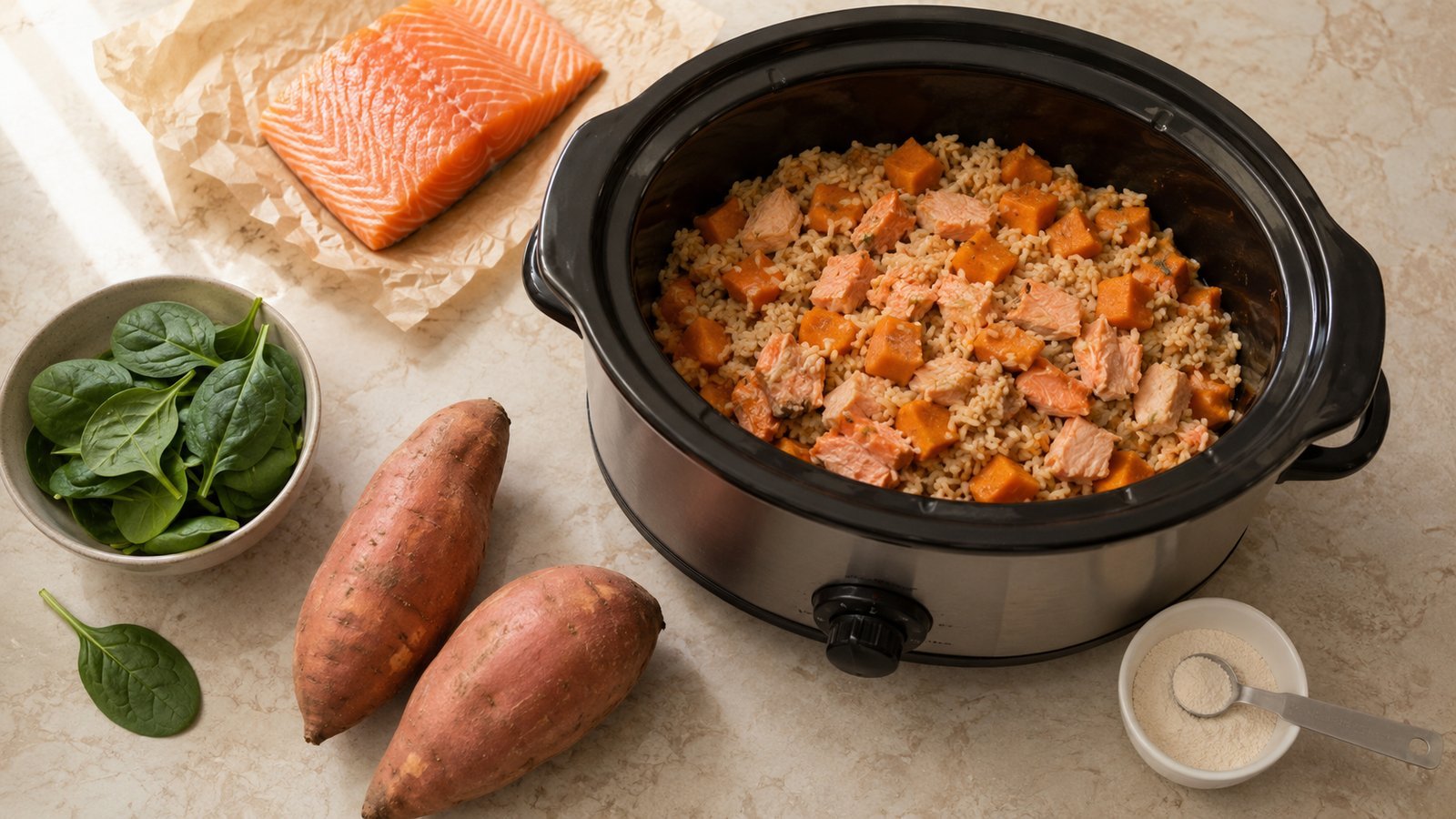
Yes — you can cook for your senior dog at home, and the senior dog food recipes below can genuinely support aging joints. But only if you get three things right that most recipes online skip entirely: calcium, portion size, and knowing when your dog’s kidneys mean these recipes aren’t for him.
That’s not a scare tactic. These are the best-documented failure points in homemade dog food, and we’ll deal with all three in the first few minutes so you can cook the rest of this page with confidence.
Here’s what you’ll get:
- 7 senior dog food recipes — 4 of them made in a crockpot, so you cook once and feed for several days
- A calcium line in every single recipe, because without it the recipe is incomplete no matter how good the ingredients look
- A phosphorus note in every recipe, so you know which ones to avoid if your vet has flagged your dog’s kidneys
- The one ingredient that has real clinical trial evidence behind it for arthritic dogs — and the dose that actually matters
- An honest account of what these recipes still don’t cover, because pretending otherwise is how dogs get hurt
First: the 95% problem nobody puts at the top of the page
In 2013, researchers at UC Davis evaluated 200 homemade dog food recipes pulled from 34 sources — websites, books, even veterinary textbooks. 95% were deficient in at least one essential nutrient. More than 83% had multiple deficiencies. The most common gaps were choline, vitamin D, zinc, and vitamin E.
(Stockman J, Fascetti AJ, Kass PH, Larsen JA. Evaluation of recipes of home-prepared maintenance diets for dogs. JAVMA 2013;242(11):1500–1505.)
Senior author Jennifer Larsen put it bluntly: it is extremely difficult for the average owner — or even a veterinarian — to build a balanced recipe from scratch.
So let’s be honest about what the recipes on this page are and aren’t.
What they are: well-constructed, senior-appropriate meals built around real food, with the calcium ratio worked out properly and the joint ingredients that actually have trial evidence behind them.
What they aren’t: complete and balanced. Like almost every homemade recipe — including the 200 in that study — these are still short on zinc, iodine, vitamin E, and in several cases vitamin D. Dogs can’t make vitamin D from sunlight the way we do; it has to come from the diet.
And here’s the part most blogs won’t tell you, because there’s no affiliate link in it: a general pet multivitamin will not fix this. Veterinary nutritionists at Tufts are explicit that off-the-shelf pet supplements aren’t formulated to balance a specific homemade recipe — they can’t be, because they don’t know what’s in your bowl. Properly closing those gaps takes a veterinary balancing supplement matched to the recipe, a formulation service like BalanceIT, or a consult with a board-certified veterinary nutritionist (ACVN).
So use these recipes one of two ways:
- As a topper or partial meal — keep unbalanced homemade food under roughly 10% of daily calories, the same rule that applies to treats. At that level, leave the calcium out entirely: your dog’s complete commercial food already supplies it, and adding more on top pushes the total past target.
- As the whole diet, properly balanced — with the calcium as written, plus a formulation service or nutritionist consult to close the micronutrient gaps.
What doesn’t work is the middle: half the bowl homemade, half kibble, calcium added, and hoping it averages out. It doesn’t average out. That’s the version that quietly goes wrong over months.
Nobody else in this niche is going to put that above the recipes. We’d rather you trust the rest of the page.
What actually changes in a senior dog’s bowl — and what doesn’t
Most “senior dog nutrition” advice is a decade out of date. Two corrections:
Older dogs do not need less protein. The old “low-protein for seniors” rule came from an assumption that protein stresses aging kidneys. Current guidance points the other way: the 2023 AAHA Senior Care Guidelines note that a senior diet may include mild increases in protein content and quality to offset age-related lean muscle loss (sarcopenia). There’s no evidence that restricting protein benefits a healthy senior, and good reason to think it costs muscle.
Phosphorus is the nutrient that actually matters — but only in the right dog. Phosphorus restriction is a therapeutic intervention for dogs with diagnosed chronic kidney disease, not a general senior precaution. That’s why every recipe below carries a phosphorus note: not so you avoid phosphorus, but so that if your vet has told you your dog’s kidney values are off, you know instantly which recipes are wrong for him.
What genuinely does change with age:
- Calories drop, appetite often doesn’t. Senior dogs are less active. Extra weight is the single worst thing you can add to a dog with sore joints.
- Chewing gets harder. Dental disease is near-universal in older dogs. Soft, moist food stops being a preference and becomes a requirement.
- Digestion gets fussier. Simpler recipes with fewer moving parts tend to land better.
If you want the full picture of what shifts after age seven, we covered it here: Senior Dog Care — What Changes After Age 7.
The 4 rules before you cook anything
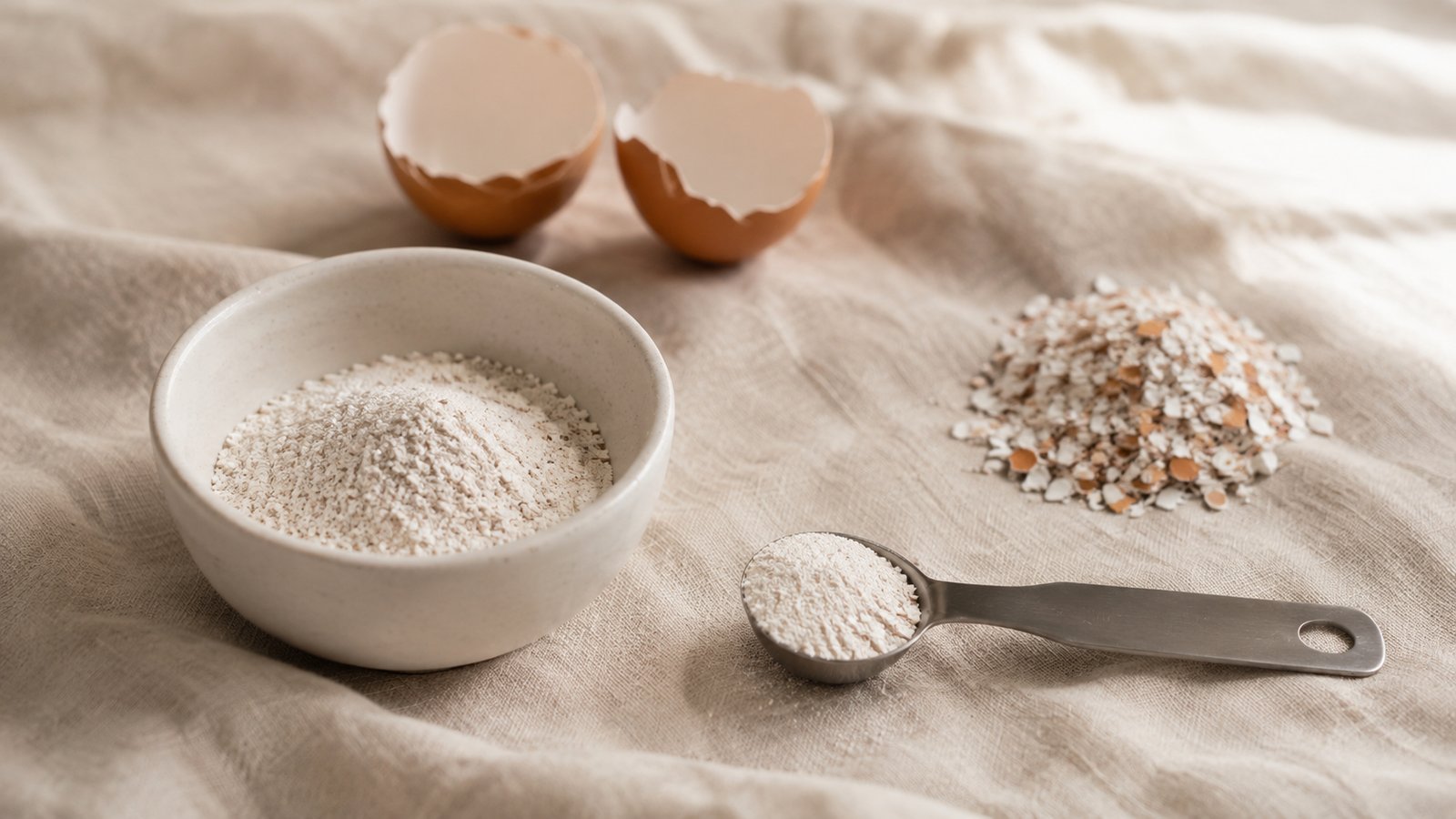
Rule 1: Every batch gets calcium — and not more than it needs
Meat is loaded with phosphorus and almost devoid of calcium. Feed a home-cooked meat-based diet without added calcium and you invert the calcium-to-phosphorus ratio — which over months to years can drive the body to pull calcium out of the skeleton to compensate.
The AAFCO range for adult dogs is a calcium-to-phosphorus ratio between 1:1 and 2:1, with the optimum sitting around 1.2–1.4:1. Straight cooked meat and rice lands far below 1:1.
The working rule: roughly 900–1,000 mg of elemental calcium per pound (450 g) of finished food.
Two ways to hit it:
- Ground eggshell — free. Rinse shells, bake at 300°F/150°C for 10 minutes, grind to a fine powder in a coffee grinder. 1 level teaspoon of eggshell powder ≈ 2,000 mg calcium, so you want roughly ½ teaspoon per pound of finished food. It must be genuine powder — gritty fragments don’t dissolve and don’t count.
- Calcium carbonate powder — more consistent and easier to measure. Follow the label’s elemental calcium figure and dose to the same target.
Two honest caveats. First, my batch weights below are estimates — yields vary with how much liquid cooks off, so weigh your finished batch if you can. Second, a level teaspoon of finely-ground eggshell holds noticeably more calcium than a coarsely-ground one, which is exactly why the calcium carbonate powder with a stated elemental figure is the more reliable option.
You’ll notice a few recipes call for less than the ½ tsp/lb rule would suggest. That’s deliberate: recipes with a lot of added water and lower-phosphorus solids (the beef and barley one especially) will overshoot the 2:1 ceiling if you apply the rule blindly. More calcium is not better — excess interferes with zinc and copper absorption, and zinc is one of the four deficiencies that UC Davis study named.
More is not safer. Use the number in each recipe.
Nuggy is years away from being a senior, so none of this is aimed at her — but the calcium line is the same one we use in her bowl. It’s not a senior rule, it’s a home-cooking rule. Seniors just have less margin if you get it wrong.
Rule 2: Read the phosphorus note if your vet has mentioned kidneys
Higher-phosphorus ingredients: organ meat, sardines with bones, dairy, egg yolks, red meat. Lower-phosphorus ingredients: white rice, sweet potato, squash, zucchini, egg whites, lean white fish.
If your dog has diagnosed kidney disease, do not adapt these recipes yourself. A therapeutic renal diet controls phosphorus, protein quality and sodium simultaneously at specific levels. Improvising it is genuinely risky. Ask your vet for a referral to a veterinary nutritionist.
Rule 3: Portion by calories, not by body weight
You will see “feed 2–3% of body weight per day” on almost every homemade dog food page on the internet. Don’t use it here. That rule comes from raw feeding, where food runs 1.5–2 kcal per gram. These slow-cooker recipes carry 3–4 cups of added water and run closer to 0.9–1.4 kcal per gram — so 2–3% will underfeed most dogs on this page, some of them badly.
Work out the actual requirement instead:
- Resting need (RER) = 70 × (body weight in kg)^0.75
- Daily need ≈ RER × 1.2–1.4 for a typical senior
A 12 lb (5.4 kg) dog comes out at roughly 300–350 kcal a day — which for these watery recipes is closer to 8–12 oz of food, not the 4.8 oz the 2–3% rule would give you.
Then adjust by body condition, which overrides the arithmetic: you should be able to feel your dog’s ribs under a thin layer of covering without pressing. If you can’t, cut back 10%. Weight control is not cosmetic in an arthritic dog — it is the highest-impact thing you control.
Rule 4: Transition over 7 days
Mix 25% new food for two days, 50% for two days, 75% for two days, then full. Senior digestion doesn’t appreciate surprises. If things get loose anyway, these gentle upset-stomach remedies will help you ride it out.
What actually helps aging joints in the bowl
Before the recipes, it’s worth knowing which “joint” ingredients have real evidence and which are marketing.
Omega-3 fatty acids from marine sources — this one is real. In a randomized, double-blind, placebo-controlled trial of 74 dogs with radiographically confirmed hip or stifle osteoarthritis, dogs given 69 mg of combined EPA+DHA per kg of body weight daily showed roughly 50% improvement in crepitus, pain and joint effusion by day 42. By day 84, median lameness grade had fallen from 4 to 1, while the placebo group stayed at 4–5. (Mehler et al., Prostaglandins, Leukotrienes and Essential Fatty Acids.)
A second study — Roush et al., JAVMA 2010;236(1):67–73 — found dogs on an omega-3-supplemented diet improved measurably in peak vertical force (weight-bearing) at day 90, with improvement in 82% of test dogs versus 38% of controls.
Read that dose carefully, because this is where owners go wrong. 69 mg/kg is the EPA+DHA content, not the volume of oil. Fish oil is only partly EPA and DHA, so “69 mg/kg of fish oil” delivers roughly a fifth of the studied dose. Check the EPA+DHA figure on the label and dose against that. Most veterinary guidance puts the therapeutic target higher still, around 100 mg/kg EPA+DHA.
The practical implication: salmon and sardines in a recipe genuinely help, but hitting a therapeutic dose from food alone is hard. If your dog has real arthritis, a dedicated omega-3 fish oil for dogs lets you dose properly rather than hoping. Ask your vet for the right amount for your dog’s weight, and note that this is one trial plus one supporting study — not a settled body of evidence.
Flaxseed is not a substitute. Flax provides ALA, and dogs convert ALA to the EPA and DHA that actually matter very inefficiently. If a recipe promises joint benefit from flaxseed, it’s overselling.
Glucosamine and chondroitin have a mixed evidence base — some trials positive, some neutral — but they’re low-risk and widely used. A senior-formula joint supplement is a reasonable addition alongside the food, not instead of it. The same goes for a general senior multivitamin as everyday support alongside a complete diet — just don’t mistake it for the balancing supplement described above. They do different jobs.
Green-lipped mussel has some supporting evidence in canine osteoarthritis, though less than fish oil (Bierer & Bui, J Nutr 2002; Corbee et al., Vet Med Sci 2022). It’s used in recipe #2.
And the unglamorous one: keeping your dog lean beats every supplement on this list. Every extra pound is load on a joint that already hurts.
The 7 senior dog food recipes
Four of these are made in a slow cooker. If you don’t own one, a 7-quart crockpot is the piece of equipment that makes home-cooking for a dog sustainable rather than a chore — one Sunday session covers most of the week.
A note on all seven: cook everything thoroughly; cool in shallow containers and refrigerate within two hours (a 5 lb batch left on the counter to “cool completely” is a food-safety problem); and no onions, garlic, grapes, raisins, xylitol, macadamia nuts, or cooked bones — ever. If you’re unsure about an ingredient, check our safe human foods guide first.
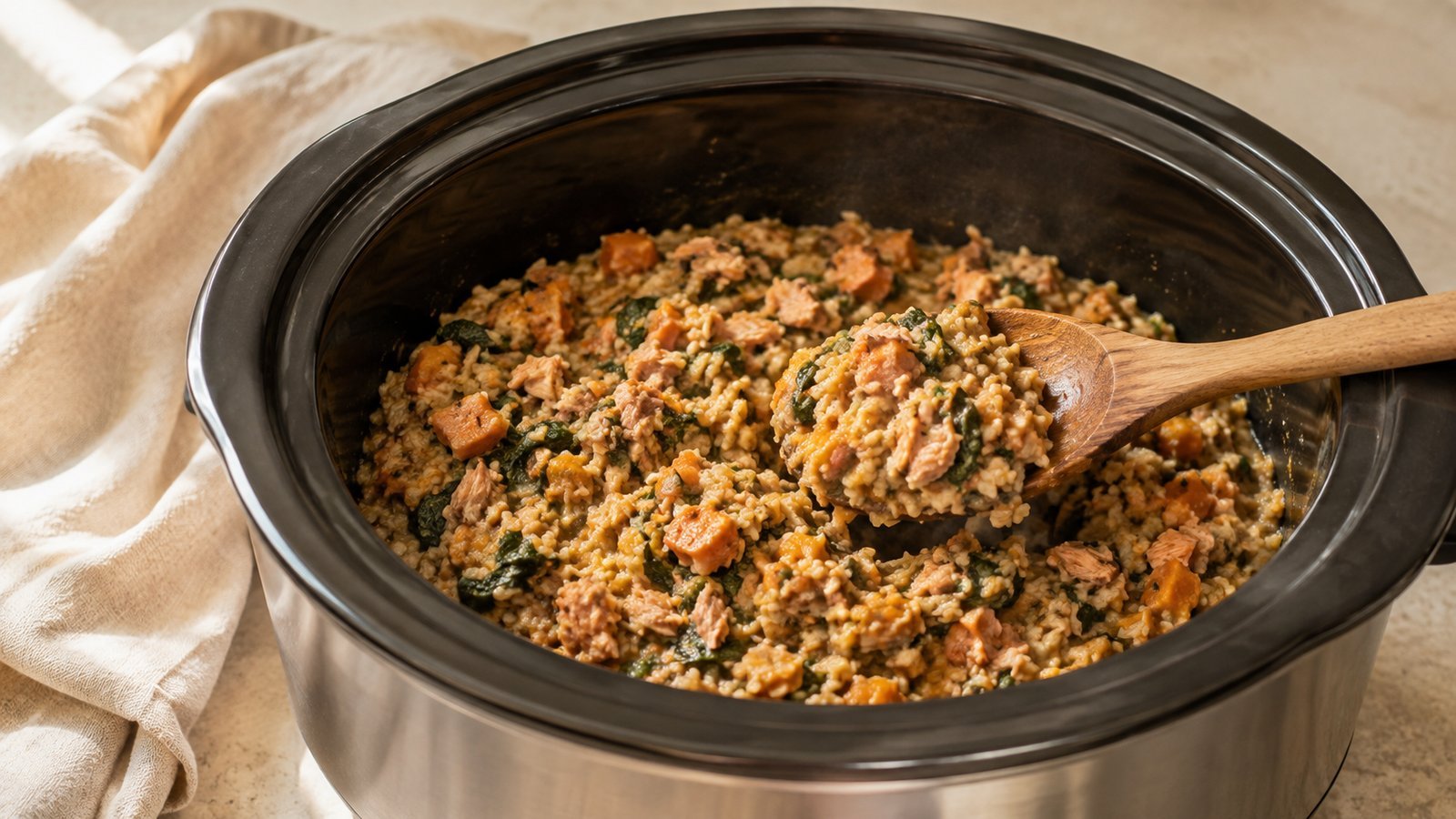
1. Slow Cooker Salmon, Sweet Potato & Spinach 🐟 Joint support
The flagship. Salmon delivers EPA and DHA — the omega-3s with actual trial data behind them — and the slow cooker turns it into something a dog with a sore mouth can eat without effort.
Ingredients
- 2 lb (900 g) boneless, skinless salmon fillet, cut into chunks
- 2 large sweet potatoes, peeled and cubed
- 2 cups spinach, roughly chopped
- 1 cup brown rice
- 3 cups water
- 1 tbsp olive oil
Method
- Add salmon, sweet potato and rice to the slow cooker with the water.
- Cook on LOW for 5 hours.
- Stir in the spinach for the final 20 minutes.
- Add the olive oil, stir through, and mash lightly to a soft, spoonable texture.
- Cool in shallow containers and refrigerate within two hours.
Add calcium: ≈2½ tsp ground eggshell powder, stirred through the cooled batch (≈5 lb finished).
Phosphorus note: Moderate. Fine for healthy seniors. Not appropriate for dogs on a renal diet without veterinary formulation.
Note on spinach: if your dog has a history of calcium oxalate bladder stones — common in older small breeds — swap the spinach for green beans or zucchini. Spinach is high in oxalate.
Why it helps aging joints: Salmon is one of the few whole foods that meaningfully contributes EPA and DHA. Pair with a measured fish oil dose if your dog is actively arthritic.
Storage: 4 days refrigerated, 2 months frozen in portions.
2. Crockpot Turkey, Pumpkin & Green-Lipped Mussel 🐟 Joint support
Lean protein, gut-friendly fibre, and the joint ingredient most owners have never heard of.
Ingredients
- 2 lb (900 g) ground turkey
- 1 can (15 oz) 100% pumpkin purée — not pie filling
- 2 cups green beans, chopped
- 1 cup oats
- 3 cups water
- Green-lipped mussel powder — dose per the product label, added after cooking
Method
- Brown the turkey briefly in a pan and drain, then add to the slow cooker with the pumpkin, green beans, oats and water.
- Cook on LOW for 4 hours.
- Cool, then stir in the green-lipped mussel powder.
Add calcium: ≈2¼ tsp ground eggshell powder across the batch (≈5 lb finished).
Phosphorus note: Moderate. Turkey is a moderate-phosphorus protein; pumpkin and green beans are low.
On the mussel powder: dose by the label against your dog’s weight, not by the teaspoon — powder densities vary too much between products for a spoon measure to mean anything. Add it to the cooled batch: commercial products are freeze-dried rather than heat-dried, so adding it cold is the cautious choice, though I haven’t found evidence establishing exactly how much cooking heat costs you.
Storage: 4 days refrigerated, 2 months frozen.
3. Crockpot Chicken, Rice & Carrot — for sensitive senior stomachs
The one to fall back on when your dog’s digestion is unhappy, or when you’re transitioning off kibble and want the gentlest possible landing.
Ingredients
- 2 lb (900 g) boneless, skinless chicken breast
- 1½ cups white rice
- 3 carrots, diced
- 4 cups water
- 1 tbsp olive oil
Method
- Everything except the oil goes into the slow cooker.
- Cook on LOW for 4 hours, until the chicken shreds with a fork.
- Shred the chicken, stir it back through, add the olive oil.
- Cool in shallow containers and refrigerate within two hours.
Add calcium: ≈2 tsp ground eggshell powder across the batch (≈4½ lb finished) — slightly under the ½ tsp/lb rule, because chicken breast and white rice are lower in phosphorus and the full dose would push the ratio too high.
Phosphorus note: Lower. White rice, carrot and chicken breast make this the mildest recipe on the list — but “lower” is not “renal-appropriate.” A prescribed kidney diet is still a different thing.
Storage: 4 days refrigerated, 2 months frozen.
Make it easier: This is the recipe to double. It freezes better than any other on the page.
4. Slow Cooker Beef & Barley with Blueberries
Richer, more calorie-dense — for the senior who needs to put condition back on.
Before you use this recipe: if your senior has lost weight or muscle without you cutting his food, see your vet first. Unexplained weight loss in an older dog is a clinical sign, not a feeding problem — kidney disease, dental pain, cancer, digestive disease and thyroid problems all present this way, and several of them make this exact recipe the wrong choice. Get bloodwork before you reach for more calories.
Ingredients
- 2 lb (900 g) lean ground beef (90/10 or leaner)
- 1 cup pearl barley
- 2 cups butternut squash, cubed
- 1 cup blueberries
- 4 cups water
Method
- Brown the beef and drain the fat. This is mainly for calorie control, which matters most in an arthritic dog. (You’ll often see fat described as a direct cause of pancreatitis; a 2026 JAVMA review found that link is weaker and more complicated than commonly stated. If your dog has a pancreatitis history, that’s a conversation with your vet rather than a rule of thumb.)
- Add beef, barley, squash and water to the slow cooker.
- Cook on LOW for 5 hours.
- Stir the blueberries through in the last 15 minutes.
- Cool in shallow containers and refrigerate within two hours.
Add calcium: ≈2 tsp ground eggshell powder across the batch — deliberately below the ½ tsp/lb rule. This recipe carries a lot of added water and comparatively low-phosphorus solids, so the standard dose would push it past the AAFCO 2:1 ceiling.
Phosphorus note: Higher per gram of protein. Skip this one entirely if kidney values have been flagged.
Storage: 4 days refrigerated, 2 months frozen.
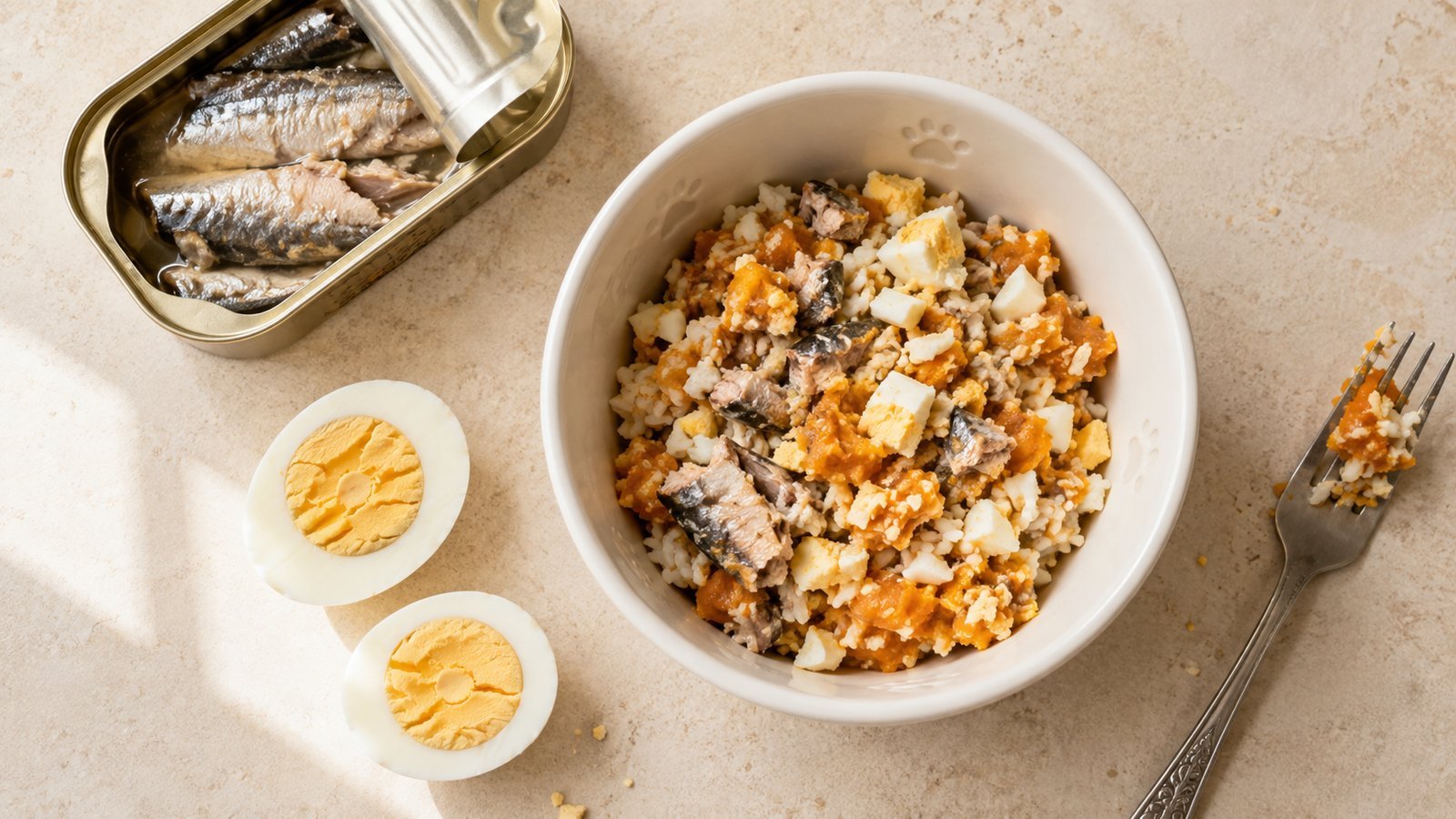
5. Sardine & Egg Mash — 5 minutes, no cooking 🐟 Joint support
The fastest omega-3 delivery on this page, and the one to make on the evening you have nothing left in you.
Ingredients
- 1 can (3.75 oz) sardines in water, no salt added
- 2 hard-boiled eggs, chopped
- ½ cup cooked white rice
- 2 tbsp plain pumpkin purée
Method
- Drain the sardines and mash them, soft bones included.
- Fold in the chopped egg, rice and pumpkin.
- Serve at room temperature.
Add calcium: the mashed sardine bones already supply roughly 380 mg of calcium — most of what this batch needs. It makes about ⅔ lb, so if you’re serving it as a full meal rather than a topper, add no more than a pinch, about ⅛ tsp, of ground eggshell. Don’t add a full ¼ tsp; you’d overshoot.
Phosphorus note: Higher. Sardines with bones plus egg yolk is a phosphorus-dense combination. Excellent for a healthy senior, wrong for a renal patient.
Why it helps aging joints: Sardines are one of the highest whole-food sources of EPA and DHA per gram. A small serving punches well above its size.
Storage: Make fresh. This one doesn’t hold.
Portion note: This is a single meal for a small-to-medium dog, or a topper for a larger one.
6. Stovetop Cod, Quinoa & Zucchini — light and easy to chew
For the senior carrying extra weight, or the dog who’s gone off richer food.
Ingredients
- 1½ lb (680 g) cod fillet
- 1 cup quinoa, rinsed well
- 2 zucchini, diced
- 2 tbsp olive oil
- 2 cups water
Method
- Cook the quinoa in the water until fluffy, about 15 minutes.
- Poach the cod in a separate pan until it flakes, about 8 minutes. Check carefully for bones.
- Add the zucchini to the quinoa for the last 5 minutes.
- Flake the cod through, add the oil, cool in shallow containers.
Add calcium: ≈1¾ tsp ground eggshell powder across the batch (≈3½ lb finished).
Phosphorus note: Lower to moderate. White fish and quinoa keep this on the lighter end.
Storage: 3 days refrigerated. Fish holds less well than meat.
Two notes: Rinse the quinoa until the water runs clear — the natural saponin coating is bitter, and more importantly it can irritate the gut and cause vomiting or loose stools, which is the last thing a sensitive senior needs. And don’t cut the olive oil: cod is extremely lean, and this recipe needs the fat to carry fat-soluble vitamins.
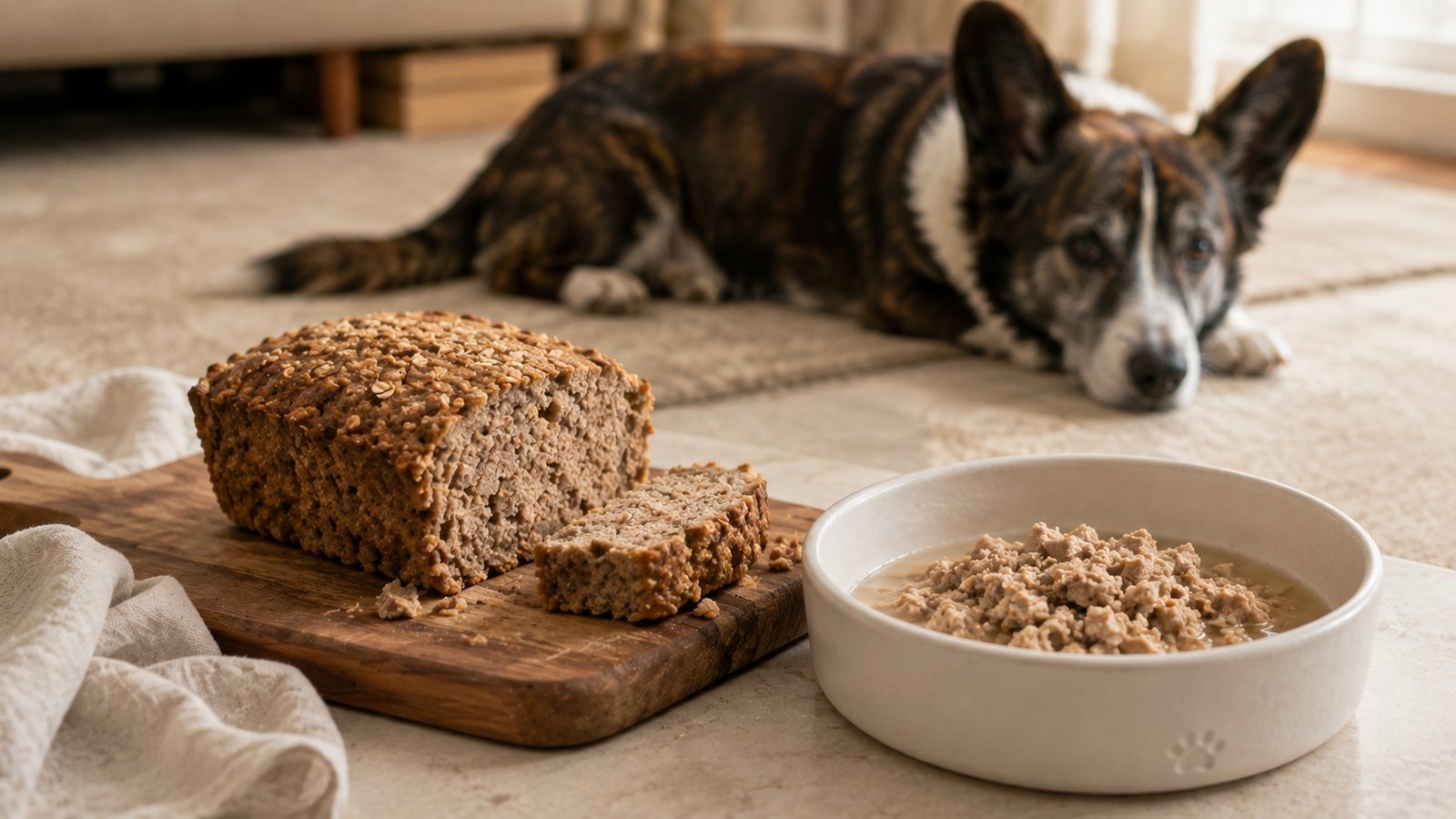
7. Baked Senior Turkey & Oat Loaf — for dogs with bad teeth
Bakes into a soft loaf that can be crumbled, mashed, or thinned with warm water into something a dog with almost no chewing ability can still eat with enthusiasm.
Ingredients
- 2 lb (900 g) ground turkey
- 1½ cups rolled oats
- 2 eggs
- 1 cup grated carrot
- ½ cup plain pumpkin purée
- ¼ cup water
Method
- Heat the oven to 350°F / 175°C.
- Mix everything thoroughly in a large bowl.
- Press into a loaf tin and bake 45–50 minutes, until firm and cooked through.
- Cool, then crumble or mash. Add warm water at serving to soften further.
Add calcium: ≈1½ tsp ground eggshell powder mixed into the raw mixture before baking (the loaf finishes at roughly 3 lb after water loss).
Phosphorus note: Moderate.
Storage: 4 days refrigerated. Slices freeze well individually — pull one out per day.
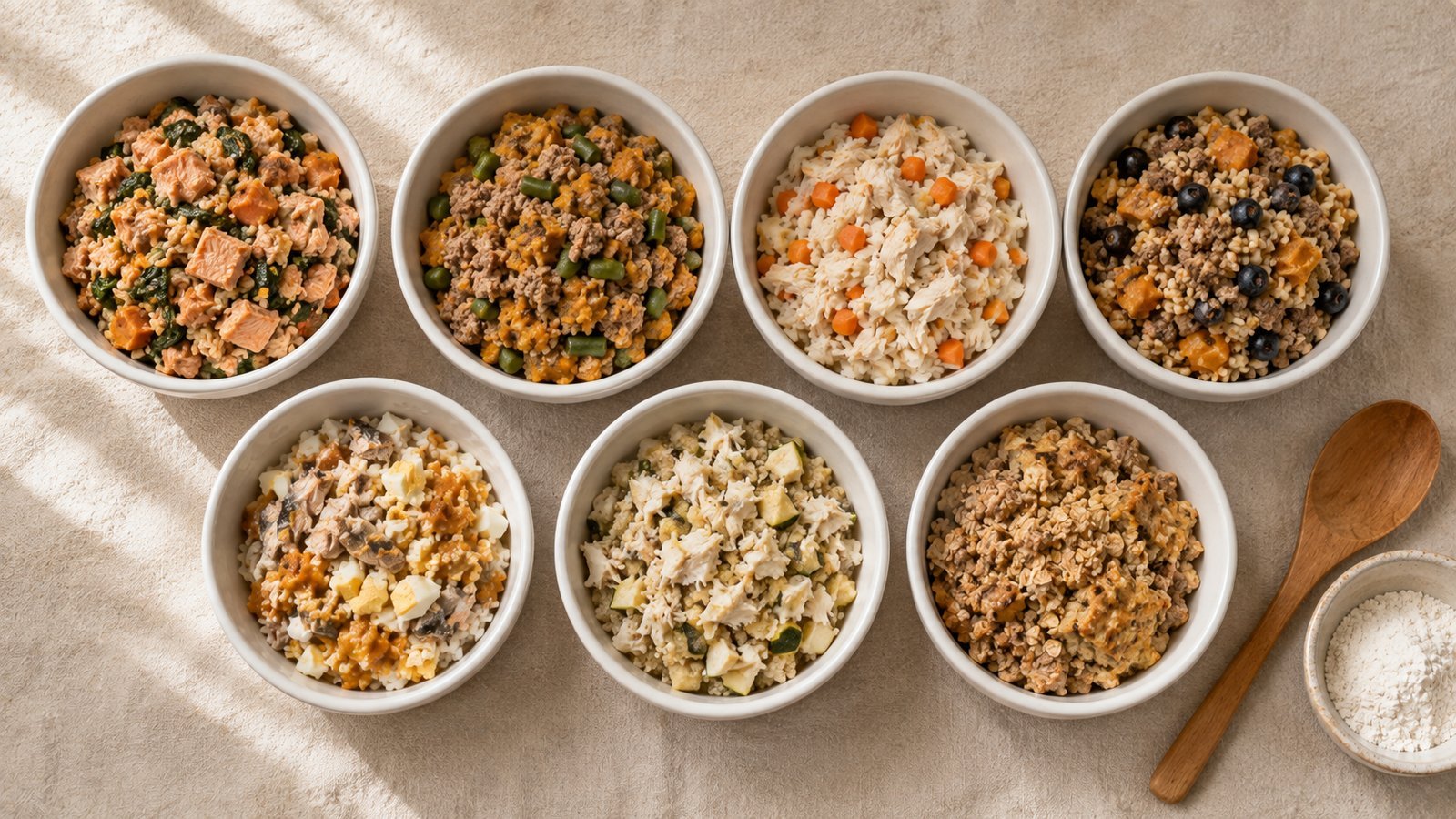
Which recipe for which senior dog
| If your dog… | Start with | Why |
|---|---|---|
| Has diagnosed arthritis | #1 Salmon, #5 Sardine | Highest whole-food EPA/DHA |
| Has a sensitive stomach | #3 Chicken & Rice | Simplest ingredient list on the page |
| Has bad teeth or few teeth | #7 Turkey & Oat Loaf | Mashes to a paste with warm water |
| Is overweight | #6 Cod & Quinoa | Lightest, lowest calorie density |
| Has lost condition unexpectedly | Vet first, then #4 | Unexplained weight loss is a clinical sign, not a feeding problem |
| Has flagged kidney values | None as written | Needs veterinary formulation — ask for a nutritionist referral |
| Has had calcium oxalate stones | Any except #1 as written | Swap the spinach out of #1 |
| Is a small senior (under 20 lb) | #5 as a meal, #3 as a base | Small dogs are hardest to portion correctly |
A note on homemade dog food recipes for small senior dogs: small breeds live longer and spend more years in the “senior” bracket. They’re also the easiest to get wrong in both directions — easy to overfeed on calorie-dense food, easy to underfeed on watery slow-cooker food. Use the RER calculation in Rule 3 rather than eyeballing it, and weigh the portion.
Foods to keep out of every recipe
Non-negotiable, at any age:
- Onions and garlic — including powdered forms in stock or seasoning
- Grapes and raisins — kidney failure risk, no established safe dose
- Xylitol / birch sugar — check any peanut butter label
- Macadamia nuts
- Cooked bones — poultry, chop and rib bones splinter, and cooking makes them worse. Canned sardine bones are the one exception: the canning process pressure-cooks them until they crush between your fingers. If a bone doesn’t crush that easily, it doesn’t go in the bowl.
- Salt, stock cubes, seasoning — a single stock cube can push sodium well past safe
- Fatty trimmings — worth avoiding for calorie control regardless
The full list is here: Foods Dogs Can Eat and Can’t.
Frequently asked questions
Can I feed these recipes as my dog’s only food? Only with the calcium as written plus a balancing supplement or a formulation service to close the zinc, iodine, vitamin E and vitamin D gaps — a general multivitamin isn’t enough. Otherwise, keep them under about 10% of daily calories as a topper, with the calcium left out. If you’d rather buy than cook, our senior dog food buying guide compares the options.
How much should I feed? Use the calorie calculation in Rule 3, not the 2–3% body weight rule you’ll see elsewhere. These recipes are much wetter than raw food and 2–3% will underfeed most dogs on this page.
Can I skip the calcium if I add cheese or yogurt? No. Dairy contributes calcium but also phosphorus, so it doesn’t fix the ratio. Use the eggshell or the calcium carbonate powder.
Can I add extra calcium to be safe? No — and this is the mistake people make after reading the first half of this article. Excess calcium interferes with zinc and copper absorption and pushes the ratio past the AAFCO ceiling. Use the number in each recipe.
My senior has kidney disease. Can I just use less meat? No. A therapeutic renal diet controls phosphorus, protein quality and sodium simultaneously at specific levels. Ask your vet for a veterinary nutritionist referral.
How long until I see a difference in his joints? In the trial referenced above, measurable improvement appeared around day 42 and continued through day 84. Give it six weeks minimum before you judge.
Can I use the same recipes for a younger dog? Yes — these are adult maintenance recipes with senior-friendly texture. Not suitable for puppies, whose calcium and phosphorus requirements are much tighter. For general adult recipes see our 6 homemade dog food meals.
Is home cooking more expensive? It can be, but it doesn’t have to be — we broke down the actual per-serving costs in cheap homemade dog food.
The bottom line
Homemade senior dog food works when you treat it as a system rather than a recipe: calcium in every batch and not a gram more, portions by calories rather than body weight, a phosphorus decision made deliberately, and marine omega-3 dosed by EPA+DHA if the joints are why you’re here.
And it works honestly when you accept what it doesn’t do. These recipes are excellent food. They are not, on their own, a complete diet — and any page that tells you otherwise is selling you something.
Nuggy gets the chicken and rice one on days her stomach is unimpressed with life, and it’s the recipe we’d hand a nervous first-timer too — hardest to get wrong, easiest to freeze.
Cook one crockpot batch this Sunday. Feed it as a topper for two weeks while you sort out the balancing side. Watch how your dog gets up off the floor — and if he’s genuinely struggling to rise, get that checked rather than assuming it’s just arthritis.
For everything else on keeping an older dog comfortable, our dog health care checklist covers the rest of the routine.
These recipes are for general information and are not a substitute for veterinary advice. Talk to your vet before changing your dog’s diet, especially if they have a diagnosed health condition.
As an Amazon Associate we earn from qualifying purchases.