
Some links below are Amazon affiliate links — we earn a small commission if you buy, at no extra cost to you.
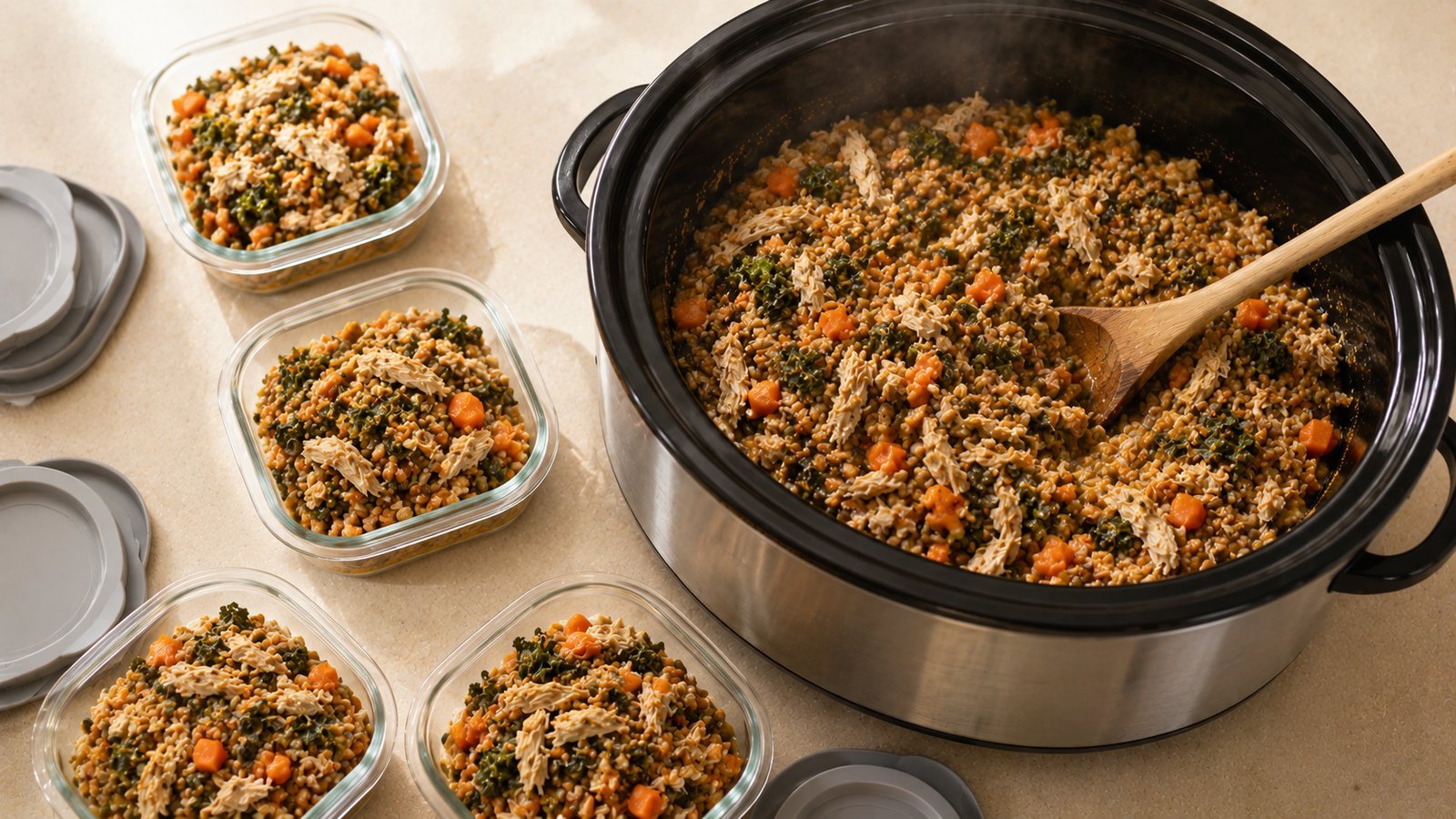
Crockpot dog food is the only version of home cooking for a dog that survives contact with a real week. You load it on Sunday, you walk away, and by evening you have four days of meals. Every other method asks you to cook again on Wednesday, and Wednesday is when people quit.
But a slow cooker full of dog food isn’t the same job as a slow cooker full of chili, and most crockpot dog food posts just hand you a recipe and wish you luck.
Here’s what’s on this page:
- 6 crockpot dog food recipes built for batch cooking, with yields and how many days each one actually feeds
- The 4 slow-cooker rules that are different when you’re cooking for a dog — including the one that sends people to the emergency vet
- The batch math: what a 7-quart crockpot produces, what it costs per day, and how to freeze it properly
- What should never go in the pot, which is a longer list than you’d think
Why the crockpot is the right tool for this
Three reasons, and none of them are “it tastes better.”
It’s the only method that scales. A 7-quart slow cooker holds enough to feed a 40 lb dog for roughly four days. You cannot batch-cook that on a stovetop without standing over it.
It handles cheap cuts. Chicken thighs, pork shoulder, beef heart — the cuts that are half the price of breast meat are exactly the ones that need long, slow, moist heat. That’s the whole point of the appliance, and it’s why crockpot cooking is where home-prepared dog food stops being more expensive than kibble. We broke the actual numbers down in cheap homemade dog food.
It produces the texture older and fussier dogs want. Everything comes out soft and mashable. No extra step.
If you don’t own one, a 7-quart slow cooker is the size that makes this worth doing — smaller ones mean you’re cooking twice a week, which puts you back where you started.
Before anything else: what these recipes are and aren’t
Same honesty I put at the top of every recipe article here, because it matters more than any recipe below.
These are not complete and balanced diets. In 2013, UC Davis researchers evaluated 200 homemade dog food recipes from 34 sources and found 95% were deficient in at least one essential nutrient, with more than 83% short on several. The usual gaps are choline, vitamin D, zinc and vitamin E.
(Stockman J, Fascetti AJ, Kass PH, Larsen JA. JAVMA 2013;242(11):1500–1505.)
And a general pet multivitamin does not fix that — veterinary nutritionists are explicit that off-the-shelf supplements aren’t formulated against a specific recipe, because they can’t know what’s in your pot. Closing those gaps properly takes a veterinary balancing supplement matched to the recipe, a formulation service like BalanceIT, or a consult with a board-certified veterinary nutritionist (ACVN).
So use these two ways: as a topper under about 10% of daily calories (leave the calcium out — your dog’s complete food already supplies it), or as the whole diet with the calcium as written plus proper balancing. The middle option — half kibble, half homemade, calcium added, hoping it averages — is the one that quietly goes wrong.
A senior or adult multivitamin is fine as everyday support alongside a complete diet. It is not a balancing supplement. Different jobs.
The 4 slow-cooker rules that change when you cook for a dog
Rule 1: Thaw the meat first. Always.
USDA guidance on slow cookers is unambiguous: always thaw meat or poultry before putting it into a slow cooker. Frozen meat keeps the contents in the bacterial “danger zone” — above 40°F and below 140°F — for far longer than is safe, because the cooker has to melt several pounds of ice before it starts cooking anything.
This is the rule people break most often, because dumping frozen chicken in the pot is exactly what makes it convenient. Don’t.
Cook until poultry reaches 165°F internally and ground meat reaches 160°F. A slow cooker on LOW runs roughly 170–280°F depending on setting, so four hours on LOW comfortably clears both — but check with a thermometer the first time you run a new recipe, not the tenth.
Rule 2: Every batch gets calcium — and not more than it needs
Meat is loaded with phosphorus and almost devoid of calcium. Cook a meat-based diet without added calcium and you invert the calcium-to-phosphorus ratio, which over months to years pulls calcium out of the skeleton.
The AAFCO range for adult dogs is a calcium-to-phosphorus ratio between 1:1 and 2:1, with the optimum around 1.2–1.4:1.
Target roughly 900–1,000 mg of elemental calcium per pound (450 g) of finished food.
- Ground eggshell — free. Rinse, bake at 300°F/150°C for 10 minutes, grind to fine powder. 1 level teaspoon ≈ 2,000 mg calcium, so about ½ teaspoon per pound of finished food.
- Calcium carbonate powder — more consistent, easier to measure to a stated elemental figure.
A crockpot-specific catch: slow-cooked recipes carry a lot of added water, which inflates the finished weight without adding any phosphorus. Apply ½ tsp/lb blindly to a very watery batch and you overshoot the 2:1 ceiling — and excess calcium interferes with zinc and copper absorption. Each recipe below states its own figure. Use that, not the general rule.
Rule 3: Cool it fast, in shallow containers
A 5-pound pot of hot dog food left on the counter to “cool completely” spends hours in the danger zone. Divide it into shallow containers and refrigerate within two hours.
And don’t use the WARM setting as storage. It’s for holding food you’re about to serve, not for parking dinner all afternoon.
Rule 4: Never slow-cook a human recipe without checking it first
This is the one that ends badly. Most human crockpot recipes start with onion and garlic, and both are genuinely toxic to dogs — they damage red blood cells, and the effect is cumulative rather than needing one big dose. Onions and garlic are both worth reading properly if you’ve been sharing stew.
Stock cubes and broths are the sneaky version — most contain onion powder, and a single cube can push sodium well past safe. Use plain water.
Crockpot dog food: the 6 recipes
Every one is built for a 7-quart cooker. If yours is 6-quart, scale down by about 15%.
Cook everything thoroughly, cool in shallow containers within two hours, and no onions, garlic, grapes, raisins, xylitol, macadamia nuts, or cooked bones — ever. If you’re unsure about an ingredient, our safe human foods guide is the place to check.
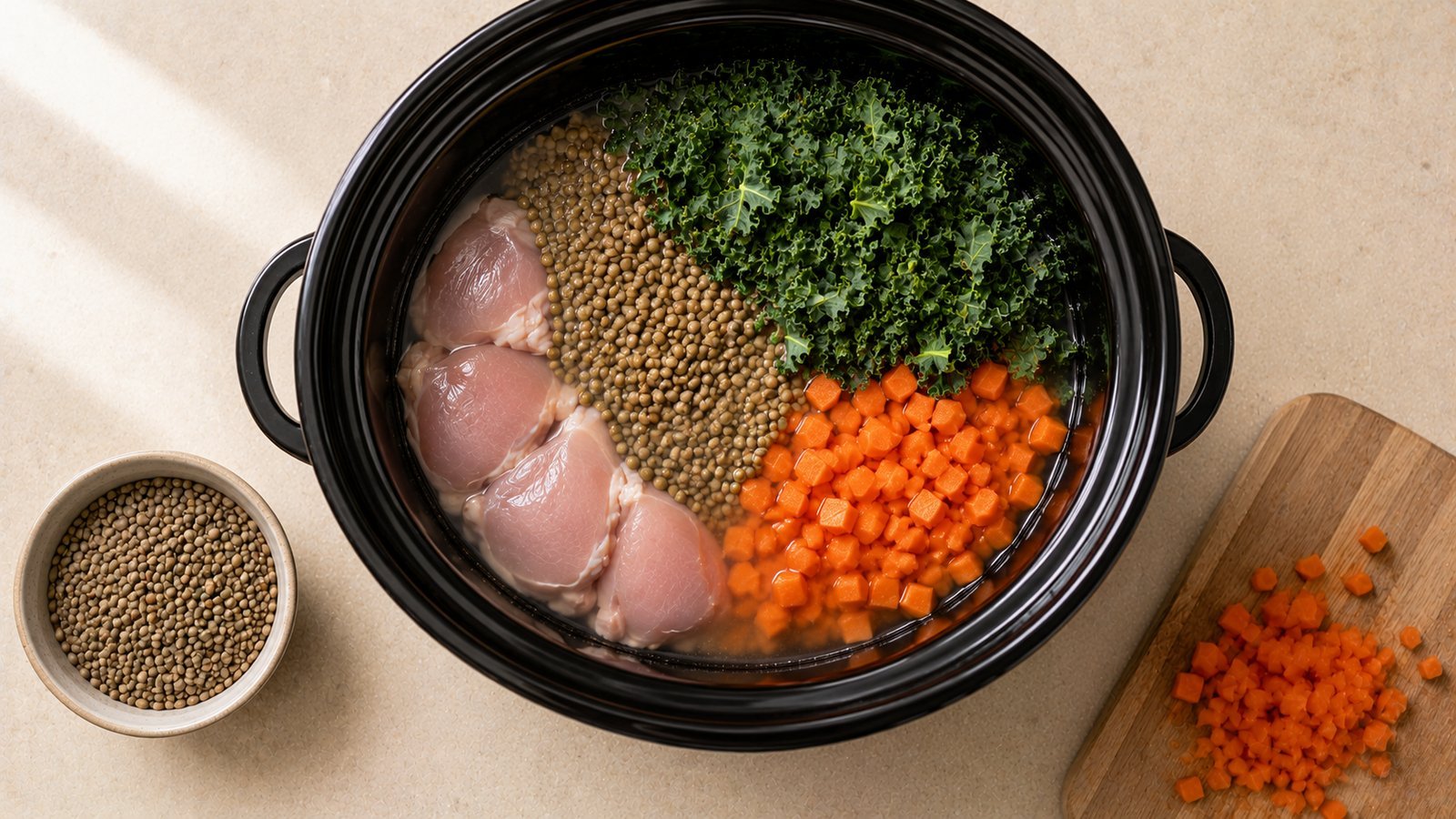
1. Chicken Thigh, Lentil & Kale
The cheapest complete-protein batch on the page. Thighs cost roughly half what breast does and slow-cook far better.
Ingredients
- 3 lb boneless, skinless chicken thighs, thawed
- 1½ cups dried green or brown lentils, rinsed
- 3 cups kale, stems removed, roughly chopped
- 2 carrots, diced
- 5 cups water
- 1 tbsp olive oil
Method
- Chicken, lentils, carrots and water into the cooker.
- LOW for 5 hours, until the lentils are soft and the chicken shreds.
- Stir the kale in for the last 20 minutes.
- Shred the chicken through, add the oil, mash lightly.
- Cool in shallow containers, refrigerate within two hours.
Add calcium: ≈3 tsp ground eggshell (≈6 lb finished). Yield: ~6 lb — roughly 4 days for a 40 lb dog fed as a full diet. Note: Introduce lentils gradually. They’re a good cheap protein but gassy if you go from none to lots overnight.
2. Pork Shoulder & Butternut Squash
Pork is under-used in homemade dog food and shoulder is one of the best-value cuts in the shop.
Ingredients
- 3 lb boneless pork shoulder, thawed, trimmed of the big fat cap
- 4 cups butternut squash, cubed
- 1 cup brown rice
- 2 cups green beans
- 5 cups water
Method
- Trim the fat properly — pork shoulder carries a lot, and a very rich batch is a bad idea for any dog with a sensitive gut.
- Pork, squash, rice and water in. LOW for 6 hours.
- Add green beans for the final 30 minutes.
- Shred the pork, skim any fat pooled on top, stir through.
- Cool in shallow containers.
Add calcium: ≈3 tsp ground eggshell (≈6½ lb finished). Yield: ~6½ lb — about 4–5 days for a 40 lb dog. Skip if: your dog has a pancreatitis history. Even trimmed, this is the richest recipe here.
3. The One-Pot Whole Chicken
The actual batch-cooking hack, and the cheapest way to do this if you buy a whole bird.
Ingredients
- 1 whole chicken (4–5 lb), thawed, giblets removed
- 2 cups white rice
- 3 carrots, diced
- 2 cups peas
- 6 cups water
Method
- Whole chicken and water into the cooker. LOW for 6 hours.
- Lift the bird out and let it cool enough to handle.
- Strip every scrap of meat off and discard every single bone. Cooked bones splinter — this is not a step to rush, and it’s not a step to do while distracted.
- Return the meat to the pot with the rice, carrots and peas. LOW for another hour.
- Cool in shallow containers.
Add calcium: ≈3½ tsp ground eggshell (≈7 lb finished). Yield: ~7 lb — about 5 days for a 40 lb dog. Why bother: a whole chicken is usually the cheapest chicken per pound you can buy, and the cooking liquid becomes part of the meal instead of going down the sink.
4. Beef Heart & Quinoa
Organ meat, but the approachable one. Heart is muscle, not offal — it behaves like lean beef, costs a fraction of steak, and is dense in taurine and B vitamins.
Ingredients
- 2½ lb beef heart, trimmed and cubed
- 1½ cups quinoa, rinsed well
- 3 cups zucchini, diced
- 2 cups spinach
- 5 cups water
Method
- Trim the heart — cut away the tough outer membrane and any large vessels.
- Heart, quinoa and water in. LOW for 5 hours.
- Zucchini for the last 45 minutes, spinach for the last 15.
- Cool in shallow containers.
Add calcium: ≈2½ tsp ground eggshell (≈5½ lb finished) — below the ½ tsp/lb rule, because this batch runs high on water relative to its phosphorus load. Yield: ~5½ lb — about 3–4 days for a 40 lb dog. Rinse the quinoa until the water runs clear. The saponin coating is bitter and can irritate the gut. Note on spinach: if your dog has had calcium oxalate bladder stones, swap it for more zucchini.
5. Turkey, Chickpea & Pumpkin
The gentlest recipe here, and the one to start with if you’re transitioning off kibble.
Ingredients
- 3 lb ground turkey
- 1 can (15 oz) 100% pumpkin purée — not pie filling
- 1½ cups chickpeas, cooked or canned and rinsed
- 2 cups oats
- 4 cups water
Method
- Brown the turkey in a pan and drain, then into the cooker with everything else.
- LOW for 4 hours.
- Cool in shallow containers.
Add calcium: ≈2¾ tsp ground eggshell (≈6 lb finished). Yield: ~6 lb — about 4 days for a 40 lb dog. Rinse canned chickpeas properly — the canning liquid is salty. Best for: sensitive stomachs, or dogs coming off a bout of digestive trouble.
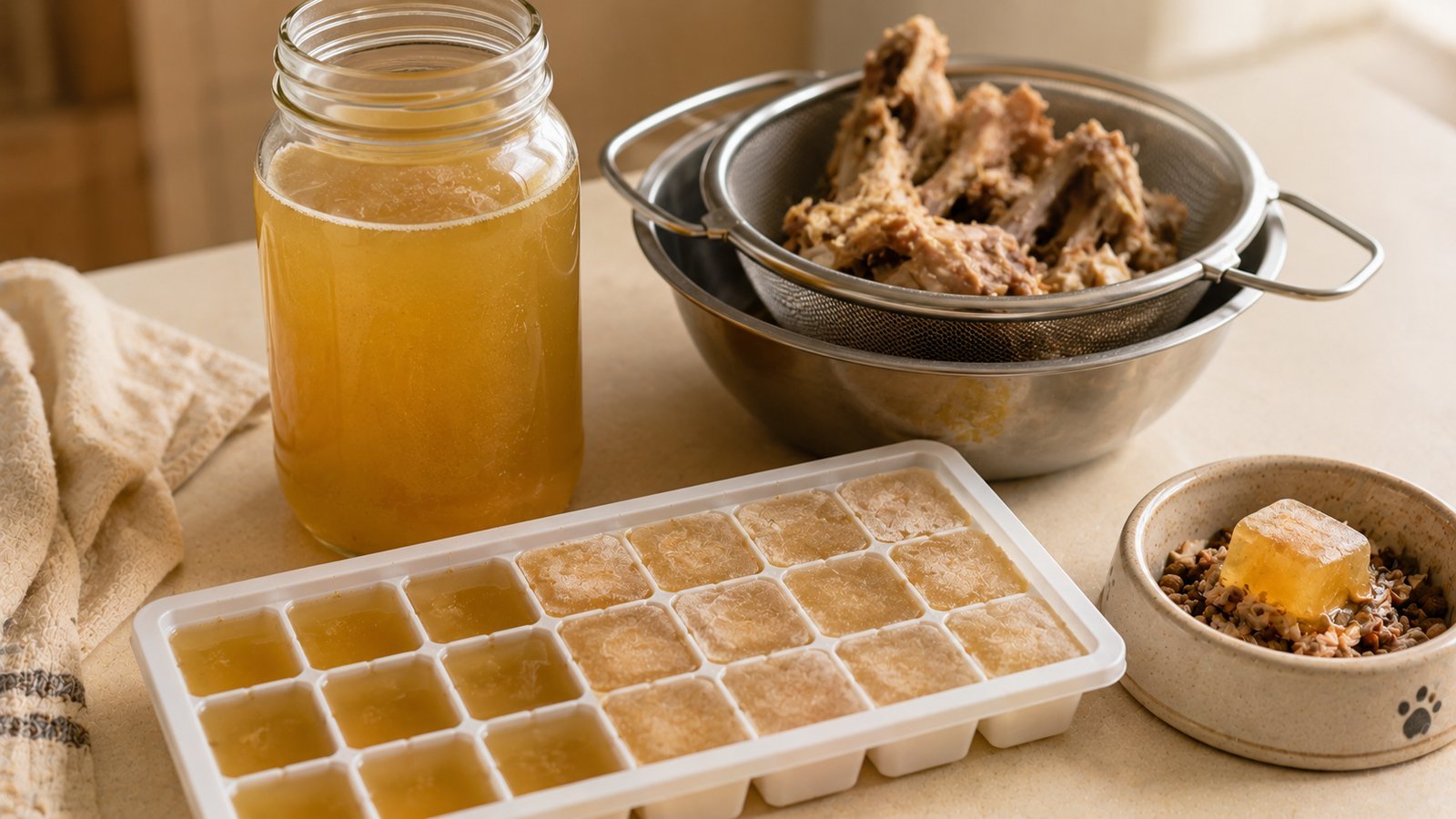
6. Crockpot Bone Broth (a topper, not a meal)
The one thing a slow cooker does that nothing else does as well. This isn’t dinner — it’s what you pour over dinner when your dog has gone off their food.
Ingredients
- 3–4 lb raw beef marrow bones or chicken frames
- Water to cover by 2 inches
- 2 tbsp apple cider vinegar (helps draw minerals out of the bone)
Method
- Bones, water and vinegar into the cooker.
- LOW for 24 hours. Yes, really — this is the one recipe where long actually matters.
- Strain through a sieve. Discard every bone. After 24 hours they’re soft and crumbly, which makes them more dangerous, not less — soft cooked bone fragments are still cooked bone.
- Chill overnight. Skim the solid fat cap off the top and discard it.
- Freeze in an ice cube tray. One or two cubes over a meal.
No calcium needed — this is a topper, not a meal, and it isn’t nutritionally complete. Yield: ~3 quarts of broth. Watch the sodium: homemade only. Shop-bought stock is not a substitute — almost all of it contains onion.
The batch math
The honest reason to do this is that batch cooking is the only version that lasts more than three weeks.
What a 7-quart cooker produces: 5½–7 lb of finished food per batch, depending on recipe.
How long that feeds a dog, fed as a full diet:
| Dog weight | Rough daily need | Days per 6 lb batch |
|---|---|---|
| 15 lb | ~10–12 oz | 8–9 days |
| 30 lb | ~1¼ lb | 4–5 days |
| 40 lb | ~1½ lb | 4 days |
| 60 lb | ~2 lb | 3 days |
| 80 lb | ~2½ lb | 2–3 days |
Portion properly, not by eye. Work out your dog’s actual requirement: resting need = 70 × (body weight in kg)^0.75, then multiply by 1.2–1.6 depending on activity. Then adjust by body condition — ribs findable under a thin covering without pressing.
Don’t use the “2–3% of body weight” rule you’ll see everywhere. That comes from raw feeding, where food runs 1.5–2 kcal per gram. These crockpot recipes carry several cups of added water and run closer to 0.9–1.4 kcal per gram, so 2–3% will underfeed most dogs — some of them badly.
Freezing:
- 3–4 days in the fridge, up to 2 months in the freezer.
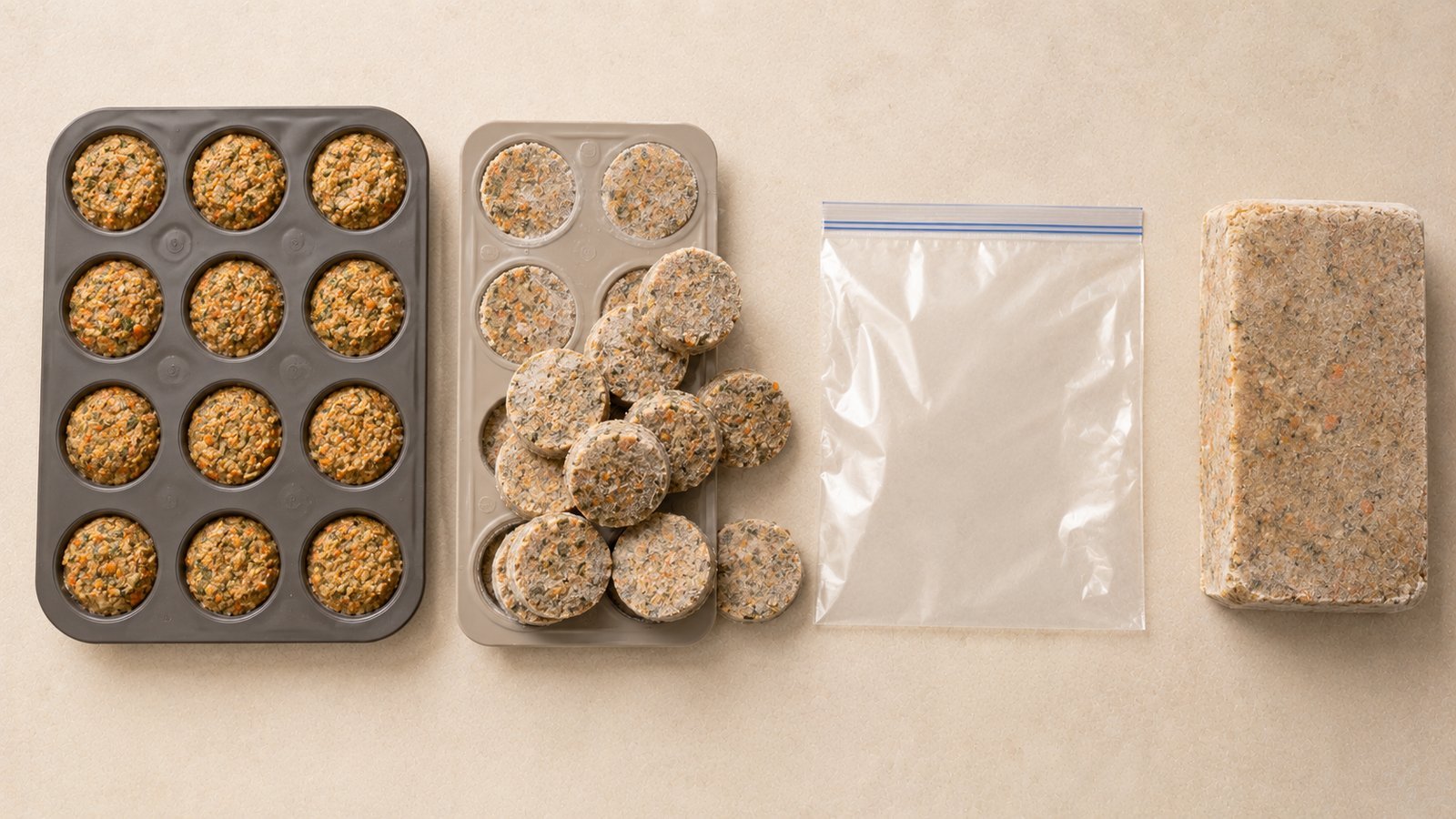
- Freeze in daily portions, not one giant block. A 6 lb brick is useless on a Tuesday morning.
- Silicone muffin trays are the cheapest portioning trick — freeze, pop out, bag the pucks.
- Thaw overnight in the fridge, never on the counter.
What should never go in the pot
- Onions and garlic — including any stock cube, broth or seasoning blend containing them
- Grapes and raisins — kidney failure risk, no established safe dose
- Xylitol / birch sugar
- Macadamia nuts
- Cooked bones of any kind — including the 24-hour broth bones, which crumble but are still cooked bone
- Salt, stock cubes, seasoning — a single cube can push sodium past safe
- Frozen meat — see Rule 1
- Large amounts of fat — trim it, and skim what pools on top
- Raw dough or anything with yeast
Full list: Foods Dogs Can Eat and Can’t.
Frequently asked questions
Can I put frozen chicken straight in the crockpot? No. USDA guidance is explicit: thaw first. Frozen meat holds the pot in the bacterial danger zone (40–140°F) far too long while it melts.
How long does crockpot dog food keep? 3–4 days refrigerated, up to 2 months frozen in portions. Cool in shallow containers and refrigerate within two hours of cooking.
Can I leave it on WARM all day? No. WARM holds food you’re about to serve; it isn’t storage. Cool and refrigerate.
Do I really have to add calcium? If it’s the whole diet, yes — meat is phosphorus-heavy and calcium-poor, and the ratio matters. If you’re using it as a topper alongside complete food, leave the calcium out entirely.
Can I use the same batch for two dogs of different sizes? Yes — same food, different portions, calculated separately. Feed them apart if either one guards food.
Is crockpot dog food cheaper than kibble? It can be, if you use cheap cuts and buy in bulk — chicken thighs, pork shoulder, whole chickens, beef heart. It stops being cheaper the moment you start with breast meat. The full cost breakdown is in cheap homemade dog food.
What about recipes for a specific need? For general adult recipes, see our 6 homemade dog food meals. For the rest of the routine, the dog health care checklist covers what else to keep an eye on.
The bottom line
Crockpot dog food works because it removes the reason people quit: cooking on a Wednesday. One session, four days of food, cheap cuts that would be inedible any other way.
Just remember the three things that make it different from cooking for yourself: thaw the meat, add the calcium the recipe specifies and no more, and cool it fast in shallow containers. And check every human recipe for onion before you adapt it.
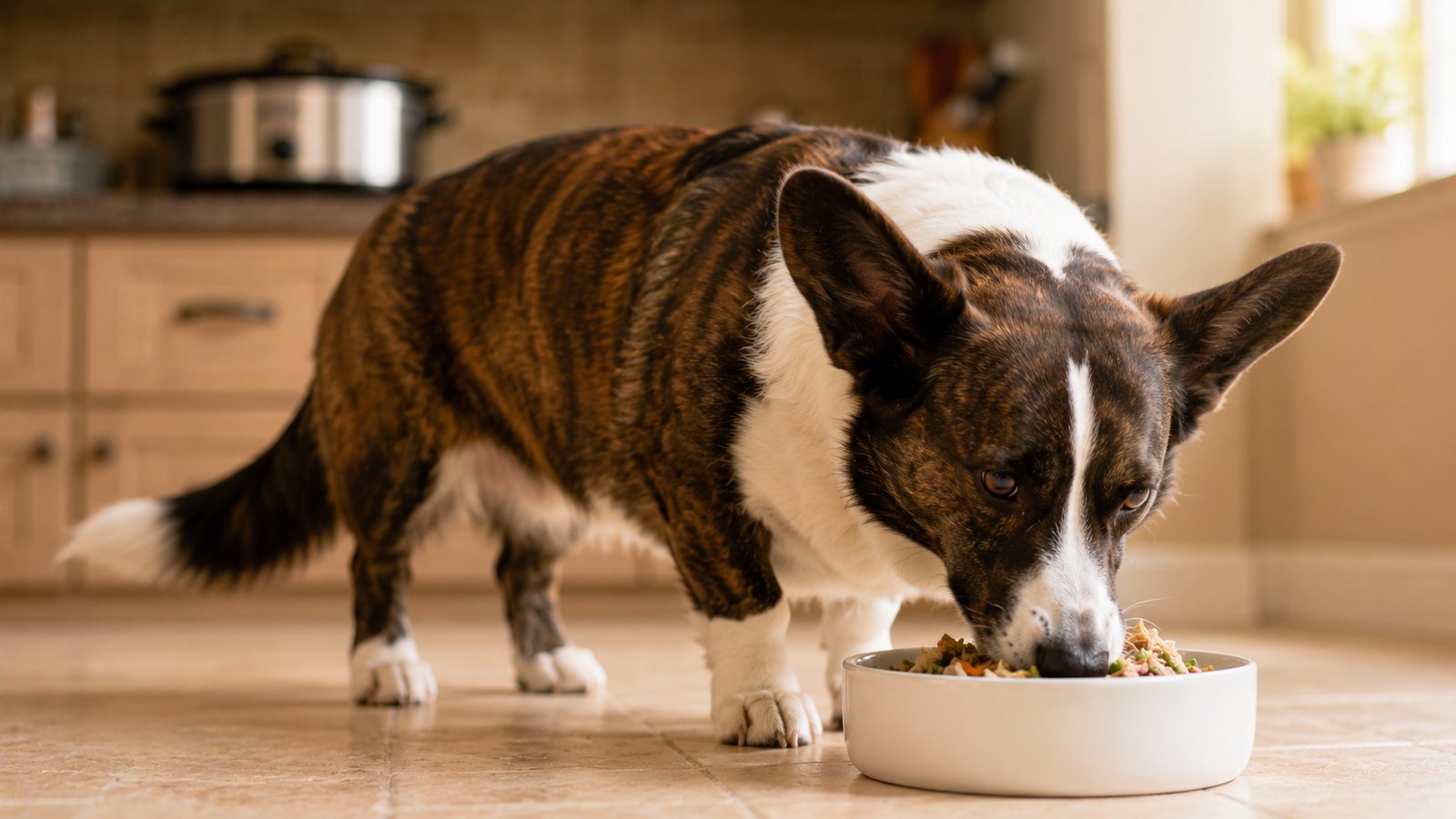
Nuggy’s favourite is the whole-chicken one, mostly because she stands under the counter for the twenty minutes it takes to strip the bird. Which batch is your dog going to campaign for?
This article is general information, not veterinary advice. Talk to your vet before changing your dog’s diet, especially if they have a diagnosed health condition.
As an Amazon Associate we earn from qualifying purchases.