
This post contains affiliate links. I may earn a small commission if you buy through them, at no extra cost to you.
When Nuggy was about eight months old, he sliced his paw pad on a piece of glass during a walk. It bled a lot, he was limping, and I had absolutely nothing useful in the house. We made it to the vet fine — but the 40-minute wait in the car while my partner drove was not something I wanted to repeat.
That week I put together a proper dog first aid kit. Here’s exactly what’s in it, what each item is for, and the situations where you use it versus call the vet immediately.
Why Every Dog Owner Needs a First Aid Kit
Dogs are curious, energetic, and not great at risk assessment. Cuts, scrapes, insect stings, minor burns, eye irritation, choking near-misses, and accidental toxic ingestion all happen — most with no warning.
A first aid kit won’t replace veterinary care for serious incidents, but it will:
- Help you stabilise a situation until you can get to the vet
- Handle minor injuries that don’t need professional attention
- Give you something to do (instead of nothing) during a frightening moment, which helps both you and your dog
The Simplest Option: A Pre-Built Kit
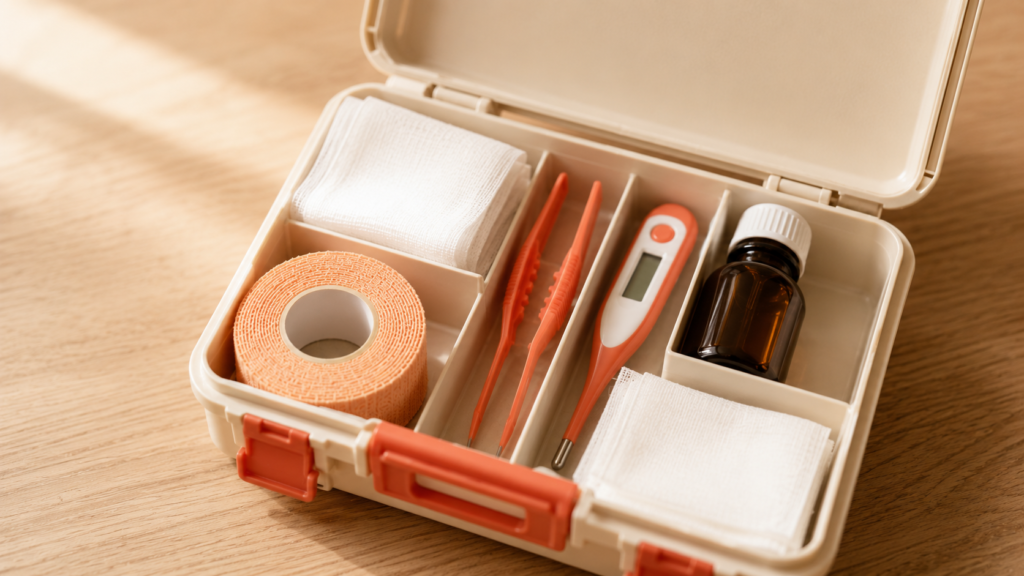
If you want everything sorted in one purchase, the ARCA PET Dog First Aid Kit covers the essentials in a compact, well-organised case. It’s what we keep at home and what I’d recommend to anyone who doesn’t want to assemble a kit from scratch. 4.8★, 1,000+ bought monthly — it includes bandaging supplies, antiseptic, tweezers, a digital thermometer, and a basic care guide.
That said, understanding what’s in your kit and why matters more than the kit itself. Here’s the full breakdown.
What to Include in a Dog First Aid Kit
Wound Care
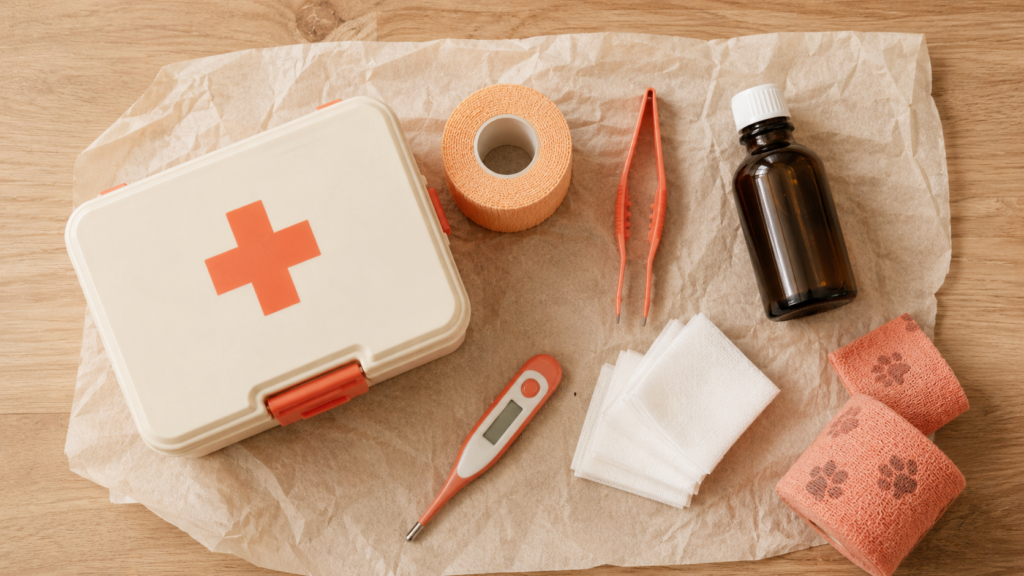
Sterile gauze pads (various sizes) — for covering wounds, applying pressure to stop bleeding, and padding under bandages. Non-stick pads are better for raw wounds.
Self-adhesive bandage wrap (vet wrap / Coban) — sticks to itself but not to fur or skin. Essential for wrapping a paw, leg, or body wound to keep it clean until you reach the vet.
Medical tape — for securing gauze pads that won’t stay on their own.
Blunt-nosed scissors — to cut bandaging material around fur without accidentally cutting skin.
Styptic powder — stops bleeding from minor cuts and nail-trimming accidents. Apply directly and hold for 30 seconds. Cornstarch is an emergency substitute.
Antiseptic solution (chlorhexidine or diluted betadine) — for cleaning minor wounds before bandaging. Do not use hydrogen peroxide on dog wounds — it damages tissue and delays healing.
Tools
Tweezers — for removing visible splinters, thorns, or visible tick bodies. For ticks: use tick-specific removal tweezers and grip as close to the skin as possible, pulling steadily without twisting.
Digital rectal thermometer — the only reliable way to take a dog’s temperature at home. Normal dog temperature: 38–39.2°C. Above 39.5°C = fever; above 40.5°C = emergency.
Saline eye wash — for flushing debris, dust, or chemicals from eyes. Do not use contact lens solution. Single-use sterile saline pods are ideal.
Torch / pen light — for looking inside the mouth, checking pupils, or examining wounds in poor light.
Disposable gloves — protect you from blood, vomit, and any substances your dog has encountered. Also useful if you’re assessing an injured, potentially pain-reactive dog.
Syringe (without needle, 10–20ml) — for flushing wounds with saline, or administering liquid medication orally.
Medications (check with your vet before using)
Antihistamine (e.g. diphenhydramine / Benadryl) — for mild allergic reactions to insect stings. Always confirm the correct dose with your vet for your dog’s weight before you need it — not all antihistamines are safe for dogs and some contain xylitol. Keep the appropriate dose written inside the kit.
Activated charcoal — sometimes recommended by poison control hotlines for certain toxic ingestions to reduce absorption. Only use if directed by a vet or poison control — not a general antidote, and harmful in some cases.Keep it in the kit, use only on instruction.
Do NOT keep: ibuprofen, paracetamol/acetaminophen, or aspirin. All are toxic to dogs.
Information
Your vet’s number and emergency vet number — written on a card inside the kit. Don’t rely on finding it on your phone in a panic.
ASPCA Animal Poison Control: 1-888-426-4435
Pet Poison Helpline: 1-855-764-7661
Your dog’s vaccination records and microchip number — a photo on your phone is enough.
How to Handle Common Dog Emergencies
Bleeding wound (paw, cut, scrape)
- Apply gentle pressure with a clean gauze pad for 3–5 minutes
- If bleeding slows: clean with diluted antiseptic, apply non-stick pad, wrap with vet wrap
- If bleeding is heavy or doesn’t slow in 10 minutes: go to emergency vet with the wound bandaged
Paw pad cuts bleed a lot — more than you’d expect for the size of the wound. Don’t panic; apply pressure and keep pressure on.
Toxic ingestion (grapes, onions, chocolate, xylitol, unknown substance)
- Don’t induce vomiting without vet instruction — makes some situations worse
- Call ASPCA Poison Control (1-888-426-4435) or your vet immediately
- Have ready: what was eaten, approximately how much, your dog’s weight
- Follow their specific instructions — they’ll tell you exactly what to do
For specific toxic foods, see our guides on Can Dogs Eat Grapes?, Can Dogs Eat Onions?, and our complete foods safety guide.
Choking
Signs: pawing at mouth, gagging without producing anything, blue-tinged gums.
- Look in the mouth — if you can clearly see an object and can safely remove it without pushing it further in, do so
- If you can’t remove it safely, apply 3–5 firm back blows between the shoulder blades with the heel of your hand
- For small dogs: hold upside down briefly and apply back blows
- If your dog loses consciousness: emergency vet immediately
Heatstroke
(Covered in detail in our Dog Summer Safety guide.)
Move to shade, offer cool water, apply cool (not ice cold) water to armpits and groin. Vet immediately.
Insect sting
Check for the stinger (bees leave it in, wasps don’t). Remove bee stinger by scraping sideways with a card — don’t squeeze it.
Apply a cool compress. Give antihistamine at vet-approved dose if your dog shows significant swelling.
Emergency if: swelling around the face or throat, difficulty breathing, sudden extreme weakness — this is anaphylaxis. Emergency vet immediately.
Seizure
Do not restrain your dog. Move furniture out of the way to prevent injury. Time the seizure. Stay calm and speak quietly.
After the seizure: keep your dog warm and quiet. Note duration and any unusual behaviour leading up to it.
A first seizure always requires a vet visit. Call while your dog is recovering.
What Your First Aid Kit Cannot Handle
A kit is for stabilising and buying time — not for replacing veterinary care. Go to the vet (or emergency vet) for:
- Wounds that won’t stop bleeding after 10 minutes of pressure
- Deep puncture wounds
- Suspected broken bones
- Eye injuries beyond simple flushing
- Significant toxic ingestion
- Breathing difficulties
- Seizures
- Any situation where your instinct says “this is serious”
The Bottom Line
A dog first aid kit takes about 20 minutes and £30–£50 to put together properly, or you can buy the ARCA PET kit and have everything in a single organised case. Either way, having it before you need it is the entire point.
The most important items — the ones that have actually been useful in real situations — are styptic powder (nail trims), saline eye wash (debris in eyes), and vet wrap (paw injuries). Keep those stocked.
For a full overview of what to watch for year-round, our Dog Health Care Checklist covers the preventive side of keeping your dog healthy.
Frequently Asked Questions
Q: What should be in a dog first aid kit?
A: The essentials: sterile gauze, vet wrap, blunt scissors, tweezers, styptic powder, antiseptic solution, digital thermometer, saline eye wash, and emergency vet phone numbers. A pre-built kit like the ARCA PET kit covers all of these.
Q: Can I use human first aid supplies on my dog?
A: Some, yes. Sterile gauze, bandage wrap, and saline eye wash are fine. Do NOT use: hydrogen peroxide (damages tissue), ibuprofen or paracetamol (toxic to dogs), or human antiseptic creams containing tea tree oil (toxic).
Q: What is styptic powder used for?
A: Styptic powder stops minor bleeding quickly — most commonly used when you cut the quick during nail trimming. Apply directly to the bleeding nail tip and hold for 30 seconds.
Q: Can I give my dog Benadryl for a bee sting?
A: Plain diphenhydramine (Benadryl) without xylitol is generally considered safe for dogs at the right dose — but always confirm the dose with your vet for your dog’s weight before using it. Not all antihistamine products are safe.
Q: When should I go to an emergency vet vs. wait for my regular vet?
A: Emergency vet: uncontrolled bleeding, breathing difficulty, suspected poisoning, seizure, collapse, suspected broken bone, severe allergic reaction. Regular vet next day: minor cuts that have stopped bleeding, mild limping with no swelling, mild digestive upset that’s resolved, minor scrapes.
Q: How often should I check my first aid kit?
A: Every 6 months — check expiry dates on antiseptic and medications, and restock anything you’ve used. A kit you haven’t checked in two years may have expired supplies exactly when you need them.