
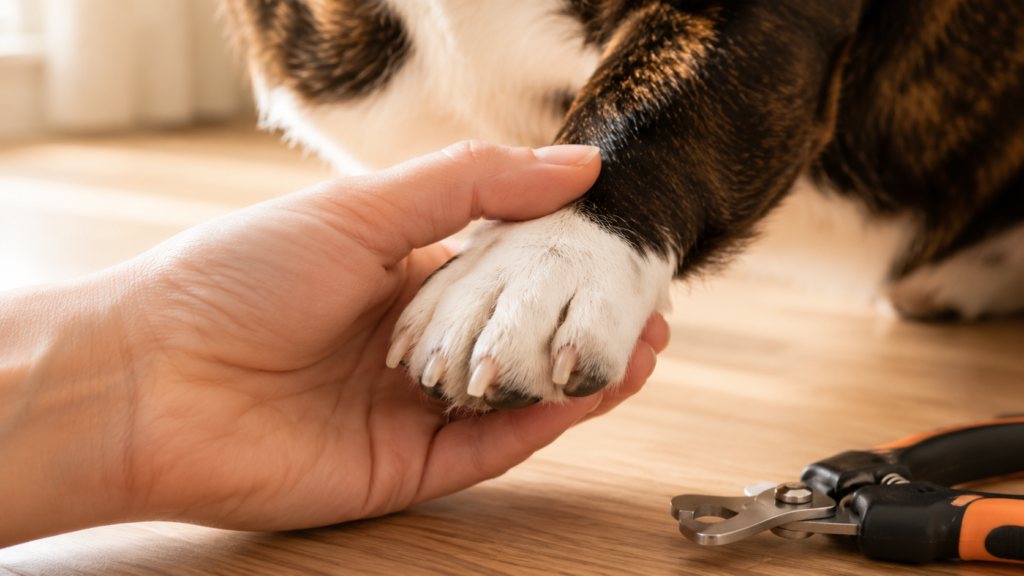
This post contains affiliate links. I may earn a small commission if you buy through them, at no extra cost to you.
Nail trimming is the grooming task most dog owners dread. Not because it’s complicated — it genuinely isn’t — but because most dogs have strong opinions about having their paws handled, and one bad experience early on can create a lasting aversion.
Nuggy took about three months of patient desensitisation before he’d let me trim his nails without turning it into a negotiation. Now he lies still for the whole thing. Here’s the method that actually worked, plus everything you need to know about technique.
Why Regular Nail Trimming Matters
Overgrown nails are more than a cosmetic issue:
- Posture and gait — long nails force a dog to adjust the angle of their paws when walking, which puts abnormal stress on the joints over time. In senior dogs this contributes to arthritis progression
- Painful splitting and cracking — very long nails can snag on carpets or crack, which is painful and creates a risk of infection
- Curling into the paw pad — nails that are never trimmed eventually curve inward and grow into the pad (dewclaws are especially prone to this)
- Scratching — long nails on a jumping dog cause real damage to skin and furniture
How often: Most dogs need their nails trimmed every 3–4 weeks. Dogs that walk frequently on hard surfaces (pavements, concrete) may wear their nails down naturally and need less frequent trimming.
The click test: If you can hear your dog’s nails clicking on hard floors, they’re overdue for a trim.
Tools You’ll Need
Option 1: Scissor-style or guillotine clippers
Traditional nail clippers. Effective, precise, and quiet. Best for small to medium dogs. Scissor-style (like pliers) gives more control; guillotine style is easier for some people but blades dull faster. The Epica Professional Nail Clipper is a solid bestseller — sharp stainless steel blades, built-in safety guard to prevent overcutting, and comfortable grip.
Option 2: Dremel / nail grinder
An electric rotary tool that files the nail rather than cutting it. Takes longer but reduces the risk of cutting the quick (the blood vessel inside the nail). Many anxious dogs actually tolerate the vibration better than the snap of clippers — worth trying if your dog is very resistant to clippers. The Dremel 7300-PT is the most widely recommended cordless option — two speed settings, rechargeable, and designed specifically for pet nails.
Styptic powder — essential. Keep it within reach every time you trim. If you cut the quick (the blood vessel inside the nail), styptic powder stops the bleeding in seconds. Cornstarch works as an emergency substitute.
Understanding the Quick
The quick is the pink blood vessel that runs through the centre of the nail. Cutting into it causes bleeding and pain — and is the main reason dogs become nail-trim averse.
In light-coloured nails: You can see the quick as a pink shadow inside the nail. Cut just below where the pink ends.
In dark nails: You can’t see the quick directly. The method: trim small amounts at a time and look at the cut surface of the nail after each snip. When you start to see a grey or pink oval appearing in the centre of the cut surface, stop — you’re approaching the quick.
If you cut the quick:
- Stay calm — your reaction teaches your dog how to feel about this
- Apply styptic powder directly to the nail tip and hold for 30 seconds
- Give your dog a treat and take a break
- Finish the session another day — don’t push through while both of you are stressed
The Distraction Method — How to Make Nail Trims Easier
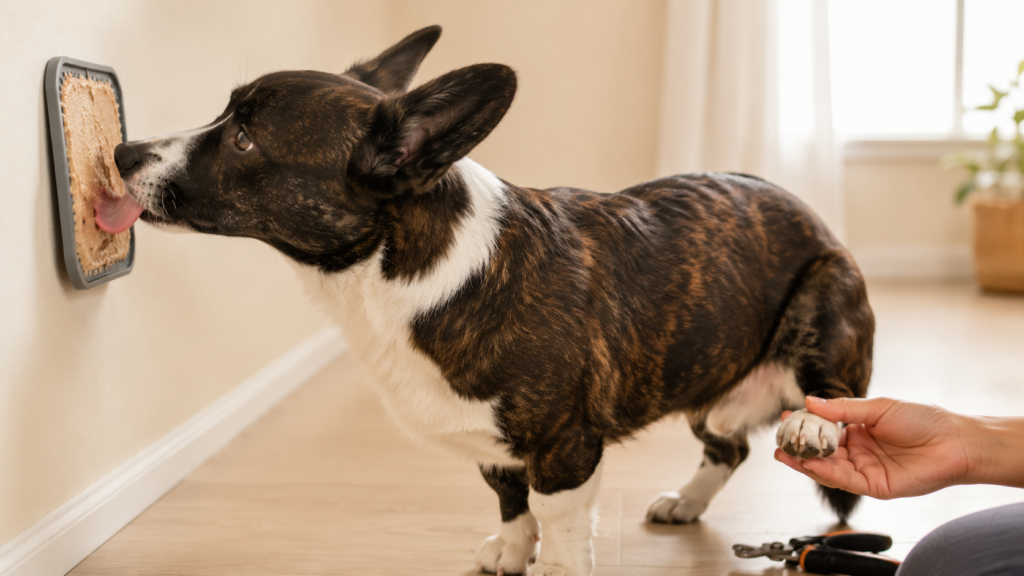
For most dogs, the hardest part of nail trimming isn’t the trimming itself — it’s keeping them still and relaxed enough to do it safely. This is where a frozen lick mat changes everything.
The setup:
- Spread Buddy Budder (xylitol-free peanut butter) onto a MateeyLife Lick Mat
- Freeze for 2–3 hours
- When it’s nail trim time, place the frozen lick mat on the floor or stick it to the wall at nose height (the suction-cup style mats are great for this)
- Let your dog settle into licking before you start
- The repetitive licking action releases calming endorphins — most dogs enter a semi-focused state that makes handling much easier
This is the single biggest practical change I made with Nuggy. From three minutes of wrestling to a calm ten-minute session.
Step-by-Step: How to Trim Your Dog’s Nails
Phase 1 — Desensitisation (do this before any trimming, especially for reluctant dogs)
If your dog already dislikes paw handling, don’t skip this phase. It takes a few days but prevents months of struggle.
- Day 1–2: Simply touch your dog’s paw, give a treat. Repeat 10–15 times. No clippers yet.
- Day 3–4: Hold the paw gently for 3–5 seconds, give a treat. Gradually increase duration.
- Day 5–6: Introduce the clippers — let your dog sniff them, touch the clippers to the paw without clipping, give a treat.
- Day 7: Clip one nail. Give a high-value treat. End the session. That’s all.
Slow is fast here. A dog that accepts paw handling calmly makes every future nail trim easier.
Phase 2 — The actual trim
- Get your dog settled — frozen lick mat in position, your dog calm and focused on licking
- Pick up one paw gently — support it from underneath, don’t grip tightly
- Isolate one nail — push the fur back if needed to see the nail clearly
- Position the clipper — at roughly 45 degrees to the nail, cutting from below upward
- Make one quick, decisive cut — hesitating causes a crushing action rather than a clean cut, which is more uncomfortable
- Check the cut surface — if you see a grey oval forming in the centre, you’re close to the quick. Stop here on this nail.
- Move to the next nail — keep your pace steady and calm
Don’t forget dewclaws — the small nail on the inner side of the leg (some dogs have them on hind legs too). These never touch the ground and grow faster than other nails. Dewclaws that are never trimmed are at the highest risk of curling into the pad.
If Your Dog Is Very Resistant
Some dogs have a genuine nail-trim phobia, often from a past painful experience. For these dogs:
- Do one paw per session, not all four. One paw = done. Big reward. Come back tomorrow.
- Work on paw desensitisation as a separate daily exercise — not connected to clipping at all
- Consider a professional groomer for the transition period while you rebuild trust at home
- Ask your vet about anxiety support for dogs with severe reactivity — in extreme cases, a mild sedative before grooming may be appropriate
The goal isn’t to power through — it’s to rebuild your dog’s association with nail trimming from “terrifying” to “annoying but fine.”
The Bottom Line
Dog nail trimming at home is a learnable skill. The technique takes about 15 minutes to understand; the real work is building the right association with your dog through consistent, positive, low-pressure sessions.
The distraction mat method made the biggest difference for us. A frozen lick mat doesn’t just keep Nuggy still — it genuinely changes his emotional state during the process.
For the full grooming picture, our At-Home Grooming Routine article covers coat, ears, teeth, and bathing in the same calm, step-by-step approach.
Frequently Asked Questions
Q: How often should I trim my dog’s nails?
A: Every 3–4 weeks for most dogs. If you can hear the nails clicking on hard floors, they’re overdue. Dogs that walk a lot on concrete may need less frequent trimming as pavement naturally files nails down.
Q: What do I do if I cut the quick?
A: Apply styptic powder directly to the nail tip and hold with gentle pressure for 30 seconds. It will stop bleeding quickly. Give your dog a treat, stay calm, and end the session. It’s painful but not dangerous.
Q: My dog screams when I try to trim their nails. Is something wrong?
A: Some dogs are genuinely more sensitive about paw handling than others. Screaming before you’ve even touched the nail is usually a conditioned stress response, not pain. Go back to basics with paw desensitisation exercises over a few weeks — it nearly always resolves.
Q: Is it better to use clippers or a grinder?
A: Both work. Clippers are faster; grinders reduce quick-cutting risk and allow more precise shaping. Some anxious dogs prefer the grinder because there’s no sharp snap. Try both and see what your dog tolerates better.
Q: Can I trim black nails safely at home?
A: Yes — trim in small increments and check the cut surface after each snip. When you see a grey or pink oval forming in the centre of the cut nail, stop. You’ll get more comfortable reading this over time.
Q: What angle should I cut dog nails?
A: Approximately 45 degrees, cutting from below upward. This follows the natural curve of the nail and helps avoid the quick. For dark nails especially, small angled cuts are safer than one large cut.