
This post contains affiliate links. I may earn a small commission if you buy through them, at no extra cost to you.
I started making some of Nuggy’s food at home after he turned two — not because commercial food is bad, but because I wanted to understand exactly what was going into his bowl. The process taught me a lot about dog nutrition, and a few of these recipes have become regulars in his rotation.
Important caveat upfront: homemade dog food should complement, not replace, a complete commercial diet unless you’re working with a veterinary nutritionist. The recipes here are balanced meal options designed to work alongside commercial food or as occasional home-cooked meals — not as the sole diet. If you want 100% homemade feeding, consult a vet nutritionist for a properly balanced plan tailored to your dog’s weight and life stage.
With that said — here are 6 recipes Nuggy has approved.
What Makes Homemade Dog Food Balanced?
Balanced homemade dog food follows a few key principles:
The basic balance rule (the 3:1:1 ratio):
- 50% lean protein — chicken, turkey, beef, fish (cooked, boneless)
- 25% complex carbohydrates — brown rice, oats, sweet potato, plain pasta
- 25% vegetables — carrots, green beans, peas, broccoli (in small amounts), courgette
Always include:
- A small amount of healthy fat — a teaspoon of fish oil or olive oil per portion
- Calcium — either through bone meal powder or by occasionally including plain yogurt
Always exclude:
- Onions, garlic, and chives (all toxic)
- Grapes and raisins (toxic)
- Xylitol (toxic — check any peanut butter)
- Salt and seasoning
- Macadamia nuts
- Chocolate
The honest caveat about calcium and micronutrients: Home-cooked food without supplementation tends to be low in calcium, zinc, and certain vitamins. For occasional meals or a mixed-feeding approach, this isn’t a problem. For a dog eating only homemade food, supplementation is necessary.
Recipe 1 — Classic Chicken and Rice (Great for Sensitive Stomachs)
This is the first meal vets recommend when a dog has an upset stomach — and it’s also a solid regular meal.
Ingredients (serves a 10 kg dog for 2 meals):
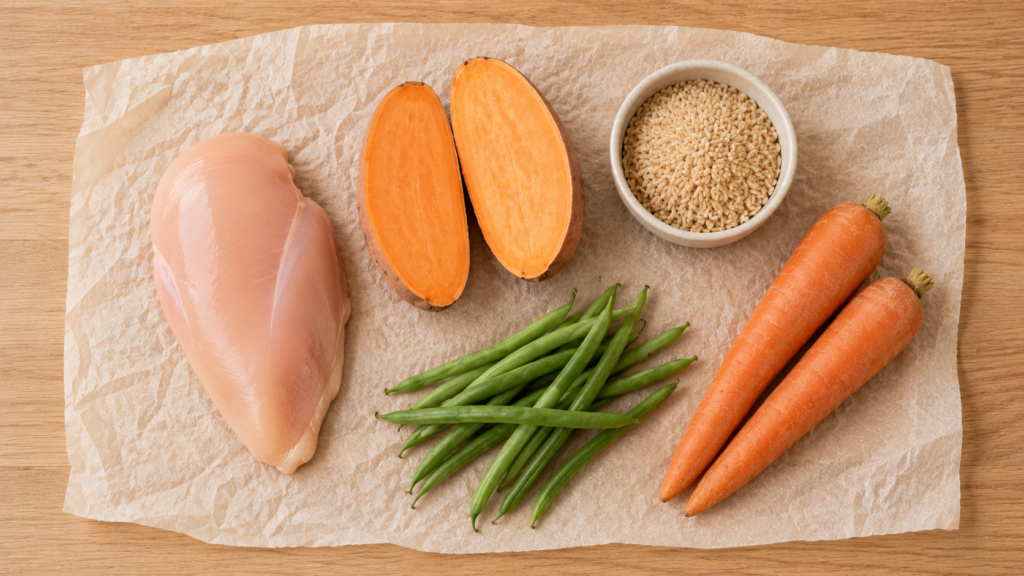
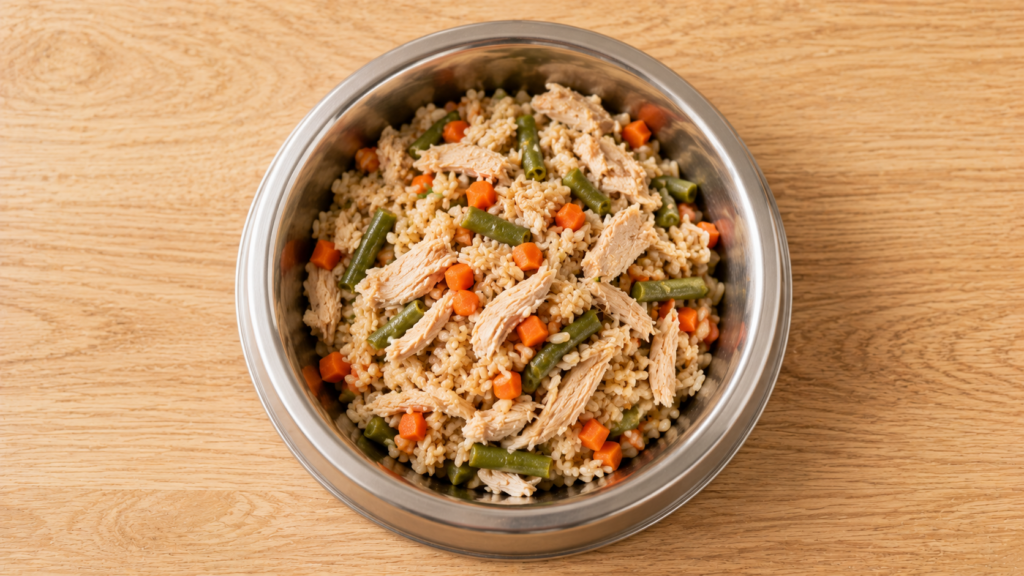
- 200g cooked chicken breast, shredded (no skin, no bones)
- 100g cooked brown rice
- 50g cooked carrots, diced
- 1 tsp olive oil
Method:
- Boil chicken until cooked through (no salt in the water). Remove all bones, shred.
- Cook brown rice separately. No seasoning.
- Steam or boil carrots until soft.
- Mix together, allow to cool completely before serving.
- Add olive oil and stir through.
Storage: Refrigerate for up to 3 days. Freeze in portions for up to 3 months.
Recipe 2 — Beef and Sweet Potato Bowl
Higher in iron and B vitamins, good for active dogs. Sweet potato provides slow-release energy and is easy on the digestion.
Ingredients (serves a 10 kg dog for 2 meals):
- 200g lean ground beef, cooked and drained
- 150g sweet potato, cooked and cubed
- 50g green beans, cooked
- 1 tsp fish oil (omega-3 boost)
Method:
- Brown ground beef in a dry pan until fully cooked. Drain any excess fat.
- Bake or boil sweet potato until soft. Cube.
- Steam green beans until tender.
- Combine all ingredients. Allow to cool. Add fish oil before serving.
Recipe 3 — Turkey and Oat Meal
Turkey is lean, oats are highly digestible, and the combination is gentle enough for dogs with food sensitivities.
Ingredients (serves a 10 kg dog for 2 meals):
- 200g ground turkey, cooked
- 80g rolled oats, cooked in water (not milk)
- 60g courgette / zucchini, grated or diced
- 50g peas (frozen and thawed is fine)
- 1 tsp olive oil
Method:
- Cook ground turkey in a pan without oil until fully cooked through.
- Cook oats in water until soft — plain porridge consistency, unsalted.
- Combine all ingredients, allow to cool, add olive oil.
Note: Courgette is one of the most dog-friendly vegetables — low calorie, hydrating, and mild-flavoured. Most dogs eat it without noticing.
Recipe 4 — Salmon and Brown Rice (Omega-3 Rich)
Excellent for coat health, joint support, and dogs with skin issues. Salmon is one of the best dietary omega-3 sources for dogs.
Ingredients (serves a 10 kg dog for 2 meals):
- 200g cooked salmon fillet (boneless — remove all bones carefully)
- 100g cooked brown rice
- 50g spinach, wilted (small amount only — spinach is fine occasionally but not daily due to oxalate content)
- 50g diced carrots, cooked
Method:
- Bake or steam salmon until fully cooked. Always cook fish — raw salmon can carry Neorickettsia helminthoeca, which is toxic to dogs. Remove all bones.
- Combine with cooked rice, wilted spinach, and carrots.
- Allow to cool fully before serving.
Recipe 5 — Chicken Liver and Vegetable Mix (Nutrient-Dense Topper)
Liver is one of the most nutrient-dense foods you can give a dog — packed with vitamin A, B vitamins, iron, and zinc. Use as a topper or mix-in rather than a main meal: no more than 5% of the diet should be liver to avoid vitamin A toxicity.
Ingredients (makes a week’s worth of topper for a 10 kg dog):
- 100g chicken liver, cooked
- 50g sweet potato, cooked and mashed
- 50g peas
Method:
- Boil or sauté chicken liver until fully cooked (no pink inside). No oil or seasoning.
- Dice finely or pulse briefly in a food processor.
- Combine with mashed sweet potato and peas.
- Add 1–2 tablespoons over your dog’s regular meal.
Recipe 6 — Slow Cooker Beef Stew (Batch Cook for the Week)
This is Nuggy’s favourite. Make a big batch on Sunday and portion it out — it keeps in the fridge for 4 days or the freezer for 3 months.
Ingredients (serves a 10 kg dog for ~8 meals):
- 500g lean beef (stewing beef or mince), fat trimmed
- 200g sweet potato, cubed
- 150g carrots, sliced
- 150g green beans
- 150g peas
- 500ml plain, low-sodium chicken stock (or just water)
Method:
- Brown the beef briefly in a pan — this isn’t essential but adds flavour your dog will appreciate.
- Add all ingredients to a slow cooker.
- Cook on low for 6–8 hours or high for 3–4 hours.
- Allow to cool. Portion into containers and refrigerate or freeze.
Storage tip: Vtopmart Airtight Containers are what we use for portioning and storing homemade food. The 24-pack means each meal gets its own container, they’re freezer-safe, and the lids actually seal properly.
For extra protein flavour and a nutrient boost, we sometimes add a small amount of Vital Essentials Freeze-Dried Beef Liver crumbled on top of the stew — Nuggy goes crazy for it and it adds a good dose of natural vitamins.
Portion Sizes — How Much Homemade Food to Give
A general guideline: dogs should eat approximately 2–3% of their ideal body weight per day in food.
| Dog weight | Daily food amount |
|---|---|
| 5 kg | 100–150g |
| 10 kg | 200–300g |
| 20 kg | 400–600g |
| 30 kg | 600–900g |
Adjust based on your dog’s activity level, age, and body condition. A lightly active adult dog sits at the lower end; a young, active dog at the higher end. Check your dog’s weight and adjust every few weeks when starting homemade feeding.
The Bottom Line
Homemade dog food can be a genuinely healthy choice when done thoughtfully. The three core principles: balanced protein/carb/veg ratio, nothing from the toxic foods list, and be honest about what you’re missing nutritionally (primarily calcium and trace minerals for full homemade diets).
These six recipes are a solid starting point. For budget-focused homemade feeding, check our Cheap Homemade Dog Food article. And if your dog has health-specific dietary needs, our Dog Health Care Checklist covers the questions worth raising with your vet.
Frequently Asked Questions
Q: Is homemade dog food actually healthier than commercial food?
A: Not necessarily — and not automatically. High-quality commercial foods are carefully formulated for complete nutrition. Homemade food can be equally or more nutritious if properly balanced, but an unbalanced homemade diet is worse than a good commercial one. The key is being intentional about the balance.
Q: Can I feed my dog homemade food every day?
A: Yes, as long as the diet is properly balanced over time. For most home cooks, a mixed approach — some homemade, some commercial — is the easiest way to ensure nutritional completeness without a vet nutritionist consult.
Q: Do I need to add supplements to homemade dog food?
A: For occasional meals or a mixed-feeding approach, usually not. For a 100% homemade diet, yes — particularly calcium, and often zinc and vitamin D. Consult a vet nutritionist for a complete supplementation plan.
Q: Can I use raw meat in homemade dog food?
A: Raw feeding is a separate approach with its own considerations — bacterial contamination, balanced raw diets, etc. The recipes in this article are all cooked. Always cook fish to avoid salmon poisoning disease. For other meats, cooking eliminates bacterial risk.
Q: How long does homemade dog food last?
A: Refrigerated: 3–4 days. Frozen in individual portions: up to 3 months. Always thaw in the fridge overnight, not at room temperature.
Q: Can I add seasoning or spices?
A: No salt or seasonings. Some herbs are fine in small amounts (parsley, basil) but there’s no need to add them. Dogs enjoy the natural flavours of well-cooked protein. Onion, garlic, and chives in any form are toxic — even powdered.