
This post contains affiliate links. I may earn a small commission if you buy through them, at no extra cost to you.
Nuggy once stole a grape right off my plate.
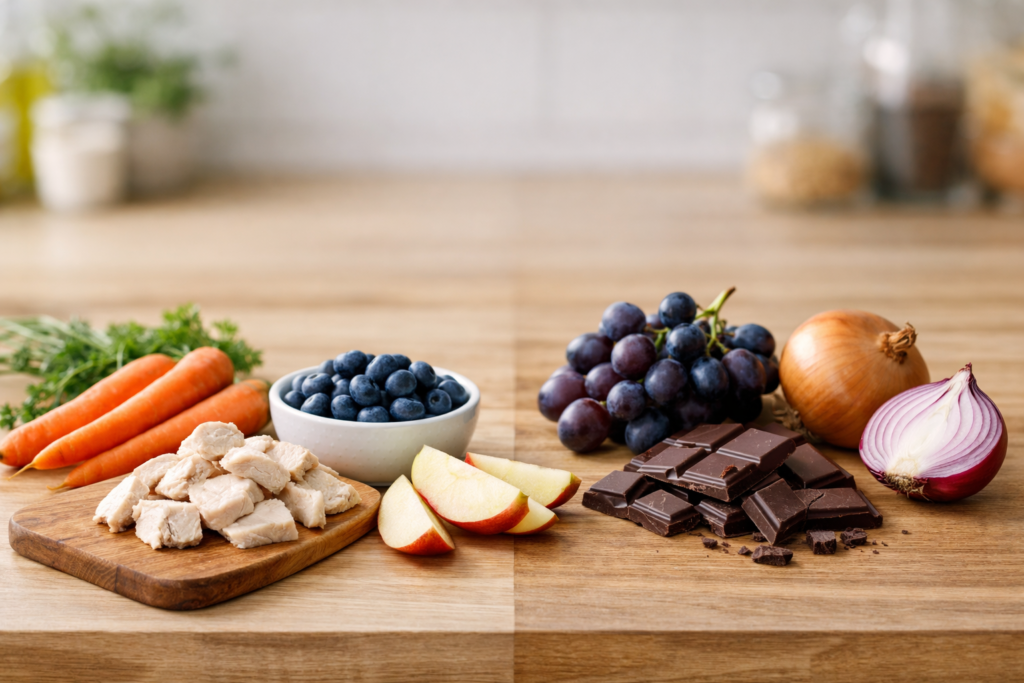
I didn’t think much of it at the time — it’s just a grape, right? Then I googled it. My stomach dropped. I called the vet within minutes.
He was fine. But that moment made me realize how much I didn’t know about what my dog could and couldn’t eat — and how casually I’d been sharing food without thinking twice.
This guide is everything I’ve learned since then. I’ve gone through 30+ common human foods, checked with our vet, and tested plenty of them with Nuggy. You’ll know exactly what’s safe, what to avoid, and what to do in an emergency.
Why Human Food Is Trickier Than It Looks
Dogs digest food very differently than we do. Their bodies aren’t built for:
- Heavy seasoning and spices
- Excess fat and salt
- Sugar and artificial sweeteners (especially xylitol)
- Many foods that are completely harmless — or even healthy — for us
The rule isn’t “human food is always bad.” The rule is that context, preparation, and portion size matter — and some foods are dangerous no matter how small the amount.
Foods Dogs Can Eat Safely
These foods are generally safe when served plain, unseasoned, and in appropriate portions.
🥦 Vegetables
| Food | Notes |
|---|---|
| Carrots | Great low-calorie snack, supports dental health. Raw or cooked, both fine. |
| Cucumber | Hydrating, almost zero calories. Perfect summer treat. |
| Green beans | Plain only — no salt, no seasoning. Low-calorie snack most dogs like. |
| Sweet potato | Cooked, no skin, no seasoning. High in fiber and vitamins. |
| Pumpkin | Plain canned pumpkin is a common digestive aid. Not pumpkin pie filling. |
| Broccoli | Small amounts only — large quantities irritate the digestive tract. |
🍓 Fruits
| Food | Notes |
|---|---|
| Apples | Remove seeds and core — seeds contain cyanide compounds. Flesh is safe. |
| Blueberries | Antioxidant superfood for dogs. Great as training treats — or grab Zuke’s Mini Naturals if you want something purpose-made and portable. |
| Strawberries | High in vitamin C. Remove stems, serve fresh or frozen. |
| Watermelon | Remove rind and seeds. Excellent hydration treat in summer. |
| Bananas | High in potassium. Limit due to natural sugar — occasional treat only. |
| Mango | Remove pit and skin. Rich in vitamins A, B6, C, and E. |
🍗 Proteins
| Food | Notes |
|---|---|
| Chicken | Cooked, plain, boneless. One of the best protein sources for dogs. |
| Eggs | Fully cooked only. Raw eggs carry salmonella risk. Great for coat health. |
| Salmon | Cooked only — raw salmon can contain parasites that are fatal to dogs. |
| Turkey | Skinless, unseasoned. Watch for onion/garlic in stuffing or marinades. |
Foods Dogs Can Eat — In Moderation
These aren’t toxic, but too much causes problems. Treat them as occasional extras, not daily food.
| Food | Why Be Careful | Max Frequency |
|---|---|---|
| Peanut butter | Must be xylitol-free — Buddy Budder is a dog-safe brand we use. High in fat. | Few times a week, small amount |
| Cheese | Many dogs are lactose intolerant. Can cause gas and diarrhea. | Small amounts, infrequently |
| Plain yogurt | Same as cheese — lactose sensitivity common. No flavored or sweetened yogurt. | Occasional, small spoonful |
| Corn | Corn kernels fine — corncob is a blockage danger, never give it. | Occasional |
| Potatoes | Cooked only — raw potatoes contain solanine which is toxic. No butter or seasoning. | Occasional |
| Shrimp | Cooked, plain, no shell. Low calorie, good protein. Too much causes digestive upset. | Occasional treat |
| Tuna | Small amounts fine — mercury accumulates with regular feeding. | Rarely |
| Pineapple | High sugar. Small pieces only. May actually reduce coprophagia (eating feces). | Occasional |
| Coconut | Small amounts OK — high fat content. Coconut oil controversial, use sparingly. | Occasional |
Enrichment tip: Peanut butter stuffed inside a KONG Classic is one of the easiest ways to keep a dog busy for 20+ minutes — freeze it overnight and it lasts even longer.
Foods Dogs Should Never Eat
These foods are dangerous regardless of portion size. Some are deadly even in tiny amounts.
| Food | Why It’s Toxic | Danger Level |
|---|---|---|
| Grapes & raisins | Cause sudden kidney failure — mechanism still unknown, but even 1 grape can be fatal for some dogs. | 🔴 Extreme |
| Chocolate | Contains theobromine — dogs can’t metabolize it. Dark chocolate and baking chocolate are the most dangerous. | 🔴 Extreme |
| Xylitol | Artificial sweetener in gum, peanut butter, candy, baked goods. Causes rapid insulin release and liver failure. | 🔴 Extreme |
| Onions & garlic | Damage red blood cells, causing anemia. Toxic in all forms — raw, cooked, powder. Effects are cumulative. | 🔴 Extreme |
| Macadamia nuts | Cause weakness, vomiting, tremors, and fever within 12 hours. Mechanism unknown. | 🔴 High |
| Avocado | Contains persin — causes vomiting, diarrhea, and in large amounts, fluid around heart. | 🔴 High |
| Alcohol | Causes the same effects as in humans but at a fraction of the dose. Even small amounts can be fatal. | 🔴 Extreme |
| Raisins | Same mechanism as grapes, potentially more concentrated. Equally dangerous. | 🔴 Extreme |
| Raw bread dough | Yeast expands in the stomach and produces alcohol as it ferments. Double danger. | 🔴 High |
| Caffeine | Coffee, tea, energy drinks — causes rapid heart rate, seizures, and can be fatal. | 🔴 High |
What to Do If Your Dog Eats Something Toxic
Stay calm — but act fast.
Step 1: Estimate how much they ate. Even a rough guess helps the vet assess risk.
Step 2: Call immediately. Don’t wait for symptoms to appear — some toxins act slowly.
Step 3: Don’t induce vomiting unless your vet explicitly tells you to. For some toxins (like caustic substances), vomiting makes it worse.
Step 4: Watch for symptoms — vomiting, lethargy, loss of coordination, pale gums, seizures. Report everything to the vet.
Having a dog first aid kit at home doesn’t replace a vet call, but it helps you stay prepared for emergencies.
What About Puppies?
Puppies have more sensitive digestive systems and developing immune systems. The rules above still apply, but with extra caution:
- Introduce new foods one at a time, with several days between each new food
- Start with very small portions — a fingertip amount is enough to test tolerance
- Watch stool consistency carefully after anything new
- When in doubt, wait until your puppy is older
Foods that adult dogs tolerate (like small amounts of cheese) may still upset a puppy’s stomach. Keep it simple until at least 6 months.
How to Safely Introduce Any New Food
Even safe foods can cause upset if introduced too quickly. A simple 4-step process:
- Start tiny — a fingertip or single piece, not a handful
- Plain and unseasoned — no butter, oil, salt, or spices
- Wait 24 hours — watch for vomiting, diarrhea, or unusual lethargy
- Increase slowly — if no reaction, you can gradually give a little more
Nuggy gets new foods this way every time. It takes patience, but it’s saved us from a few unpleasant vet visits.
Want to Know About a Specific Food?
This guide covers the big picture. If you want the full breakdown on a specific food — exact safe amounts, what to do if your dog eats too much, recipe ideas — we have individual guides for each one:
Safe foods:
- Can Dogs Eat Watermelon?
- Can Dogs Eat Strawberries? (coming soon)
- Can Dogs Eat Bananas?
- Can Dogs Eat Apples?
- Can Dogs Eat Carrots? (coming soon)
- Can Dogs Eat Eggs?
- Can Dogs Eat Blueberries?
- Can Dogs Eat Mango? (coming soon)
- Can Dogs Eat Sweet Potatoes? (coming soon)
- Can Dogs Eat Pumpkin? (coming soon)
- Can Dogs Eat Chicken? (coming soon)
- Can Dogs Eat Salmon? (coming soon)
- Can Dogs Eat Cucumber? (coming soon)
- Can Dogs Eat Green Beans? (coming soon)
Moderation foods:
- Can Dogs Eat Peanut Butter? (coming soon)
- Can Dogs Eat Cheese? (coming soon)
- Can Dogs Eat Pineapple? (coming soon)
- Can Dogs Eat Corn? (coming soon)
- Can Dogs Eat Shrimp? (coming soon)
- Can Dogs Eat Tuna? (coming soon)
- Can Dogs Eat Potatoes? (coming soon)
- Can Dogs Eat Broccoli? (coming soon)
- Can Dogs Eat Coconut? (coming soon)
Toxic foods — full breakdown:
- Can Dogs Eat Grapes?
- Can Dogs Eat Chocolate?
- Can Dogs Eat Onions? (coming soon)
- Can Dogs Eat Garlic? (coming soon)
- Can Dogs Eat Avocado? (coming soon)
- Can Dogs Eat Raisins? (coming soon)
- Can Dogs Eat Macadamia Nuts? (coming soon)
Frequently Asked Questions
Can dogs eat bread?
Plain white or whole wheat bread in small amounts is generally safe — no nutritional value, but not harmful. Never give bread with raisins, garlic, onion, or xylitol.
Can dogs eat rice?
Yes. Plain cooked white rice is one of the safest foods for dogs, especially for upset stomachs. Brown rice is fine too, just harder to digest.
Can dogs eat leftovers?
Usually not a good idea. Most leftovers contain seasoning, salt, fat, or sauces that are problematic for dogs. Plain cooked protein (chicken, turkey) is the exception.
How much fruit can a dog eat?
A good rule of thumb: treats — including fruit — should make up no more than 10% of your dog’s daily calories. For a medium dog, that’s roughly a small handful of berries or 2–3 apple slices.
What’s the safest human food to give a dog?
Carrots, plain cooked chicken, and blueberries are consistently at the top of the list — low risk, genuinely nutritious, and most dogs love them.
Is it OK to give dogs human food every day?
In small amounts, yes — if it’s safe food and it’s not replacing balanced meals. The problem is when human food becomes a significant part of the diet or when it’s given without thinking about what’s in it.
The Bottom Line
Human food doesn’t have to be stressful — it just needs to be intentional.
When you know what’s safe and what isn’t, sharing a carrot or a piece of chicken becomes a moment of connection rather than a gamble.
Nuggy gets the occasional blueberry, a piece of apple, or a plain chicken strip as a treat. He loves it. And I love that I know it’s safe.
Keep this page bookmarked. As we add individual food guides to the blog, this page will grow into the most complete resource you’ll find — all in one place.
Looking for treat ideas using dog-safe foods? Check out our Homemade Frozen Dog Treats, Peanut Butter Dog Treats, and Cheap Homemade Dog Food guides.