
This post contains affiliate links. If you make a purchase, we may earn a small commission at no extra cost to you.
I tell Nuggy I love him every single day. Multiple times. Sometimes it comes out of nowhere — he’s just sitting there looking vaguely majestic and I can’t help myself.
But here’s the uncomfortable truth I had to sit with: Nuggy doesn’t understand those words. Not even a little.
Dogs don’t process human language the way we wish they did. They pick up on tone, on rhythm, maybe their name — but “I love you” is just a pleasant-sounding noise coming from their favorite human. That doesn’t mean they can’t feel loved. It just means we have to say it in a way their brain actually understands.
Here are 10 things that genuinely register as love for a dog — backed by how their nervous system actually works.
1. Give Them Your Full, Undivided Attention
Put the phone down. Close the laptop. Sit on the floor with them for ten minutes.
Researchers at Azabu University in Japan found that when dogs and their owners make eye contact, both experience a spike in oxytocin — the same bonding hormone that surges between a parent and a newborn. Dogs literally experience a biochemical “I love you” when you look at them with warmth and intention.
One important nuance: a soft, relaxed gaze is bonding. A hard, sustained stare is threatening. You want the first kind — the way you’d look at someone you genuinely adore. Nuggy knows the difference, and I suspect your dog does too.
Ten minutes of genuine, phone-free presence communicates more than hours of passive coexistence in the same room.
2. Learn to Read Their Body Language
This one sounds like it’s about them. It’s actually one of the most loving things you can do.
When you correctly read and respond to your dog’s signals — when you notice they’re overwhelmed at the dog park and you leave, when you see their whale eye and give them space, when you recognize a play bow for the invitation it is — they learn something profound: this person gets me.
That’s trust. And trust is the foundation of feeling safe, which is the closest thing a dog has to feeling loved.
If you haven’t read our breakdown of dog body language, it’s genuinely one of the most useful things you can spend 10 minutes on as a dog owner: Dog Body Language Explained — How to Read Your Dog’s Signals
3. Give a Special Treat They Don’t Get Every Day
Not their regular kibble. Not even their usual training treats. Something that makes their nose go insane and their eyes go wide.
The key word is special. A treat only lands as a meaningful gesture when it stands out from the daily routine. If Nuggy gets freeze-dried liver every single day, it stops being special. But if he gets a stuffed lick mat on a random Tuesday afternoon for no reason at all — that’s a gift. He knows it. His tail says it clearly.
For Nuggy, the move that works every time is loading a MateeyLife Lick Mat with Buddy Budder dog peanut butter and handing it over with way more ceremony than the situation technically calls for. He goes from 0 to absolute zen in about 30 seconds.
The Buddy Budder is worth specifically calling out — it’s made for dogs (no xylitol, no additives), and it’s so thick it clings to the lick mat perfectly for a long session. We’ve gone through a lot of jars in this household.
Pro Tip: Want to make the treat even more special? Freeze the loaded lick mat overnight. The cold temperature slows them down, extends the enrichment session, and works like a charm on hot days.
If you want more ideas for homemade versions, we’ve got 10 Simple Homemade Dog Treats You Can Make Any Day — most take under 20 minutes.
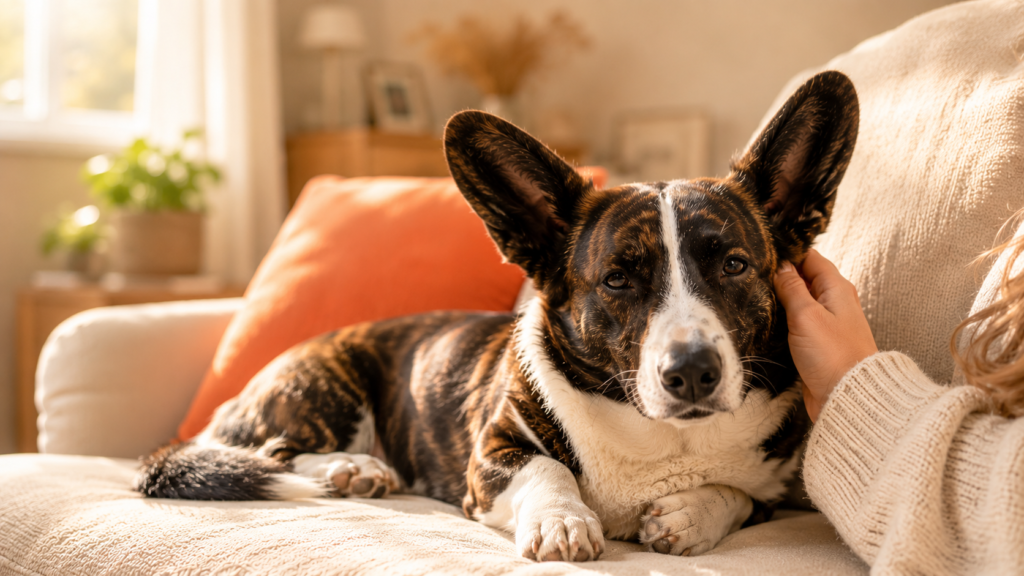
4. Touch Them Where They Actually Enjoy It (Not Where You Prefer)
This one’s hard to hear: most dogs don’t enjoy hugs.
I know. I hate it too. But from a dog’s perspective, being wrapped in arms is a form of restraint — it limits their ability to move, which triggers mild-to-moderate stress in many dogs. They tolerate it from people they love. That’s not the same as enjoying it.
Where dogs actually love to be touched (when they’re comfortable with you):
- Base of the tail and lower back — most dogs will lean into this
- Behind and under the ears — that spot that makes their back leg do the thing
- Chest and sternum — a slow chest rub is deeply calming
- Belly — only when they offer it. A belly-up posture is an invitation, not a default
The secret is to read their response. If they lean in, stay still, or sigh — keep going. If they shift away, lick their lips, or turn their head — they’re done. Respecting that boundary is love.
5. Play Enrichment Games With Them — and Actually Be Present
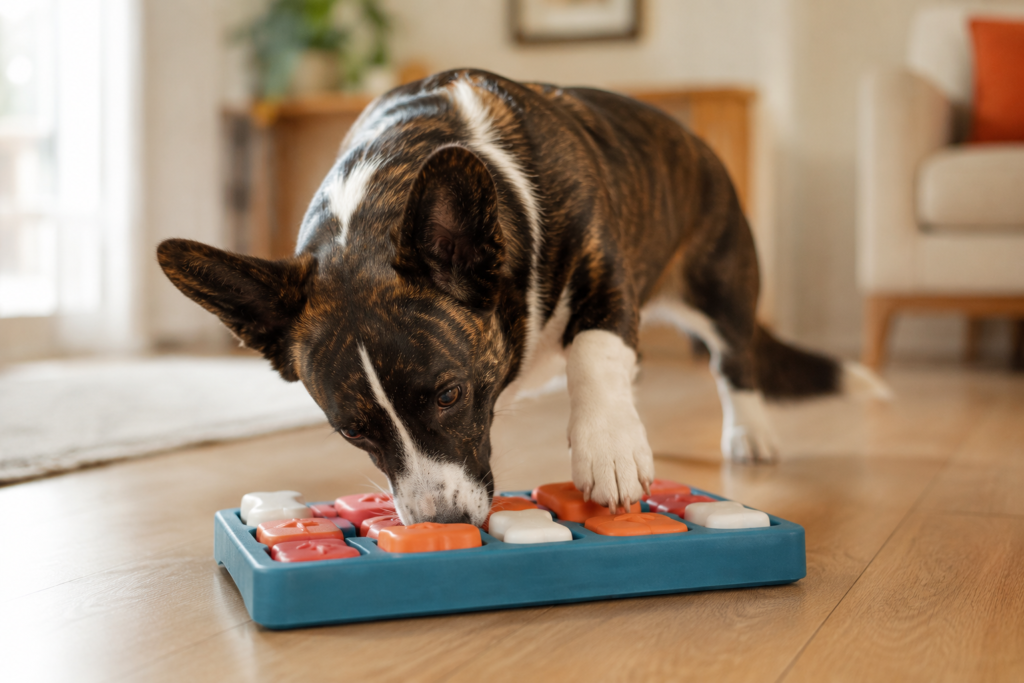
Here’s the mistake I used to make: I’d hand Nuggy a puzzle toy and walk away to do something else. I thought I was doing something good for him. I was, technically. But I was missing the whole point.
The thing that makes enrichment activities emotionally meaningful isn’t just the mental stimulation — it’s that you’re there doing it together. Your presence, your encouragement when they figure it out, your reaction to their mini-victory when the treat finally drops out — that’s what turns a solo puzzle into a bonding moment.
Our current favorites for this kind of shared play:
The Nina Ottosson Dog Brick Level 2 is exactly the right difficulty for most dogs — challenging enough to hold their focus for 10–15 minutes, but not so frustrating they give up. Nuggy attacks it like a little detective. The celebration when he clears a compartment is genuinely one of the best things in my week.
For more ideas you can do with zero equipment, we’ve pulled together 12 Easy Enrichment Ideas That Actually Calm Your Dog — great for rainy days or when you don’t feel like going outside.
6. Hand-Feed Them — Even Just Once in a While
This sounds small. It’s not.
In dog training, hand-feeding is one of the fastest ways to build a bond with a fearful or shy dog — because food is survival, and when survival comes from your hand, you become associated with safety at the deepest level.
You don’t have to do this every day. But occasionally scooping out part of their meal and feeding them piece by piece, from your palm, communicates something that a bowl on the floor simply doesn’t. It says: I’m the source of good things. You can count on me.
Nuggy gets hand-fed his last few pieces of kibble most evenings. He sits, makes eye contact, and takes each piece so gently it’s almost embarrassing how much I love him for it.
7. Do Short Training Sessions — Not to Train, But to Connect
Training sessions aren’t just about teaching behaviors. Done right, they’re one of the most powerful connection rituals you can have with a dog.
Here’s what’s happening from their perspective during a good training session: they try something, it works, they get rewarded, they try again. Over and over. The world is predictable. You are predictable. They can relax because the rules make sense and you are consistent.
That feeling — that the person in front of them is safe, fair, and reliable — is love in dog language.
Keep sessions short: 3–5 minutes is genuinely enough. End on a success. Use high-value rewards for anything new. And if either of you is frustrated, stop and try again tomorrow.
The dogs that seem most deeply bonded to their owners are almost always dogs whose owners trained them. Not because training creates obedience, but because the process of training creates trust.
8. Let Them Sniff Freely on Walks
This is the one most people underestimate.
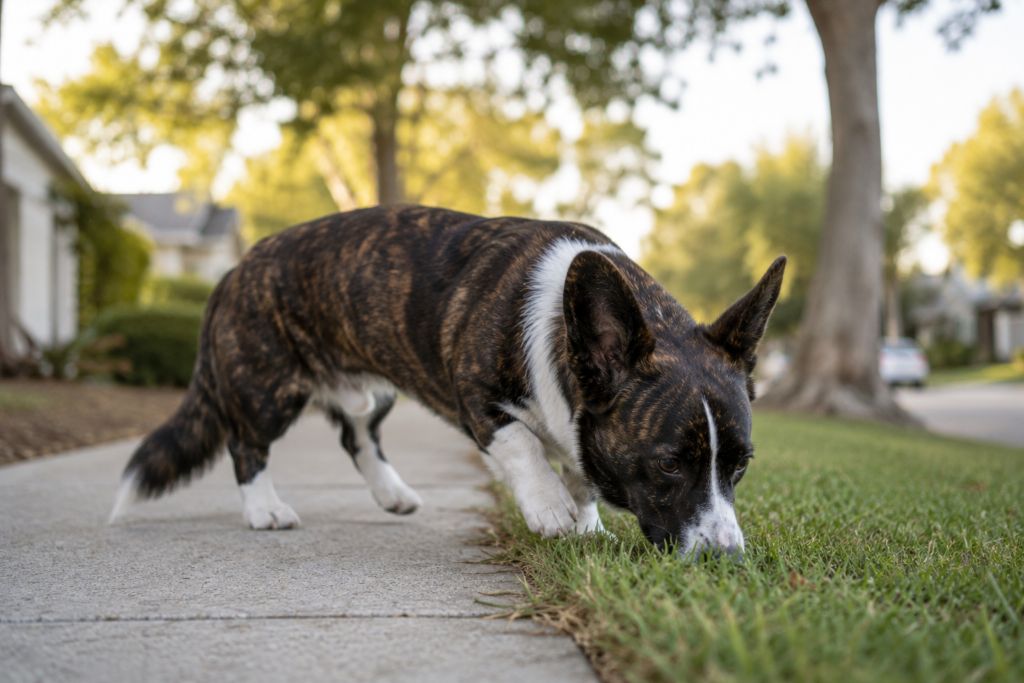
Sniffing is how dogs process the entire world. Their nose contains roughly 300 million olfactory receptors compared to our 6 million — meaning a smell that we experience as a single note, a dog experiences as a full symphony with layered harmonics. A lamppost on your street is basically a local newspaper for Nuggy.
When you pull your dog away from a smell to keep moving, you’re cutting their sentence short mid-thought. Every time.
A 20-minute walk where they’re allowed to sniff freely will tire your dog out more than an hour of brisk walking on a tight leash. More importantly, letting them sniff says: your needs matter on this walk, not just mine.
Try a “sniff walk” — same route, no agenda, let them stop wherever they want for as long as they want. Watch how different they are when you get home.
9. Sit With Them During a Lick Mat Session
This is different from item 3. That one was about the treat being special. This one is about what you do while they have it.
Instead of handing Nuggy his lick mat and walking away, try sitting beside him while he works it. Don’t do anything. Don’t scroll your phone. Just be there.
What ends up happening, if you let it, is a strangely peaceful shared moment. Nuggy licks. I sit. He occasionally glances up at me with what I can only describe as deep satisfaction. His whole body relaxes. His breathing slows. Mine does too, honestly.
Licking activates the parasympathetic nervous system in dogs — it’s literally calming at a physiological level. When you’re present during that calming state, your presence becomes associated with safety and peace.
The MateeyLife Lick Mat 2-pack is what we use — the textured surface holds peanut butter and yogurt well, they’re easy to clean, and having two means one’s always in the freezer ready to go.
10. Keep Their Routine — Predictability Is Love
Dogs are creatures of extraordinary routine. Meals at the same time. Walks at the same time. Bedtime rituals that happen in the same order every night.
When your dog knows what to expect and when to expect it, their nervous system can relax. Anxiety in dogs is often — not always, but often — a response to unpredictability. They’re always braced for what might happen next. A consistent routine removes that bracing. It tells them: the world is safe. I’m safe with you.
This one requires no equipment, no products, and no special skills. It just requires showing up consistently. Which, when you think about it, is one of the most fundamental expressions of love in any relationship.
Nuggy knows when it’s walk time before I’ve even picked up the leash. He knows when his dinner is coming. He knows the bedtime sequence. And every single day, when those things happen on schedule, some small part of his nervous system says: good. everything is as it should be.
The Language Worth Learning
You don’t have to stop saying “I love you” to Nuggy. I’m never going to stop. But now when I say it, I follow it up with something he actually understands — a lick mat, a walk where he can sniff everything, a few minutes sitting together with nothing to do.
He can’t say it back in words. But a dog who leans into your hand, makes soft eye contact, and falls asleep against your leg?
That’s fluent.
Which of these does your dog respond to most? Drop it in the comments — I always love hearing what works for other dogs. And if you want more enrichment ideas, 12 Easy Enrichment Ideas That Actually Calm Your Dog is a great next read.