
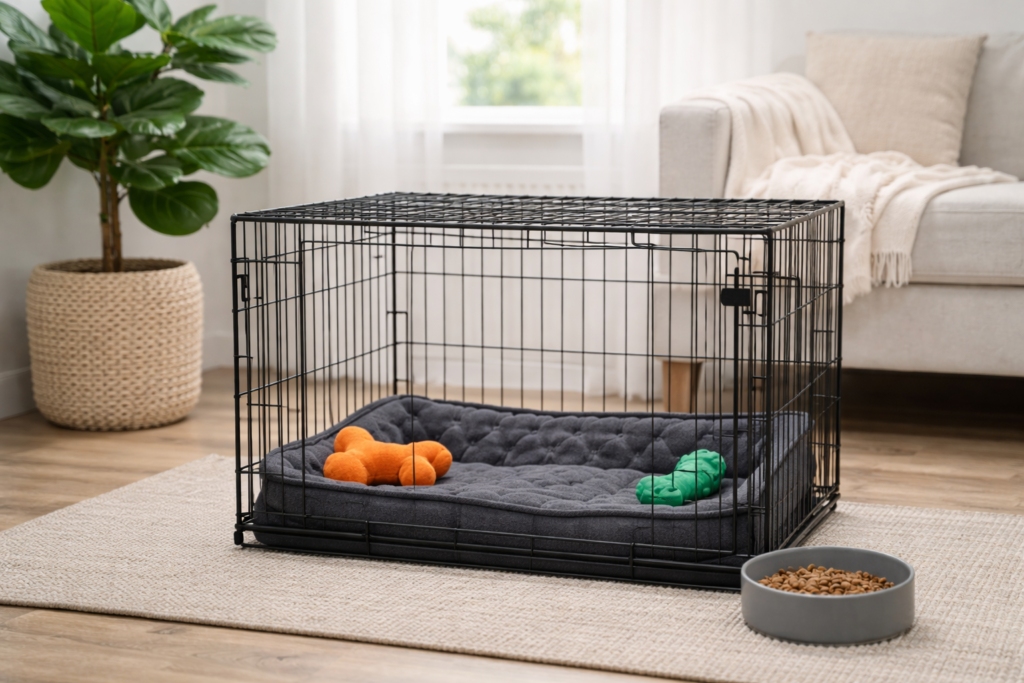
Leaving a puppy home alone can feel harder for the owner than for the dog.
You close the door, and immediately hear barking, whining, or crying from the crate.
Your heart sinks.
You wonder if you’re doing something wrong — or worse, if you’re causing stress or emotional harm.
The truth is this:
Most puppies don’t struggle with the crate itself.
They struggle with how the crate is introduced, used, and connected to your departure routine.
This guide will walk you through a calm, realistic approach to crate training that actually helps puppies settle when left alone — without ignoring distress, forcing “cry it out,” or relying on gimmicks.
Why Puppies Cry or Bark in the Crate When You Leave
Puppies are not born knowing how to be alone.
Independence is a learned skill.
When a puppy vocalizes in the crate after you leave, it’s usually because of one (or more) of these reasons:
- The crate predicts sudden isolation
- Your departure routine feels abrupt or emotionally charged
- The puppy has not practiced calm separation in small doses
- The crate is only used when you leave (never when you’re home)
This is not misbehavior.
It’s a communication gap.
Crate Training vs. Separation Distress: Know the Difference
Before fixing the routine, it’s important to understand what you’re seeing.
Normal adjustment behavior looks like:
- whining or barking that fades within a few minutes
- short protest, then settling
- calm behavior once the puppy realizes nothing bad is happening
Concerning signs may include:
- escalating panic
- frantic scratching or biting at the crate
- nonstop vocalizing that does not reduce
- heavy drooling or stress behaviors
Most puppies fall into the first category — they need structure, not tougher rules.
The Most Common Mistake Puppy Owners Make
The biggest mistake isn’t “leaving too soon.”
It’s this:
Only using the crate when you’re leaving the house.
When the crate always predicts absence, it becomes emotionally loaded.
The puppy doesn’t learn that the crate is safe — only that it means you’re gone.
The fix isn’t longer crate time.
It’s neutral crate exposure while you’re still home.
How to Build a Calm Crate Routine That Actually Works
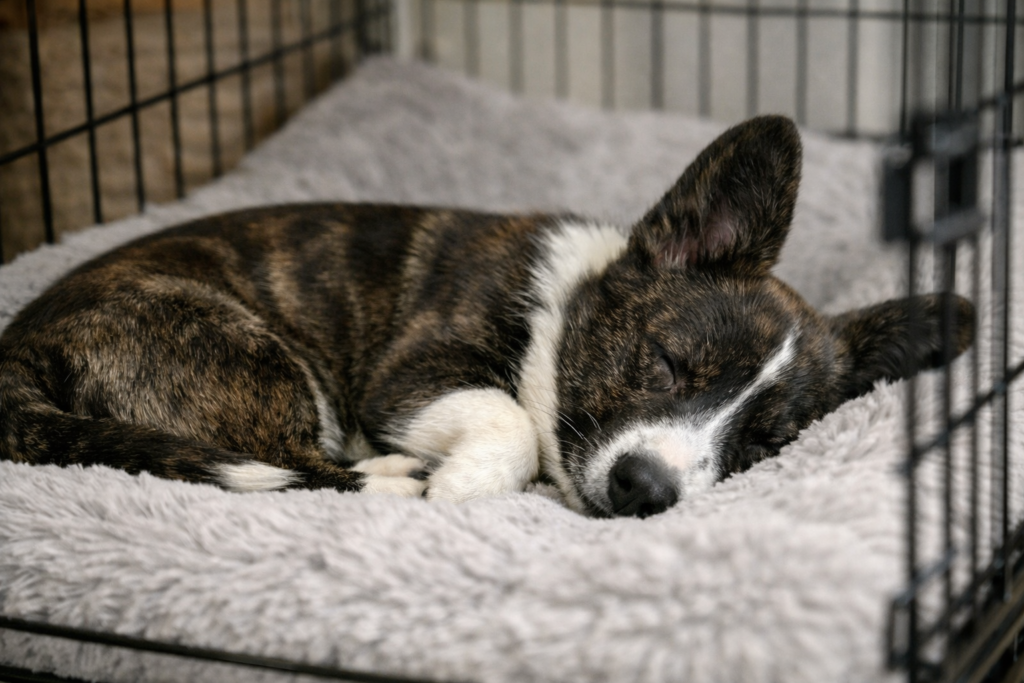
This approach focuses on predictability, not force.
1. Make the Crate Part of Daily Life (Not a Signal)
Your puppy should experience the crate:
- while you’re cooking
- while you’re working nearby
- during calm moments after play or meals
Short, relaxed crate time while you’re home teaches:
“The crate doesn’t mean abandonment.”
No big praise.
No dramatic exits.
Just normal life continuing.
2. Separate “Crate Time” From “Leaving Time”
Before your puppy can handle being alone, they must first learn to be calm in the crate without you leaving.
Practice:
- crating the puppy
- moving around the house
- briefly stepping into another room
- returning calmly
These repetitions matter more than long absences.
3. Create a Predictable Pre-Departure Routine
Puppies thrive on signals they can understand.
A simple, calm routine before leaving might include:
- potty break
- short play or sniff time
- water
- crate entry without emotion
Avoid:
- apologizing
- excessive affection
- lingering at the door
Calm energy teaches calm expectations.
4. Start With Absences That Are Too Easy
Leave for:
- 30 seconds
- 1 minute
- 3 minutes
Return neutrally.
This is how puppies learn:
“You leave. You always come back.”
Duration comes later. Confidence comes first.
What You’ll Need
This post contains affiliate links. If you buy through them, we may earn a small commission at no extra cost to you.
Three items make a real difference for the 7-day plan:
- MidWest iCrate — the most popular folding wire crate for puppies. Comes with a divider panel so you can start small and expand as your puppy grows. Available in multiple sizes.
- KONG Classic — stuff it with peanut butter and freeze overnight. A frozen Kong in the crate keeps a puppy calm and focused for 10–20 minutes — exactly what you need in Days 1–3.
- Lick Mat — a flat alternative to the Kong. Spread peanut butter or wet food on the surface. Licking is naturally calming — it slows breathing and reduces arousal before crate time.
7-Day Crate Training Plan
This plan breaks crate training into daily milestones. Most puppies stop night crying by Day 3 when this approach is followed consistently.
Day 1 — Build Positive Association (5-Minute Sessions)
Goal: The crate is a good place. No pressure, no closing the door yet.
- Toss treats inside. Let the puppy enter voluntarily.
- Feed meals near or inside the crate.
- 3–5 sessions of 5 minutes each. Door stays open or barely closed.
- End every session before the puppy wants to leave.
Day 2 — Close the Door, Stay in the Room
Goal: The closed door is not a threat.
- Close the door for 1–2 minutes while you stay visible.
- Open before any protest, not because of protest.
- Use a frozen Kong or lick mat to associate the crate with calm enjoyment.
Day 3 — Short Absences in Another Room
Goal: You can disappear briefly and return. No drama.
- Crate the puppy, step into another room for 30 seconds.
- Return neutrally — no big greeting.
- Gradually extend: 1 minute, 3 minutes, 5 minutes.
- Brief whining that stops = normal. Escalating panic = shorten the session.
Day 4 — First Overnight in the Crate
Goal: Sleep through the night (or close to it).
- Place the crate in or near your bedroom — proximity reduces anxiety.
- Last potty break right before bedtime.
- Use a snuffle mat or worn t-shirt for scent comfort.
- If the puppy wakes and whines: one calm potty break is fine. Avoid play or affection at 2am — it teaches that night crying = reward.
Day 5 — Crate During Daytime While You’re Home
Goal: The crate is a normal resting place, not just a “leaving signal.”
- Crate the puppy for 20–30 minute naps while you’re home and visible.
- This breaks the crate-equals-departure association.
- Repeat 2–3 times during the day.
Day 6 — First Real Departure (Short)
Goal: You leave the house. The puppy settles.
- Use the pre-departure routine: potty → calm play → water → crate entry. No emotional goodbye.
- Leave for 15–20 minutes maximum.
- Return neutrally. Check for signs of distress (wet bedding, scratching marks, frantic behavior).
Day 7 — Self-Settled Puppy
Goal: The puppy goes in calmly and settles on their own.
- Most puppies at this stage enter the crate without resistance when the routine is consistent.
- Absences can now extend to 1–2 hours with confidence.
- Night crying should have reduced significantly — or stopped entirely.
Note: Progress depends on the individual puppy. If Day 4 overnight goes badly, repeat Days 2–3 before trying again. The timeline is a guide, not a deadline.
Should You Let a Puppy Cry in the Crate?
This is one of the most emotionally loaded questions — and for good reason.
A brief protest followed by settling is normal learning.
Sustained panic is not.
The goal is not silence.
The goal is emotional regulation.
If crying escalates instead of decreases, the routine needs adjustment — not endurance.
How Long Does It Take for Puppies to Settle?
There is no exact timeline, but most puppies improve when:
- the crate is introduced gradually
- routines are consistent
- departures are unemotional
- independence is practiced daily
Progress often comes in waves, not straight lines.
That’s normal.
When Crate Training Finally Clicks
You’ll notice small signs first:
- quieter protests
- faster settling
- relaxed body language
- calm behavior when you prepare to leave
These are signs that your puppy is learning trust — not just tolerance.
FAQ
Is it okay to leave a puppy alone in a crate?
Yes, if the crate is introduced gradually and used during calm moments, not only when you leave. For most puppies, the crate becomes a safe resting space.
How long is it normal for a puppy to cry in the crate?
Brief crying that fades within a few minutes is common. Ongoing or escalating distress usually means the routine needs adjustment.
Should I ignore my puppy if they cry in the crate?
Ignoring short protest can be part of learning, but ignoring panic is not helpful. The goal is calm, not forced silence.
How long does it take for a puppy to get used to the crate?
Most puppies improve over days or weeks with consistent routines. Progress is usually gradual, not instant.
Why does my puppy cry only when I leave the house?
This often means the crate is linked to your departure. Practicing calm crate time while you are still home helps break that association.
Final Thoughts: Calm Is Taught, Not Forced
Helping a puppy feel safe alone isn’t about “toughening them up.”
It’s about showing them, repeatedly, that being alone is predictable and temporary.
When crate training is done with clarity and consistency:
- puppies gain confidence
- owners gain peace of mind
- guilt disappears
And leaving the house stops feeling like a moral dilemma.