
This post contains affiliate links. If you make a purchase, I may earn a small commission at no extra cost to you.
When I first started grooming Nuggy at home, I made the very relatable mistake of just… winging it. Nuggy is a Corgi, which sounds simple — short-ish coat, how hard can it be? Turns out: double coat, seasonal blowing, and a very specific brushing technique that I did wrong for months.
The truth is that dog grooming styles aren’t really about what looks cutest. They’re about what’s actually appropriate for your dog’s coat structure. The wrong cut or the wrong maintenance routine can cause matting, skin irritation, or — in the case of double-coated dogs — serious temperature regulation problems.
This guide breaks down the four main coat types and what actually works for each one, whether you’re grooming at home or briefing a groomer before an appointment.
Quick Reference — Coat Type Finder
Not sure which coat type your dog has? Here’s the fast version:
| Coat Type | What it looks like | Examples |
|---|---|---|
| Short / smooth | Lies flat, minimal length, low shedding or seasonal shedding | Beagle, Boxer, Dachshund, Bulldog, Greyhound |
| Long / silky | Flows or falls long, often soft texture, needs frequent brushing | Golden Retriever, Cocker Spaniel, Afghan Hound, Maltese |
| Curly / wavy | Dense, coiled or wavy, low-shedding (often hypoallergenic) | Poodle, Labradoodle, Bichon Frise, Portuguese Water Dog |
| Double coat | Two-layer system: soft dense undercoat + tougher topcoat | Husky, Corgi, German Shepherd, Golden Retriever, Shiba Inu |
Note: some dogs have overlapping types — Golden Retrievers are both long and double-coated, which means they need care from both categories.
Short / Smooth Coats — Low Maintenance With One Catch
Short-coated dogs like Beagles, Boxers, and Dachshunds look like the easy option, and in many ways they are. But “short” doesn’t mean “no work” — it just shifts where the work goes.
What works for grooming style
Short coats don’t need trimming the way long coats do. The main styling decision is whether to do anything at all — and the answer is usually “no.” The natural coat length is the style. Professional groomers will typically offer a “bath and brush” service for short-coated dogs rather than a haircut, which is both cheaper and correct.
The exception is some short-coated dogs with feathering around the ears, legs, or tail (like Beagles). A light trim here can be done with rounded scissors to keep things tidy, but it’s optional and mostly aesthetic.
What the maintenance actually looks like
- Brushing: Once a week with a rubber curry brush or a short-bristle brush. The rubber tool pulls loose hairs out efficiently and most short-coated dogs find it pleasant — essentially a massage.
- Shedding management: Short-coated dogs can be heavy shedders. During seasonal blows (spring and fall), increase brushing to 2–3× per week and use a deshedding glove or a soft slicker brush to get ahead of it.
- Bathing: Every 4–6 weeks or when dirty. Short coats dry fast and don’t trap as much dirt as longer coats.
Pro Tip
For short-coated heavy shedders like Boxers or Beagles, a quick once-over with a slightly damp rubber glove before a walk pulls a surprising amount of loose coat. Takes 2 minutes and saves it from ending up on your furniture.
What to avoid
Shaving a short-coated dog is unnecessary and can temporarily disrupt the natural coat texture. There’s no thermoregulation benefit (unlike the myth around double coats), but there’s also no real harm — it just grows back looking patchy for a few months.
Long / Silky Coats — Styling Options, But Maintenance Is Non-Negotiable
Long-coated dogs like Golden Retrievers, Cocker Spaniels, and Maltese have the most grooming style options — but that flexibility comes with a maintenance requirement that can’t be skipped. A long coat that isn’t regularly brushed mats, and mats cause skin problems, restrict movement, and can only be removed by shaving.
What works for grooming style
Long coats give you real choices, and different owners prioritize differently:
Full natural length — The coat grows to its natural length and is maintained through regular brushing and trimming around the face, paws, and sanitary areas. This is the classic look for breeds like Golden Retrievers and Afghan Hounds. It requires the most brushing commitment but looks the most “true to breed.”
Puppy cut / teddy bear cut — The coat is trimmed to a uniform short length (usually 1–2 inches) all over. This drastically reduces brushing time and is a practical choice for owners who can’t commit to daily brushing. Technically not a precise grooming term — tell your groomer the length you want.
Breed-specific trim — Some long-coated breeds have traditional cuts (the Cocker Spaniel’s layered ear and body trim, for example). If you care about the traditional look, a groomer who specializes in your breed is worth finding.
Sporting trim / modified trim — For working or active dogs, a shorter functional trim around the ears, legs, and belly that reduces tangling without going full puppy cut.
What the maintenance actually looks like
- Brushing: Daily or every other day for full natural length. You’re looking for mats especially behind the ears, under the armpits, around the collar, and in the groin — these are the friction zones.
- Bathing: Every 3–4 weeks. Long coats can hold odor and tangles worsen when dirty coat dries unevenly.
- Professional grooming: Every 6–10 weeks for a trim, depending on how fast the coat grows.
Safety Note
Never brush a mat. Wet it lightly with a detangling spray, work it apart from the outside edges in with your fingers, then brush. Pulling a brush through a dry mat is painful and can break the skin.
What to avoid
Shaving is the one thing long-coated dogs shouldn’t get if they’re also double-coated (which many are — Goldens especially). The coat grows back unpredictably and the double coat’s structure is disrupted. If a groomer recommends shaving for “summer comfort,” get a second opinion.
Curly / Wavy Coats — The Highest Maintenance Type
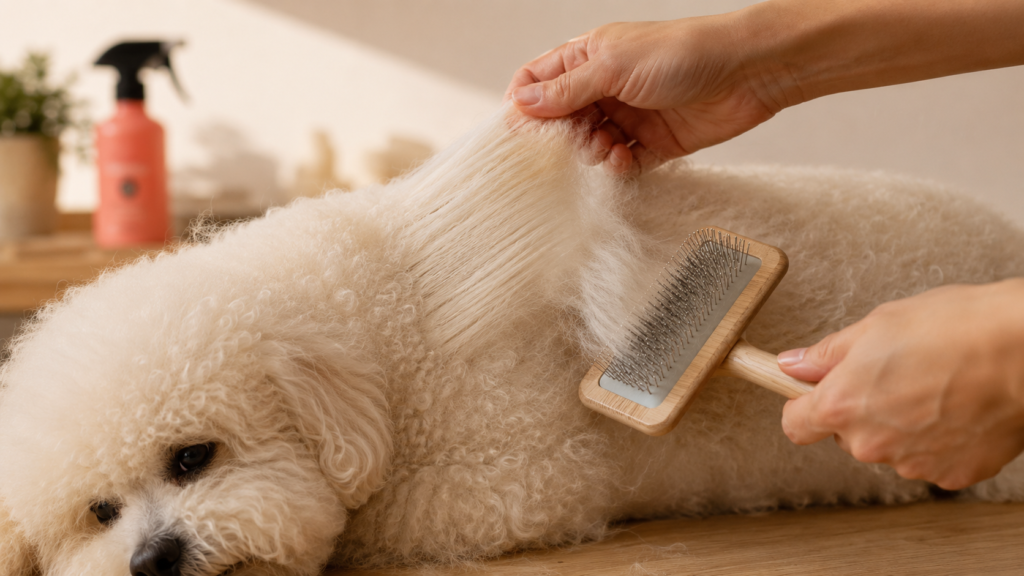
Poodles, Labradoodles, Bichon Frises, and Portuguese Water Dogs are popular partly because they shed minimally. The trade-off: curly coats don’t shed loose hairs — they trap them. This means the dead coat stays in the coat and mats from the inside out. Without regular brushing, a curly coat becomes a solid matted mass surprisingly quickly.
What works for grooming style
Curly-coated dogs have the most established set of grooming styles in the dog world, largely because Poodles have been show dogs for centuries and every cut has a name.
The puppy cut / lamb cut — Short all over, rounded head and legs. The most common “pet” style. Low maintenance between grooms, looks perpetually fluffy.
The teddy bear cut — Similar to the puppy cut but with a rounder face, specifically shaped to look like a stuffed animal. Usually requires a skilled groomer to execute well.
The sporting clip — Moderate length on the body, shorter on the face and legs. Good for active dogs. Easier to maintain than a longer coat but still looks intentional.
Continental / English Saddle clips — The traditional Poodle show cuts with pom-poms and shaved sections. These are groomer territory entirely — not a home grooming situation.
For Doodle mixes (Labradoodles, Goldendoodles), there’s no breed standard, so you have full flexibility. Most Doodle owners go with a puppy cut every 8–12 weeks and brush 3–4× a week between appointments.
What the maintenance actually looks like
- Brushing: Every 2–3 days minimum for any curly coat. Daily for dogs kept at longer lengths. Use a slicker brush and work section by section.
- Professional grooming: Every 6–10 weeks. Curly coats grow year-round and become unmanageable quickly.
- Bathing: Every 3–4 weeks. Curly coats hold moisture close to the skin, so thorough drying after baths matters — uneven drying contributes to mats.
Pro Tip
Line brushing is the technique that actually prevents mats in curly coats: part the coat in horizontal sections and brush each one from the skin outward. It’s slower than brushing top-to-bottom, but it’s the only method that catches the mats forming closest to the skin before they consolidate.
What to avoid
Don’t let the coat grow out between professional grooms without increasing brushing frequency. A curly coat that’s overdue for a haircut AND under-brushed is often the reason groomers have to shave a dog down to the skin — not because they wanted to, but because there’s no other option.
Double Coats — The Most Misunderstood Coat Type
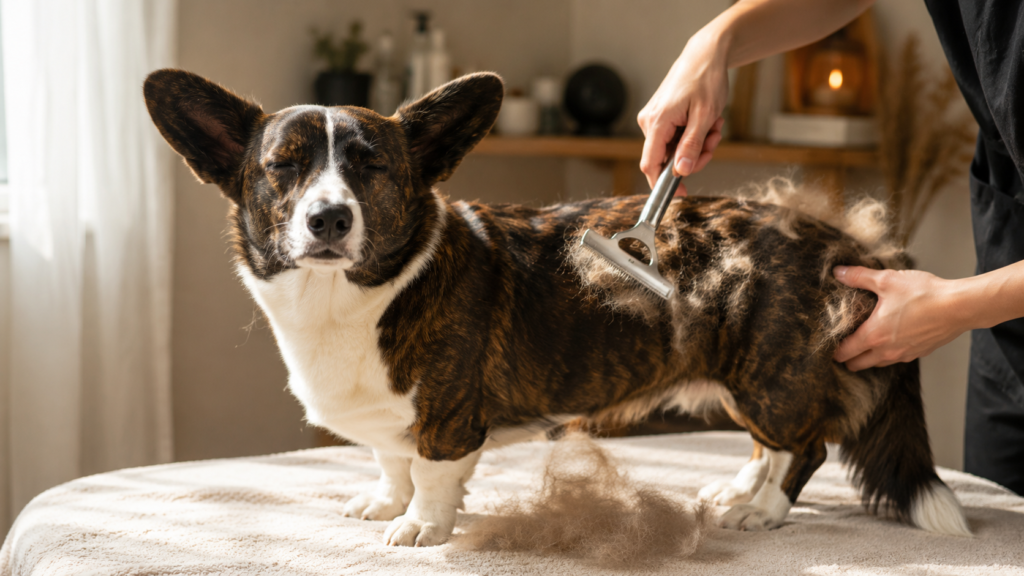
Huskies, Corgis, German Shepherds, and many working breeds have a two-layer coat system: a dense, soft undercoat that provides insulation, and a coarser outer layer of “guard hairs” that repels dirt and moisture. This system works extremely well — as long as you don’t interfere with it.
What works for grooming style
Here’s the honest answer: double-coated dogs have one grooming style. Their natural coat. The outer guard hairs and the undercoat structure are fixed by the breed — you can’t really “style” a double coat the way you can a long or curly coat.
What you can do is manage the coat well, which keeps it looking clean and healthy:
- Regular deshedding: The undercoat sheds seasonally (twice a year, called “blowing coat”) and continuously at a lower rate. Brushing pulls the dead undercoat out before it mats against the skin. This is the core of double coat maintenance.
- Light trimming (optional): Some groomers will lightly trim the feathering around the ears, paws, and pants area. This is cosmetic and fine. What’s not fine is clipping the body coat short.
- Keeping the coat clean: A clean double coat repels dirt and dries faster. Dirty, oily coats mat more easily.
What the maintenance actually looks like
- Brushing: 2–3× per week normally, daily during seasonal shedding. Use an undercoat rake or deshedding tool to reach the dense undercoat — a standard slicker brush only catches the topcoat.
- Bathing: Every 6–8 weeks. Double coats take a long time to dry completely — use a high-velocity dryer or plan for a full day of air drying. Damp undercoat against the skin causes “hot spots” (skin irritation).
- Professional grooming: “Deshedding treatments” where a groomer uses specialized tools to pull the loose undercoat out efficiently are genuinely worth it, especially before coat-blowing season.
Safety Note
Do not shave a double-coated dog for summer. This is the single most common double coat mistake. The undercoat actually insulates in both directions — it keeps dogs cooler in summer, not warmer. Shaving removes this protection and can cause “coat funk” (the topcoat grows back incorrectly, sometimes permanently) and leave the skin exposed to sunburn. If a groomer recommends it, decline.
The Right Brush for Each Coat Type
Getting the brushing technique right matters less if you’re using the wrong tool. Here’s the fast version:
| Coat Type | Primary Tool | Secondary Tool |
|---|---|---|
| Short / smooth | Rubber curry brush or grooming glove | Soft bristle brush |
| Long / silky | Pin brush or slicker brush | Wide-tooth comb (mat detection) |
| Curly / wavy | Slicker brush | Metal comb (line brushing) |
| Double coat | Undercoat rake or deshedding tool | Slicker brush for topcoat |
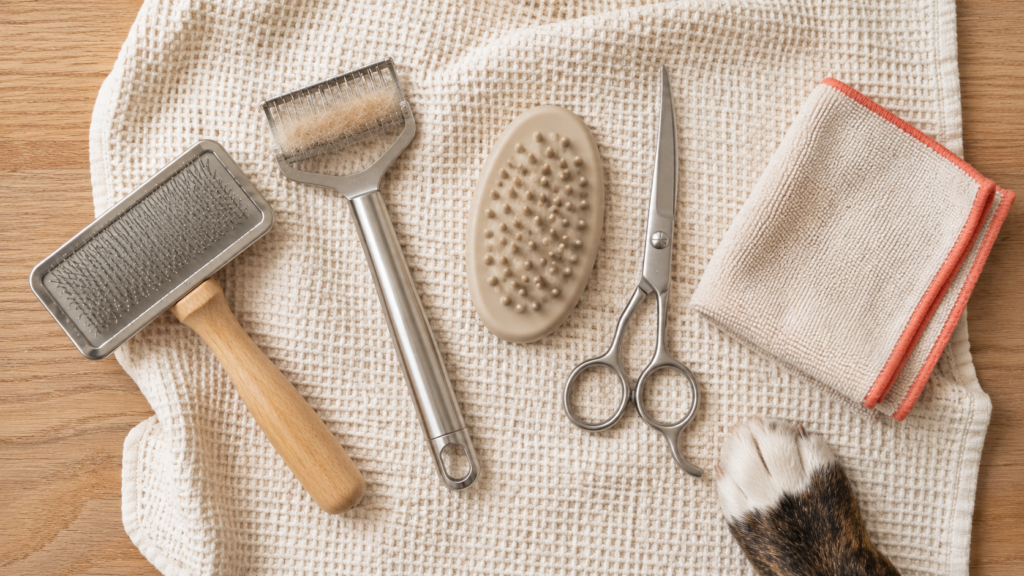
The Docrok Deshedding Brush + Metal Comb set (4.6★, 10K+ bought/month) covers double coats and long coats well — I use the metal comb on Nuggy’s legs and ears where the undercoat mats fastest. For curly coats, the Hertzko Self-Cleaning Slicker Brush is the most practical option — the self-cleaning button ejects the hair so you’re not picking it out by hand after every session.
What to Tell Your Groomer
If you’re taking your dog to a professional groomer, being specific saves time and prevents results you didn’t want. “Just a trim” is not specific enough.
Tell them:
- The coat length you want (in inches, or bring a photo)
- What to leave longer and what to trim (many owners want a shorter body but longer ears/tail)
- Any specific concerns (mats in a certain area, skin sensitivity, a spot the dog hates being touched)
- What style you absolutely don’t want (particularly for double coats — be explicit that you do not want a shave-down)
For double-coated dogs specifically: ask for a “deshed and tidy” rather than a haircut. This tells the groomer to focus on undercoat removal and light tidying rather than length reduction.
The Bottom Line
Your dog’s coat type determines most of the decisions here, not personal preference. Short coats don’t need haircuts. Long and curly coats need regular professional trims and more home brushing than most people expect. Double coats need their structure left alone.
Nuggy is double-coated, and the biggest grooming upgrade I made was switching from a standard slicker brush to an undercoat rake. It cuts brushing time in half and removes dramatically more loose coat. If you’ve been struggling with shedding on a double-coated dog, that’s the one thing to try.
What coat type does your dog have — and what’s been the hardest part of managing it? Drop a comment below, I read all of them.
You might also like:
FAQ Section
Q: What is the best grooming style for a short-coated dog?
A: Short-coated dogs don’t really need a haircut-style groom. The best approach is a regular bath and brush routine using a rubber curry brush or grooming glove. Trims are only needed for optional tidying around ears or feathering.
Q: Can I shave my double-coated dog in summer to keep them cool?
A: No — this is one of the most common grooming mistakes. Double coats insulate in both directions, keeping dogs warm in winter and cool in summer. Shaving removes this system and can permanently damage the coat’s structure. Focus on regular deshedding instead.
Q: How often should I groom a curly-coated dog at home?
A: Curly-coated dogs (Poodles, Doodles, Bichon Frises) need brushing every 2–3 days at minimum to prevent mats from forming inside the coat. Between professional grooms (every 6–10 weeks), daily brushing is ideal for longer coat lengths.
Q: What’s the difference between a puppy cut and a teddy bear cut?
A: The terms are often used interchangeably, but technically a puppy cut refers to a uniform short length all over the body, while a teddy bear cut specifically focuses on a rounded face shape. Both result in a short, low-maintenance coat.
Q: What brush should I use for a long-coated dog?
A: A pin brush or slicker brush for the main coat, plus a wide-tooth metal comb to check for mats close to the skin. The comb is the tool that actually catches mats before they consolidate — if the comb can’t move through a section, there’s a mat forming.
Q: How do I know if my dog has a double coat?
A: Part the fur and look at the base. If you see a dense, soft, fluffy layer underneath a coarser outer layer, your dog has a double coat. Common double-coated breeds include Huskies, Corgis, German Shepherds, Golden Retrievers, and Shiba Inus.